
The Comedogenic Scale Explained: Reading 0-5 Ratings
A comedogenic rating of 4 on a single ingredient tells you far less than most people assume. The comedogenic scale explained in plain terms is a 0–5 reference system that estimates how likely an individual cosmetic ingredient might be to contribute to clogged pores under specific testing conditions. It is a triage tool for shortlisting suspects on an INCI list, not a verdict on whether a finished moisturizer, sunscreen, cleanser, or serum will break you out. Once you understand what the number actually measures, you stop rejecting good products for the wrong reasons and start reading formulas the way they deserve to be read.
Table of contents
What the 0–5 comedogenic scale actually measures
Most versions of the scale run from 0 to 5, and each step describes a reported tendency, not a promise:
| Rating | General interpretation | How to use it |
|---|---|---|
| 0 | Generally non-comedogenic | Usually a lower-priority concern on a label |
| 1 | Very low potential | Often tolerated; individual reactions still possible |
| 2 | Low potential | Low risk; congestion-prone users may still monitor it |
| 3 | Moderate potential | Worth investigating with product type and concentration |
| 4 | High potential | A more relevant suspect in a leave-on product |
| 5 | Very high potential | A strong reference flag, not proof of breakouts |
A higher number means an ingredient has shown a greater tendency to contribute to follicular plugging under particular testing conditions. It does not mean the ingredient will definitely cause breakouts for you. The whole point of the categories is triage: they help you decide which ingredients in a long label deserve a closer look first, instead of treating every line as equally risky.
Why an ingredient can clog pores in the first place
A comedone forms when material builds up inside a hair follicle. Sebum, dead skin cells, and cellular debris can combine with abnormal shedding inside the follicle, producing an open comedone such as a blackhead or a closed comedone under the surface.
Certain cosmetic ingredients may feed that process by adding occlusive material at the follicle opening, encouraging plugging, lingering in a rich or film-forming product, interacting with the rest of the formula, or being used at a concentration or frequency that does not suit a particular person.
Here is the trap worth avoiding: "oily" or "heavy-feeling" is not the same as "comedogenic." Petrolatum has been reported as non-comedogenic in both rabbit and human testing in a critical reappraisal of comedogenicity, yet it feels greasy. Texture on the skin is not a reliable predictor of pore-clogging potential, so judging a product by how slick it feels will steer you wrong in both directions.
Where the 0–5 ratings came from, and their limits
Many traditional comedogenicity ratings trace back to rabbit-ear testing, where an ingredient is applied to rabbit ear skin and researchers assess follicular changes or comedone formation. The classic reading treats 0–1 as little or no significant response, 2–3 as moderate, and 4–5 as stronger.
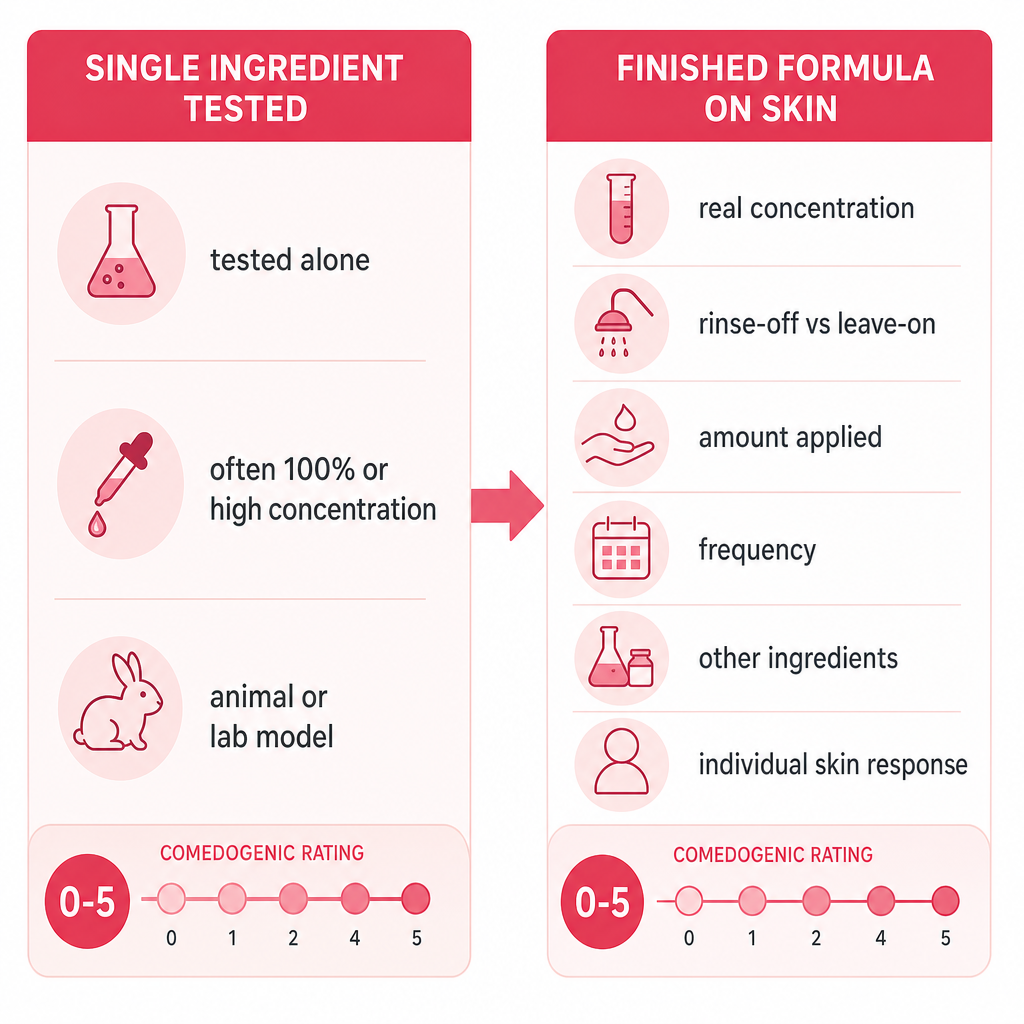
Those studies built the familiar system, but they carry real caveats. Rabbit-ear results do not perfectly reproduce normal human skincare use, and ingredients were often tested at high or undiluted concentrations rather than the levels found in a finished product. A review of human comedogenicity testing specifically warns that results from single ingredients tested at 100% concentration in animal models cannot be applied automatically to complete products. The outcome can shift once an ingredient is diluted, combined with other ingredients, or applied to human skin.
Why an ingredient rating is not a product rating
A product is more than its highest-rated ingredient. The finished formula behaves differently depending on the concentration of the flagged ingredient, whether the product is rinse-off or leave-on, how much you apply, how often you use it, the overall texture and structure, and the other ingredients that change spread, absorption, or film formation. Where you use it, face versus body versus a small patch, matters too, as does your own tendency toward congestion.
Consider two products. An ingredient rated 4 may sit near the end of an INCI list in a lightweight lotion, present at a trace amount. Another ingredient rated 1 may be used prominently near the top of a rich leave-on balm. The number alone cannot tell you which one is more likely to congest your skin. So the useful question is not "does this product contain a comedogenic ingredient?" It is "does this complete formula contain a plausible congestion trigger, and how strong is that evidence given how I actually use the product?"
How to read the order of an INCI list
Cosmetic ingredients are generally listed in descending order of predominance until the smaller-quantity ingredients are reached. Ingredients near the beginning often appear at higher concentrations than those near the end, which gives the list position real interpretive value.
That said, position adds context, not precision. The label never reveals an exact percentage, so a rating of 4 near the end of a list is not equivalent to a rating of 4 near the top. The ingredient's role in the formula and the product's intended use still matter. Our pore-clogging checker reads the exact cosmetic label and surfaces ingredients with non-zero comedogenicity ratings, sorted from the highest reported rating to the lowest, so you can see the strongest reference flags first. We built it as a screening aid, not as a prediction of certain breakouts. When you want to see every function and category on a label rather than only pore-clogging flags, our ingredient checker reads a pasted INCI list and shows per-ingredient matches, functions, comedogenicity, irritancy, and categories.
Why the same oil scores differently on different sites
Two reputable charts can give the same ingredient a 0 and a 4, and neither is necessarily lying. Comedogenic ratings conflict because studies do not always use the same test species, ingredient purity, concentration, vehicle or base, application method, exposure time, test location, or scoring system.
Oils are especially prone to this because their composition varies by source, processing, and refinement. A different batch or a different extraction method can genuinely behave differently. The same review of comedogenicity testing notes that animal-model results and human use cannot be treated as interchangeable, and that observing the finished product on human skin carries real weight. The practical takeaway is to trust a repeated pattern across several products and across your own experience more than a single database number.
That is also why avoiding every ingredient rated 1 through 5 backfires. Cutting every non-zero ingredient makes product selection needlessly restrictive and can push people toward over-cleansing or over-exfoliating to compensate. A saner reading treats 0–1 as lower-priority flags, treats 2 as a "monitor" rating rather than an automatic rejection, and investigates 3–5 more closely, especially in leave-on products on areas that clog easily.
What non-comedogenic on a label really means
"Non-comedogenic" generally suggests a product was designed or tested not to clog pores. It does not guarantee the product will work for every acne-prone person.
In the United States, the FDA does not pre-approve cosmetic products or maintain a list of approved cosmetic claims. The agency explains that cosmetic claims must be truthful and not misleading, but "non-comedogenic" is not a universal government-approved rating backed by one mandatory test method. Treat the claim as one piece of information: check the full INCI list, consider the product format, and watch how your own skin responds over time.
A quick worked example makes this concrete. Imagine a moisturizer listing ethylhexyl palmitate (4/5), lanolin alcohol (4/5), and shea butter (3/5), plus several ingredients rated 0–1. That does not prove the moisturizer causes acne. It does flag a formula worth investigating if you reliably get closed comedones after rich leave-on products, especially when those flagged ingredients appear early in the list, the product is thick and stays on the skin, and you apply it generously. The same result is far less informative if the flagged ingredients appear in trace amounts, the product is rinsed off, or your own repeated use has never produced congestion.
Turning a rating into a buying decision
Comedogenicity is only one axis of how a product can disagree with your skin. A rating concerns potential follicular plugging. It does not measure irritation, stinging, redness, dryness, allergic contact dermatitis, or breakouts unrelated to a specific comedogenic ingredient. So a rating should sit alongside your history with similar products, whether the product is leave-on or rinse-off, the formula's texture, ingredient position on the label, your main skin concern, and whether you can introduce it without swapping several other products at once.
For a promising product that carries one moderate or high reference flag, you do not have to reject it outright. Line it up against an alternative with our side-by-side product comparison tool and pick the option with fewer plausible concerns for your routine. If the flag is specifically about Malassezia-related sensitivity rather than pore-clogging, that is a different screening question entirely; use our fungal acne ingredient checker instead of treating the two categories as interchangeable.
When you do test a suspect product, keep the rest of your routine as stable as practical and observe where the bumps appear, when they started, whether they are new or recurring, and whether they improve after you remove the suspect. Our checker pages suggest watching a suspected product over roughly one skin cycle before drawing conclusions, while still keeping concentration, formulation, and individual response in view. Use that as a general observation principle, not a diagnostic timetable, and never keep using a product that causes severe irritation or a clearly worsening reaction just to finish the window.
Frequently asked questions
Is a comedogenic rating of 0 a guarantee that I will not break out?
No. A 0 generally indicates low or no reported pore-clogging potential for that ingredient under particular testing conditions. Your reaction can still depend on the complete formula, how you use it, irritation, hormones, and individual skin behavior.
Is a rating of 5 always bad for acne-prone skin?
No. It is a strong reference flag, but the outcome depends on concentration, product type, exposure, and the rest of the formula. A 5 is a reason to investigate, not automatic proof that the product will cause breakouts.
Is comedogenicity the same as fungal acne safety?
No. Comedogenicity concerns potential pore-clogging behavior, while Malassezia-focused screening answers a different question. A product can warrant investigation under one category without failing the other.
Can a cleanser contain a highly rated ingredient?
Yes. A rinse-off cleanser and a leave-on moisturizer do not expose skin to a formula the same way. Contact time, concentration, and the complete formula all change how meaningful an ingredient rating is.
Does Macherre give a personal breakout prediction?
No. Our free web checker reads a pasted cosmetic INCI list and displays informational ingredient matches and reference flags. It does not provide a guaranteed prediction of breakouts or a medical diagnosis.