How to Find a Dupe for Any Skincare Product
Finding a product that performs like your favorite serum without the sticker shock is more achievable than most people think. In about 30 minutes, you can learn how to find a dupe for a skincare product that matches the results you actually care about—often at a fraction of the cost. The trick isn't chasing an identical ingredient list; it's matching the parts that make your original work: its hero actives, its base, and how well it fits your skin. A good dupe delivers very similar results while staying friendlier to your budget, and it never has to be an ingredient-for-ingredient clone to earn a spot in your routine.
Table of contents
What a dupe actually is, and where it falls short
A dupe is a more affordable or more accessible product that uses similar ingredients to mimic the feel and results of a pricier one. In the real world, dupes fall into two honest buckets. Formula twins share nearly identical ingredient lists, especially in the top half. Functional dupes sit in the same category with the same hero active—say, a niacinamide serum—but use a slightly different base or supporting cast.
Here's the honest limit you should carry into every search: ingredient lists don't reveal exact percentages for most ingredients, so two products can read almost the same on paper yet behave very differently on skin. Small differences in texture, pH, or preservatives can also change how well your skin tolerates a formula, which matters most if your skin is reactive. So the goal isn't a perfect copy. The realistic win is close enough in performance, better for your skin and budget, and safe to slot into your routine.
Before you start: your dupe-hunt checklist
Gather these first so the search stays fast and grounded in reality rather than guesswork:
- The exact name of the product you want to dupe, and ideally the packaging.
- The full ingredient list (INCI) for that product.
- A clear sense of your skin type and main concerns—oiliness, dryness, acne, rosacea, and so on.
- A short list of known triggers or no-go's, like fragrance, coconut oil, or certain alcohols.
- A budget range and preferred availability: local drugstore, online only, cruelty-free, whatever matters to you.
- Access to Macherre on web or in the app to scan, analyze, and compare.
If you have sensitive, reactive, or medically diagnosed skin, add two more items: any products your dermatologist has specifically approved or banned, and a note of any current prescription topicals. Prescription treatments are a special case we cover further down—those are never candidates for a homemade dupe.
The step-by-step method for finding a real dupe
Step 1: Decide what kind of dupe you actually want
Start by answering three quick questions. Are you trying to save money, remove a trigger like fragrance, or simply find something that's in stock? Do you care more about identical texture or identical results? And is this a basic product like a cleanser or moisturizer, or a higher-risk active like a retinoid or a strong acid?
For most people the safest priorities are the same product type, the same or very similar hero actives, and a better fit with your personal triggers rather than a perfect sensory match. Naming your non-negotiables now saves you from falling for a pretty texture that breaks you out later.
Step 2: Decode your original product's ingredient list
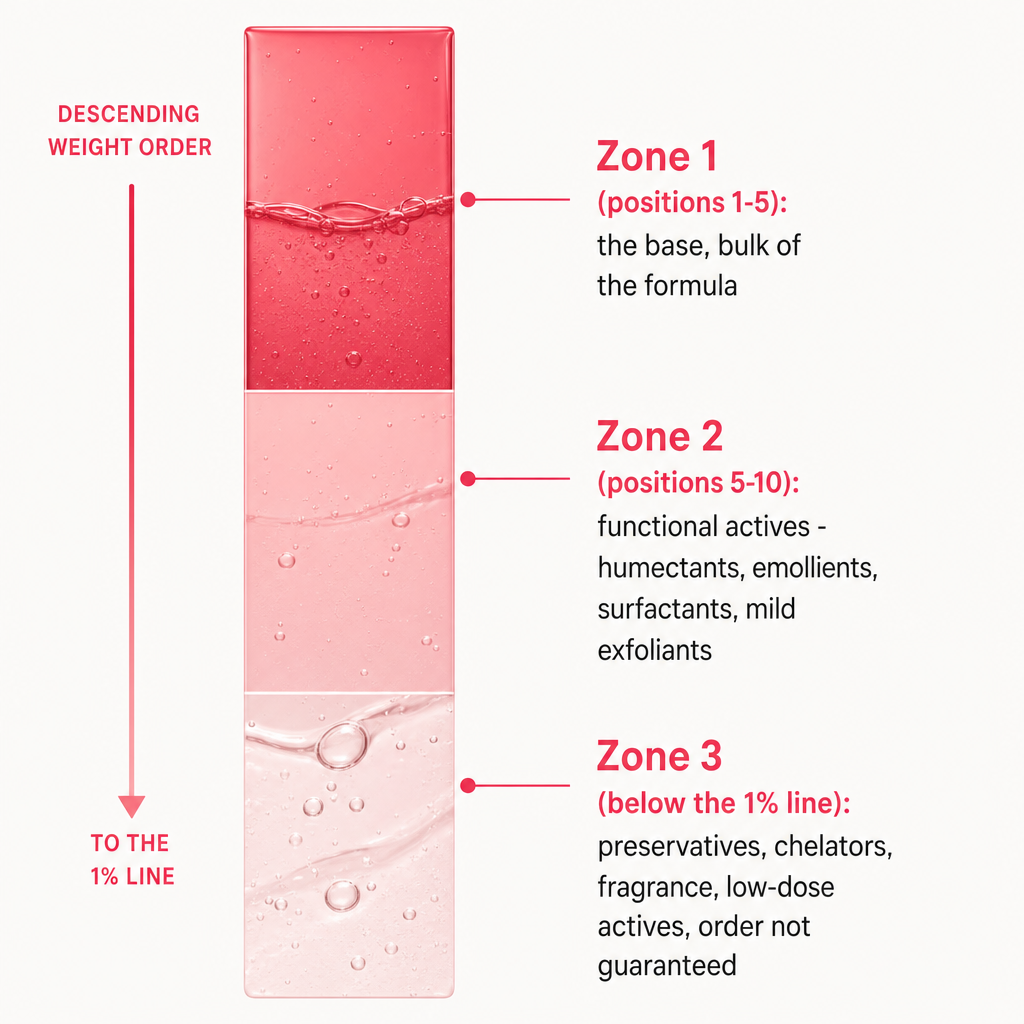
Ingredient labels follow strict rules worldwide. Across major markets including the EU, UK, US, and Canada, cosmetic ingredients are listed in descending order of weight until roughly the 1% line; below that threshold, ingredients can appear in any order. Regulators also require the list to be introduced by the word "Ingredients" and to use standardized INCI names rather than marketing names.
That structure tells you a lot. The first three to five ingredients usually make up the bulk of the formula—the base. The next five to ten often include the functional players: humectants, emollients, surfactants, and mild exfoliants. Everything past the 1% line tends to be preservatives, chelators, fragrance, and low-dose actives.
To speed this up, use the cosmetic barcode scanner for ingredient clarity to pull the full list into Macherre without typing, then run it through our ingredient checker that decodes any skincare ingredient list to see, in plain language, what each component does and which ones might irritate or clog for your skin. Pay closest attention to the top five to seven ingredients, named actives like retinol, ascorbic acid, niacinamide, salicylic acid, or ceramides, and any fragrance or essential oils if you're sensitive. You now have a profile of your original: base, key actives, and red flags.
Step 3: Lock in your non-negotiables
From that profile, decide what a dupe absolutely must keep. Usually that's the same product category and texture, the same hero actives, and a compatible base. If you're oily or acne-prone, lean toward lighter, non-occlusive bases; if you're dry, a richer emollient base may serve you better. Trigger avoidance belongs here too. If fragrance bothers you, skipping fragrance and certain botanical extracts becomes non-negotiable. If you're acne-prone, avoiding high-risk comedogenic oils matters just as much. Macherre's pore-clogging and seborrheic dermatitis checkers turn those instincts into concrete filters instead of hopeful guesses.
Step 4: Decide what you're willing to change
A dupe usually changes at least one thing—price, format, sensory profile, or the little extras like soothing plant additions that may drop off while the basics stay. That's fine. What matters is staying honest about risk. Don't expect identical performance from strong actives when their concentration and pH are hidden, and be especially careful duping exfoliating acids, strong retinoids, and anything that tingles or peels.
Be skeptical of front-label claims here. Analyses of popular "fragrance-free" moisturizers found that about 45% still contained at least one fragrance, botanical, or cross-reactive ingredient capable of triggering a reaction, and many "hypoallergenic" products still contained known potential allergens. Reading the actual list beats trusting the marketing every time.
Step 5: Start with structured suggestions
Because ingredient lists are dense and concentrations are hidden, algorithmic matching is often safer and faster than eyeballing every INCI list yourself. In Macherre, search for the product you use or scan it, then open the dupe finder that surfaces a match in seconds. It weighs ingredient overlap, the presence of your key actives, category and texture fit, and a compatibility score for your skin profile. From there you can filter by price and size, avoid flags like fragrance or fungal-acne triggers, and narrow to a realistic shortlist without manually sifting dozens of products.
Step 6: Compare your best candidates side by side
With two to four serious contenders, open your original and a candidate together in the side-by-side skincare comparison tool. Check whether the base is similar—water plus glycerin plus comparable emollients—or completely different. Confirm they share your hero actives in roughly similar positions on the list. Then look at whether any fragrance, essential oil, or problem preservative has been added or removed. A strong candidate keeps a similar base structure, shares your hero actives, avoids adding your triggers, and fits your budget. A high compatibility score is reassuring, but a low score tied to your main concern is a clear signal to keep looking.
Step 7: Safety-check for your specific skin
Run each top candidate through targeted checks. Use the pore-clogging (comedogenic) checker for acne-prone or very oily skin, the seborrheic dermatitis checker if you deal with flaking redness around the nose, brows, scalp, or ears, and the general ingredient checker to flag irritants and explain unfamiliar ingredients. If a candidate looks perfect on paper but lights up with warnings for your skin type, move it down the list.
Step 8: Patch test and introduce it slowly
Because labels don't reveal concentrations and every skin barrier differs, patch testing is essential—especially for sensitive skin. Apply a pea-sized amount to a small area like your inner forearm or behind the ear once a day for three to seven days, and watch for burning that lasts beyond a few minutes, persistent redness, roughness, or new bumps. If it passes, swap in just that one product and keep everything else unchanged for at least one to two weeks. When you're replacing strong actives like retinoids or acids, go even slower: every other night or a few times a week.
Step 9: Check for routine clashes
A product can shine on its own yet clash with the rest of your lineup—think overlapping retinoids or too many exfoliants at once. Add your existing products plus the new dupe to Macherre's routine builder and let it flag over-exfoliation, stacked strong actives, or combinations that commonly irritate. If it surfaces a serious clash, adjust when you use the dupe or choose a gentler option.
Common mistakes and how to fix them
The most frequent trap is chasing identical INCI lists while ignoring your own skin. Two lists can look alike yet feel completely different because of concentration, pH, or subtle stabilizers. If a "perfect" match gives you burning or breakouts, it isn't a dupe for you. Prioritize comfort and stability, and adjust frequency or pick a slightly less identical but more tolerable option.
A second common miss is trusting "fragrance-free" and "hypoallergenic" at face value. Since roughly 45% of moisturizers labeled fragrance-free still contained fragrance-related ingredients, and a large share of "hypoallergenic" products contained a known potential allergen, always run the product through the ingredient checker and favor formulas the checker confirms are free of fragrance and allergenic botanicals.
People also swap categories by mistake, treating a hydrating toner as a serum dupe just because both list hyaluronic acid. Viscosity, concentration, and intended use differ, so compare within the same category and format—watery essence against watery essence, gel serum against gel serum. Another avoidable error is overhauling everything at once. Change one product at a time and jot down a quick note of the date and any reaction, or you'll never know which swap caused a problem.
Finally, resist the urge to DIY the formula itself. Mixing your own copy of a commercial product at home without formulating and regulatory knowledge is risky; legal cosmetics must meet strict ingredient, labeling, and safety standards including correct declaration and stability testing. Keep your DIY to choosing safer established formulas, not compounding your own.
When to hunt solo and when to ask a professional
Dupe-hunting is comfortably safe for basic moisturizers, gentle cleansers, hydrating serums, and simple single-active products like low-strength niacinamide or basic hyaluronic acid. Add caution when the product leans on strong retinoids, high-percentage glycolic or salicylic acid, or a high-strength vitamin C that noticeably stings—and when you have active eczema, rosacea, or psoriasis, a history of serious contact allergies, or recent procedures like peels, microneedling, or lasers.
Some situations call for a professional outright. If a dermatologist prescribed the product, don't try to dupe it. In many markets those treatments are regulated as drugs, with active drug ingredients declared and managed differently from cosmetics. If a new dupe causes severe burning, swelling, or rash, stop and seek medical advice. For chronic conditions, ask your dermatologist which over-the-counter options are safe, then use Macherre to filter within that approved shortlist. We're built to narrow down safe candidates quickly; your dermatologist can confirm which to try first.
Frequently asked questions
How close does a dupe really need to be?
For most people, a good dupe shares the same product type and texture, carries the same hero active, and keeps a similar base structure while avoiding your known triggers. An exact ingredient-for-ingredient copy is neither necessary nor usually possible.
Can I tell if something is a dupe just by reading the ingredient list?
You can spot potential dupes by comparing base ingredients in the top half of the list and checking whether hero actives sit in similar positions. But you can't see exact concentrations or pH, so real performance stays an educated guess—which is why patch testing still matters.
Is it safe to find a dupe for my prescription cream?
No. Prescription treatments like prescription retinoids, steroid creams, and medicated rosacea gels are regulated as drugs, not cosmetics, and declare active drug ingredients separately. Don't replace them with a cosmetic dupe without your prescriber's input.
How do I find a dupe with very sensitive or allergy-prone skin?
Lean on an ingredient checker rather than front-label claims, since many "fragrance-free" and "hypoallergenic" products still contain fragrance-related or botanical allergens. Favor simpler formulas with fewer potential irritants, and always patch test for several days before applying to your whole face.
How many dupes should I test at once?
Start with one and use it consistently for two to four weeks, unless it clearly irritates your skin, before deciding whether it truly replaces your original. You can save one or two backup candidates in Macherre, but avoid testing multiple dupes for the same step simultaneously.