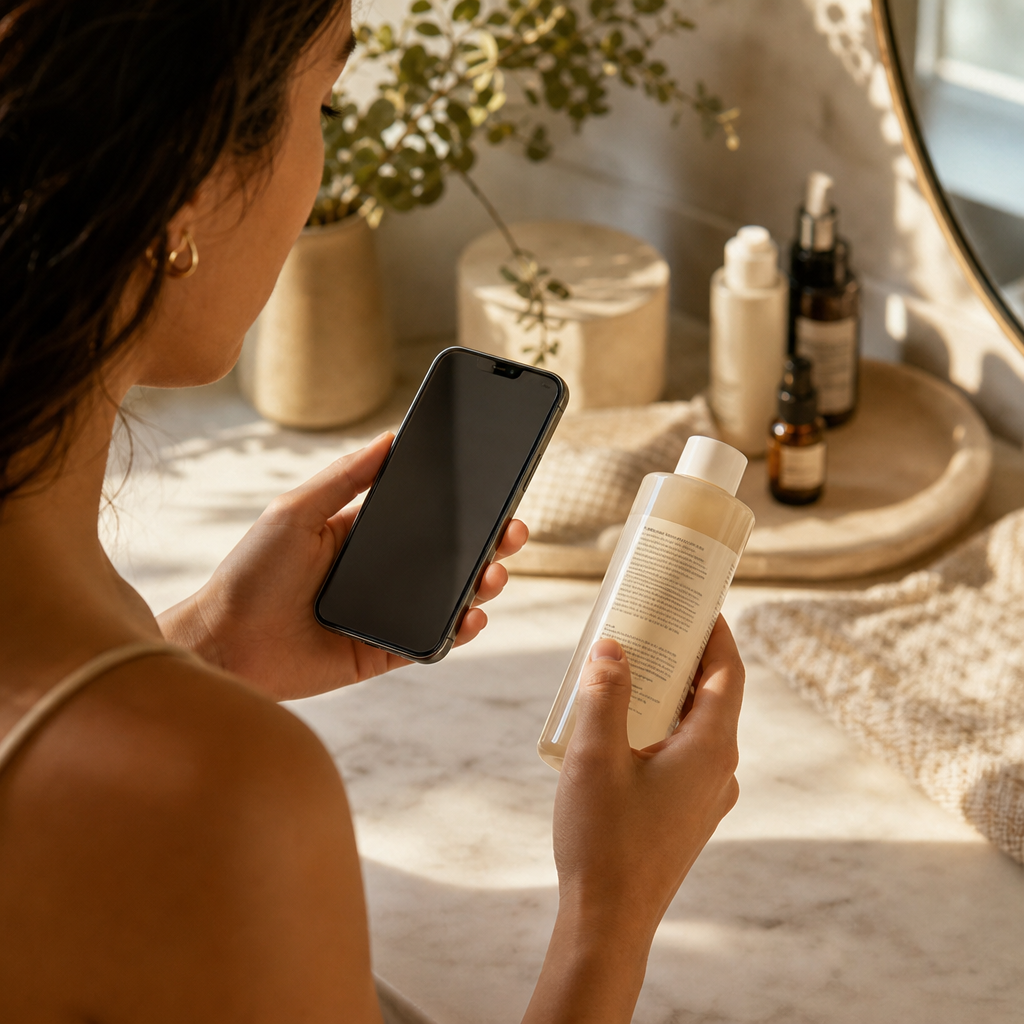
How to Use a Skincare Product Scanner App
A skincare product scanner app earns its place the moment you're standing in a store holding a jar you can't quite read, or staring at a retailer page full of names like caprylic/capric triglyceride and wondering whether any of it matters for your skin. The short answer to how to use a skincare product scanner is this: feed it the real ingredient list, read what each component actually does, check the screening flags that relate to your concerns, and then patch-test before you commit. The tool does the decoding. You still make the call.
What trips people up is assuming every scanner does the same thing. Some read a pasted ingredient list and hand back per-ingredient detail. Others identify a product from its barcode and connect that formula to a saved skin profile. Those are different jobs, and knowing which one you're using changes what the result means. Below we walk through both, where our free web checker ends and the Macherre app begins, and how to read matches and flags without turning a single number into a diagnosis.
Table of contents
What a skincare product scanner actually reads
A scanner doesn't see how a product will behave on your particular face. It works from the product's ingredient declaration, usually printed as an INCI list. That's the raw material for everything it tells you.
Two details about that list shape how you read any result. First, cosmetic ingredients are generally listed in descending order of predominance, though ingredients present at 1% or less may appear in any order after the higher-concentration ones, and colour additives follow their own rules (FDA cosmetics labeling guide). So position gives you a rough sense of how much of something is in the jar near the top of the list, and almost nothing once you drop past that 1% threshold. Second, INCI names are standardised identifiers used across labels and ingredient databases, and the European Commission's cosmetic ingredient glossary incorporates that internationally recognised nomenclature (EU cosmetic ingredient database). That standardisation is why a scanner can match "glycerin" on a drugstore moisturiser and a luxury serum and treat them as the same thing.
So a scanner can usually help you answer practical questions: Is glycerin present as a humectant? Is there fragrance? Are there ingredients associated with exfoliation or occlusion? Which names deserve a second look for acne-prone, sensitive, or fungal-acne-prone skin? Are two products built around similar ingredients? What it can't reliably do is pin down the exact percentage of each component, confirm the product suits you, or isolate which single ingredient caused a past reaction.
Web ingredient checker or barcode scanner?
Pick the tool based on what you're actually holding. Our free web checker and the in-app barcode scanner solve different starting problems.
| If you have… | Use… | What you can expect |
|---|---|---|
| A typed or copied INCI list | Web ingredient checker | Per-ingredient matches with functions, categories, comedogenicity and irritancy references |
| A product in-store with a barcode | The app's cosmetic barcode scanner | Product lookup plus ingredient analysis when the record and formula are available |
| A product the barcode can't find | The INCI list, entered manually | A direct formula check that doesn't depend on a catalogue record |
| Two products you're deciding between | Side-by-side comparison | A clear view of where the formulas differ |
| A possible swap for a product | The dupe finder | Formula-based alternatives, with no promise of identical results |
One thing to be clear about: our web ingredient checker is a stateless lookup. It reads the list you paste, returns ingredient-level information, and doesn't tie that to a skin profile or produce a personal compatibility score. Pasted lists aren't stored long-term or attached to an account. Persistent scans, saved shelves, profiles, and routine features live in the Macherre app, not the web tool.
How to read ingredient matches without overreacting
A match only means the scanner recognised the name. It doesn't grade the ingredient as good or bad, and the instinct to treat every unfamiliar chemical-sounding word as a red flag is exactly what the tool is meant to calm down.
A few common entries show why context beats reaction. Glycerin is a humectant that helps attract and hold water. Caprylic/capric triglyceride is usually an emollient that adds softness and slip. Preservatives protect water-based formulas from microbial growth, which is a feature, not a flaw. Fragrance ingredients improve how a product feels and smells but matter more if you already know you're fragrance-sensitive. Exfoliating acids or retinoid-related ingredients can be genuinely useful for specific goals while calling for gradual introduction.
The same ingredient also behaves differently depending on its concentration, whether the product is leave-on or rinse-off, the formula's pH, what it's combined with, how often you apply it, and the current state of your skin barrier. Because an ingredient list rarely reveals exact concentrations, the smartest use of a scanner is to shortlist questions and compare formulas, not to hand down a verdict. If a name doesn't resolve, check the spelling or try the canonical INCI term; typos, newer names, and vague trade names can fail to match. Our ingredient dictionary is there when you want more context on what a specific component is generally used for.
What comedogenicity and irritancy flags really mean
Our web checker includes comedogenicity and irritancy reference values on a 0–5 scale. These are screening signals pulled from reference data, not predictions about your skin.
A comedogenicity flag means an ingredient has been associated with pore-clogging potential somewhere in that reference data. It does not prove the finished product will clog your pores, because the database can't account for the concentration used, the rest of the formula, how much you apply, or how your skin responds. An irritancy reference works the same way: it flags that a component has irritation potential, not that everyone reacts. A formula with several potentially irritating ingredients is a good candidate for cautious testing, but the scanner can't diagnose contact dermatitis or confirm an allergy.
Treat these numbers as triage, not judgment. If congestion is your specific worry, the pore-clogging checker focuses the screening on that question so you're not guessing across the whole list.
When to reach for a specialised checker
Different concerns deserve different screens, and lumping them together usually produces noise instead of clarity. Three checkers handle distinct questions.
For fungal-acne-prone skin, the fungal-acne ingredient checker screens an INCI list for potential Malassezia-trigger matches. It flags candidates worth attention; it does not diagnose fungal acne or guarantee a product is safe or unsuitable for you.
Seborrheic dermatitis is a separate question, even though Malassezia can be relevant to both discussions. The seborrheic dermatitis checker looks for trigger flags tied to that condition specifically. Keep the two screening purposes apart rather than assuming a clear fungal-acne result covers seb derm too.
And for straightforward congestion worries, the pore-clogging checker highlights ingredients linked to comedogenicity references. All three narrow a formula for further thought. None replaces a clinical diagnosis or a treatment plan from a professional.
Where a personal compatibility score fits
A personal compatibility score belongs to the Macherre app, where a skin profile and supported product analysis come together. It summarises how a formula may line up with information you've entered: skin type, sensitivities, goals, and selected preferences. Used well, it's a comparison aid that saves you re-reading every list from scratch.
What it is not is a medical rating. A higher or lower score does not establish that a product will or won't cause a breakout, that it's safe for an allergy, that it will treat eczema, rosacea, acne, or seborrheic dermatitis, that it's cleared for pregnancy or breastfeeding, that you can skip a patch test, or that one formula is objectively better than another. Our free web INCI checker doesn't generate this score at all, because it's a stateless ingredient lookup rather than a profile-based analysis. If you want the personalised layer, that's the app's job.
Here's how this plays out in practice. Say you're choosing between two moisturisers for combination skin that's prone to congestion. The useful question isn't "which one scores higher." It's whether either contains a fragrance you already avoid, which has more emollient or occlusive ingredients, whether comedogenicity references show up, whether the product is leave-on or rinse-off, whether an active overlaps with something already in your routine, and whether the two are genuinely different or close cousins. Inspect each formula in the product catalogue, run a side-by-side comparison, then test the stronger candidate gradually. For a full multi-step routine, the routine creator helps arrange product use and surface potential clashes, without standing in for professional treatment advice.
What a scanner cannot tell you
It's worth being blunt about the limits, because the tool is most useful when you know where its vision ends. A scanner may not know the exact concentration of each ingredient, whether the packaging holds the newest formula, how the product was stored, or whether a fragrance component is tucked under a general label term. It can't tell you whether your skin will react to a particular ingredient, whether a symptom is acne, allergy, irritation, eczema, rosacea, or something else, or whether a product is appropriate alongside a prescription treatment.
It also can't guarantee results. Product claims, reviews, ingredient flags, and app scores are four different kinds of information, and treating them as interchangeable evidence is how people end up disappointed. The scanner reads a label well. Your skin history, your routine, and a careful test fill in the rest.
Patch-test before it joins your routine
A favourable scan is not a green light to slather a new product over your whole face. The American Academy of Dermatology recommends applying a skincare product to a small test area twice daily for seven to 10 days, using the normal amount and leaving it on for the usual duration; for a wash-off product, leave it on the test spot for about five minutes or as the instructions direct (AAD patch-test guidance).
Stop using the product if a concerning reaction appears. Persistent, severe, or recurrent symptoms are worth raising with a qualified healthcare professional, and formal medical patch testing may be needed to investigate a suspected contact allergy. The scanner gets you to a confident shortlist faster; the patch test is what confirms the shortlist was right for your skin.
The most useful way to use a scanner, then, is as a formula-reading and comparison assistant. Start with the real INCI list, understand what the ingredients do, read the screening flags that match your concerns, compare against alternatives, and patch-test before regular use. Reach for our web checker when you already have an ingredient list, and for the app's barcode scanner, profile, shelves, comparisons, and routine tools when you want product-level organisation and personalised context. New to building a routine around these checks? Our guide on how to build a skincare routine for beginners is a good next stop.
Frequently asked questions
What is the best way to use a skincare product scanner?
Turn the ingredient label into understandable information, then combine that with your skin history, the product format, your routine, and a patch test. One flag or score is a prompt to investigate, not a final decision.
Can I scan a product without a barcode?
Yes. If you have the INCI list, paste it into the web ingredient checker. If a barcode is unavailable or unrecognised in the app, use the available OCR or manual ingredient-list option instead.
Does the Macherre web checker give a personal skin score?
No. The free web checker shows per-ingredient matches, functions, categories, comedogenicity and irritancy information. It's stateless and not connected to a skin profile, so the personal compatibility score lives in the app.
Can a scanner tell me whether a product is safe?
No. A scanner provides educational, informational screening. It can't establish individual safety, diagnose a condition, predict breakouts, or give medical, allergy, pregnancy, or breastfeeding clearance.
Should I avoid every ingredient with a comedogenicity or irritancy flag?
No. A flag is a reason to look at the full formula and weigh your own history. Concentration, product format, how you apply it, and your individual response all change the outcome.
Can I use the scanner for makeup and body care?
Yes, whenever you have a cosmetic INCI list. The same interpretation approach works for foundation, sunscreen, shampoo, body lotion, and lip products, keeping in mind that rinse-off and leave-on exposure differ.