Teenage Skincare 101: A Dermatologist-Approved Routine for Clear Skin
Table of Contents
- Why Teen Skin Reacts Differently Than Adult Skin
- The 4-Step Routine That Replaces Every 10-Step Trend
- The Over-Treatment Trap That Makes Acne Worse
- When to Add Extra Products (And When You're Wasting Money)
- The Lifestyle Inputs Your Routine Cannot Override
- Your Written Routine Template
You've tried the viral 10-step routine. You've borrowed your mom's moisturizer, watched the breakouts get worse, and stared at a $68 serum bottle wondering why "dermatologist-approved" on the label didn't translate to clearer skin. Here's what nobody on TikTok told you: teenage skincare is not a smaller version of adult skincare. Teen skin is biologically different — thinner, more reactive, and driven by hormonal signals that adult anti-aging products were never designed to address. Most routines marketed to teens are either reformulated adult products or, worse, repurposed anti-aging serums sold to skin that isn't aging yet.
The American Academy of Pediatrics has flagged this directly: trendy skincare routines "may look cool online" but frequently contain retinol and exfoliating acids inappropriate for younger skin, according to HealthyChildren.org (AAP). Meanwhile, Gen Alpha spent $4.7 billion on beauty products in 2023, per AYTM market research — a market that is enormous and largely misaligned with teen skin biology. By the end of this article, you'll have a four-step routine, a decision matrix for actives, and a written template you can take to a bathroom shelf today.
Why Teen Skin Reacts Differently Than Adult Skin
Before you pick a single product, understand what your skin is actually doing. Teen skin behaves the way it does because of four specific biological realities that adult skincare marketing rarely addresses.
Androgen-driven sebum production. Puberty triggers a sharp increase in androgen activity. Androgens enlarge sebaceous glands and increase sebum (oil) output. This is why teen acne concentrates on the T-zone — forehead, nose, and chin — where sebaceous gland density is highest. The upper back and shoulders follow the same pattern for the same reason. Your skin isn't broken, and it isn't dirty. It's responding correctly to a hormonal signal you can't shut off with a face wash. Once you accept that, you stop attacking your skin and start managing it.
Skin thinness and barrier sensitivity. Adolescent skin is thinner than mature adult skin and has not been exposed to repeated cycles of active ingredients. Industry analysis from Beauty Independent notes that children's and adolescent skin "is significantly thinner than adults' skin" and requires reformulation rather than dilution of adult products. The practical consequence: a glycolic acid concentration an adult tolerates four nights a week can disrupt a teen's barrier within seven days. Same molecule, same concentration, completely different outcome — because the substrate is different.
Why "dermatologist-approved" doesn't mean "formulated for teens." This is the regulatory distinction nobody explains on the bottle. Dermatologist-approved is a marketing claim, not a clinical certification. A product can carry the phrase by being reviewed once by any single licensed dermatologist — there's no standardized panel, no required clinical trial, no age-specific testing. Formulated for adolescent skin is a different claim entirely, and it's rare. It means active ingredient concentrations and pH have been adjusted for thinner, more reactive skin. When you read a label, the second phrase matters. The first one tells you almost nothing.
The TikTok contamination problem. Today's Parent reporting on #SkinTok found that TikTok has become the primary skincare information source for tweens and teens, and the routines promoted there are typically eight-to-ten-step adult anti-aging protocols compressed into thirty-second videos. A CBS News investigation documented influencers being sponsored to promote $700+ product hauls — including Drunk Elephant assortments — to seventeen-year-old audiences. The economic incentive is clear. The dermatological logic is not. A teenager doesn't need peptide complexes or growth factors any more than a sixteen-year-old needs reading glasses.
Knowing why teen skin is different is the prerequisite for choosing the right four products. That's the next section, and it's shorter than you'd expect.
The 4-Step Routine That Replaces Every 10-Step Trend
Four products. Used consistently. That's the entire teenage skincare routine that delivers measurable results for the vast majority of teens. Anything beyond this is either targeted at a specific observed problem or marketing.
Step 1 — Gentle cleanser (AM and PM)
Use a pH-balanced cleanser in the 5.0-5.5 range, sulfate-free or low-sulfate, without aggressive foaming agents marketed as "deep clean." Aggressive surfactants strip the lipid barrier, which signals sebaceous glands to overproduce oil to compensate. You end up oilier than you started. The AAP recommends a gentle cleanser as the foundation of any adolescent routine, per HealthyChildren.org. Frequency: twice daily, thirty seconds, lukewarm water. Hot water makes redness worse. Cold water doesn't "close pores" — pores aren't doors.
Step 2 — One active treatment (PM only, three times per week to start)
This is where most teens fail by stacking. Pick one active: benzoyl peroxide at 2.5% or salicylic acid at 0.5-2%. Never both at the same time. Never daily for the first two weeks. Apply only to acne-prone zones, not the full face. The full-face approach is what causes the irritation everyone blames on the product when the actual problem is the application pattern.
Step 3 — Moisturizer (AM and PM)
The myth that oily skin doesn't need moisturizer is the single most expensive misconception in teen skincare. Without moisture, the barrier signals more sebum production — the exact opposite of what you want. Look for non-comedogenic, fragrance-free formulations that include ceramides or glycerin. Apply within sixty seconds of cleansing while skin is still slightly damp. This isn't a luxury step. It's the step that decides whether your active ingredient works or wrecks your face.
Step 4 — Mineral SPF 30+ (AM only)
Non-negotiable, especially when you're using actives. Both benzoyl peroxide and salicylic acid increase photosensitivity, and unprotected sun exposure on healing acne creates post-inflammatory hyperpigmentation — the dark marks that outlast the original breakout by six to twelve months. Mineral filters (zinc oxide, titanium dioxide) are preferred over chemical filters for reactive teen skin because they sit on top of skin rather than absorbing into it.
Benzoyl Peroxide vs. Salicylic Acid: Which Active Belongs in Your Routine
The choice between these two actives is driven by the type of acne you have, not the severity.
| Factor | Benzoyl Peroxide (2.5%) | Salicylic Acid (0.5-2%) |
|---|---|---|
| Best for | Inflammatory acne (red bumps, pustules) | Comedonal acne (blackheads, whiteheads) |
| How it works | Kills C. acnes bacteria, reduces inflammation | Dissolves dead skin and sebum inside the pore |
| Starting frequency | 3x/week, PM only | 3x/week, PM only |
| Common irritation | Dryness, peeling, bleaches fabric | Mild stinging, dryness |
| Avoid combining with | Retinol, vitamin C | Other exfoliants, retinol |
Source: AAP guidance on adolescent skincare ingredients.
A teen with mostly blackheads and clogged pores will see better results from salicylic acid because it's oil-soluble and works inside the pore where the clog actually sits. A teen with red, painful, inflamed bumps benefits more from benzoyl peroxide's antibacterial action against Cutibacterium acnes. The single most common mistake — and it's a costly one — is using both. That combination guarantees barrier damage within two weeks, after which both products stop working and start hurting.
Both ingredients carry AAP-acceptable safety profiles at the concentrations above. Stronger versions (10% benzoyl peroxide, prescription 2% salicylic preparations, or topical retinoids) should involve a dermatologist rather than a TikTok recommendation. Tracking which active works for your specific acne pattern is itself a skill — and emerging tools that use the role of AI in predicting skincare needs can shorten the trial period considerably compared to manual logs.
The Over-Treatment Trap That Makes Acne Worse
There is a feedback loop that explains why some teens spend $300 on a routine and end up with worse skin than they started with: too many actives → barrier damage → inflammation → compensatory sebum production → more acne. This is the cycle CBS News documented when reporting on teens spending hundreds of dollars on layered routines and seeing measurable deterioration in skin health. The product wasn't the problem. The number of products was the problem.
Four specific failure patterns drive this loop:
Stacking incompatible actives. Mixing benzoyl peroxide with retinol on the same night oxidizes the retinol and causes severe irritation — both molecules are reactive and they react with each other before they react with your skin. Mixing salicylic acid with a physical scrub creates micro-tears in already-thinned stratum corneum. Mixing vitamin C with benzoyl peroxide neutralizes both, leaving you with two expensive products doing nothing. The compatibility chart isn't optional reading.
Daily exfoliation. Teen skin renews on a roughly twenty-eight-day cycle. Daily AHA or BHA use chronically thins the stratum corneum and disrupts that cycle. The diagnostic signal: skin that "feels tight" after washing isn't clean. It's stripped. Tightness is not a clean indicator. It's a damage indicator.
Skipping moisturizer because skin is oily. Already covered, but it bears repeating with the mechanism: a compromised lipid barrier sends a chemical signal to sebaceous glands that more oil is needed. You produce more oil. You feel oilier. You skip moisturizer harder. The loop tightens.
The four-week patience problem. Real acne improvement takes eight to twelve weeks of consistent routine. Teens often quit at week three because they expected the TikTok-promised "overnight transformation" and assumed the product wasn't working. Cell turnover, follicular healing, and sebum regulation simply don't happen on a three-week timeline. They never have.
Are You Over-Treating Your Skin? Six-Question Self-Check
- Does your skin sting or burn within thirty seconds of applying any product? (If yes → barrier is compromised.)
- Are you using more than one active ingredient (benzoyl peroxide, salicylic acid, retinol, AHA, vitamin C) in the same routine?
- Have you added a new product in the last two weeks?
- Is your skin peeling, flaky, or unusually red between treatments?
- Are you cleansing more than twice a day, or using face wipes between cleanses?
- Have you been on your current routine for less than four weeks but already declared it "not working"?
If three or more answers are yes, strip back to cleanser, moisturizer, and SPF only for fourteen days before reintroducing one — and only one — active.
More products and stronger actives don't accelerate clear skin — consistency and barrier health do. A simple routine you use for eight weeks beats a complex one you quit after three.
When to Add Extra Products (And When You're Wasting Money)
Every dollar spent beyond the four core products has to justify itself by solving a current, observed problem. Most add-ons don't. The Sephora Kids phenomenon — Gen Alpha spending $4.7 billion on beauty in 2023 per AYTM — is largely driven by anti-aging products (peptide serums, retinol creams, growth factor formulations) that have no biological purpose on teen skin. Buying a peptide complex at fifteen is like taking blood pressure medication because you might develop hypertension at forty-five.
Add-On Decision Matrix for Teen Skin
| Product | When It Helps | When It's Wasted Money | Best Timing |
|---|---|---|---|
| Niacinamide (5%) | Visible enlarged pores, post-acne redness | Already using BP or salicylic — redundant | AM, after cleanser |
| Vitamin C (10-15%) | Dark spots after acne heals | Active acne phase — high irritation risk | AM, before moisturizer |
| Retinol | Comedonal acne not responding after 12 weeks | Under 16 without dermatologist guidance | PM, alternating with BP nights |
| Hydrating toner | Tight, dehydrated skin from active use | "Pore-tightening" or astringent versions | AM + PM, after cleanser |
| Pimple patches (hydrocolloid) | Single inflamed whiteheads with visible head | Closed comedones, cystic acne | Overnight on individual lesions |
| Clay/charcoal mask | Occasional oil control (1x/week max) | Daily use, or already on BP | PM, once weekly |
AAP guidance flags retinol as inappropriate for younger adolescent skin without medical supervision, per HealthyChildren.org.

Beauty Matter has documented that teen-targeted brands are now repositioning to address this gap, with new launches focused on actives appropriate for adolescent skin rather than reformulated adult anti-aging. That shift is recent and welcome, but it doesn't change the consumer rule: a product earns a spot in the routine only if it solves a problem you can actually see in the mirror today, not a hypothetical concern marketed to you about the next twenty years.
The sequencing rules to memorize: never combine retinol with benzoyl peroxide on the same night, vitamin C and benzoyl peroxide cancel each other out, and introduce only one new product every two weeks. The two-week introduction window matters because if irritation begins, you need to know which product caused it. If you change two things at once, you've eliminated your own ability to diagnose the problem.
For an acne-prone teen, the cheapest path to clear skin is usually subtraction, not addition. Cut the routine in half before you spend another dollar. Then, if a real residual problem remains after eight weeks, add exactly one targeted product from the matrix above.
The Lifestyle Inputs Your Routine Cannot Override
The four-step routine is necessary but not sufficient. Six lifestyle factors directly affect how teen skin behaves, and ignoring them means even a perfect routine plateaus around week six. None of these are surprising. All of them are routinely ignored.
- Sleep duration (7-9 hours). Skin repair and inflammation regulation happen during deep sleep, particularly the first two cycles of the night. Teens averaging under six hours show more inflammatory acne in practice, and phone use within an hour of sleep extends sleep-onset latency by enough to matter. The phone before bed is the single most modifiable variable for most teens.
- Dairy and high-glycemic foods. The chocolate-causes-acne myth is mostly false. Research suggests the actual dietary triggers in adolescent acne are skim dairy and high-glycemic carbohydrates — white bread, sugary drinks, sweetened cereals — which spike insulin and IGF-1, which in turn increase sebum production. Whole milk and unsweetened chocolate are weaker triggers than commonly assumed. This is directional; if you suspect a food trigger, eliminate it for four weeks and observe.
- Face touching and phone hygiene. The average teen touches their face many times per hour without noticing. Phones carry significantly more bacteria than the surface they were last placed on, and you press that surface against your jawline every time you take a call. Wipe phone screens with isopropyl wipes daily. Replace pillowcases every three to four days during active acne periods. The pillowcase is a cheap variable to control.
- Stress and cortisol cycling. Cortisol elevation increases sebum production and slows wound healing. Exam weeks and major life stressors visibly correlate with breakouts, anecdotally and in many practitioners' experience. Sleep is a more effective cortisol regulator than meditation alone for most teens — fixing the bedtime helps more than adding a new app. Pattern recognition between lifestyle and skin response is exactly what new tools attempt to automate; see how predictive AI is being applied to skincare for the longer-term picture.
- Sweat without cleansing. Post-workout sweat sitting on skin for over thirty minutes traps bacteria against the follicle, particularly under headbands, helmets, and tight collars. Rinse with water (not a full cleanse) immediately after sports. Full cleanse at the next available opportunity. The rinse alone removes most of the risk.
- Sun exposure on healing acne. UV exposure on inflamed or recently inflamed skin creates post-inflammatory hyperpigmentation — the dark marks that outlast the original acne by months. SPF is acne care, not just skin cancer prevention. If you've ever had a pimple heal into a brown spot that lingered for half a year, you've already paid the price for skipping SPF on healing skin.
A perfect skincare routine cannot overcome consistent sleep deprivation or a high-inflammatory diet. Your skin reflects your overall habits, not just your product choices.
Your Written Routine Template
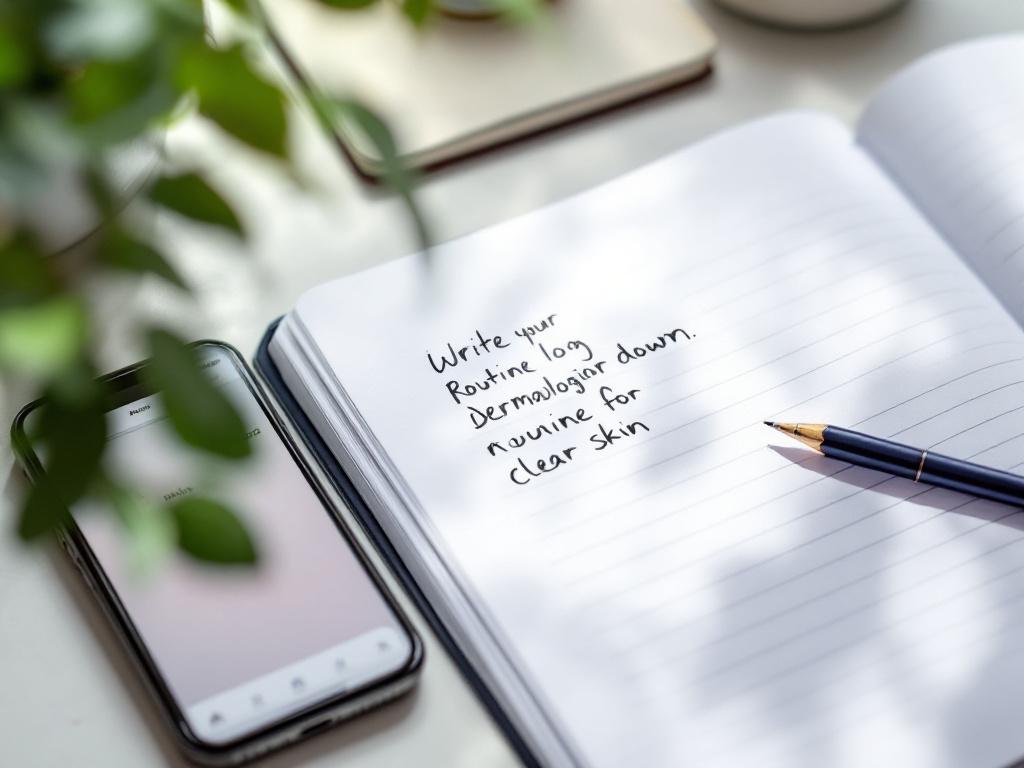
This is the take-away tool. Fill it in once, follow it for eight weeks, change one variable at a time. Skipping the writing-it-down step is the most common reason teens can't tell whether their routine is working — memory of skin condition is unreliable, photos and notes are not.
Step 1 — Identify Your Acne Type (Circle One)
- Comedonal: mostly blackheads and whiteheads, no significant redness → salicylic acid path
- Inflammatory: red bumps, pustules, painful spots → benzoyl peroxide path
- Mixed: both types present → start salicylic acid only, add benzoyl peroxide after week 4 if needed
- Cystic: deep, painful nodules under the skin → see a dermatologist before starting any active
Step 2 — Write Your AM Routine
- Cleanser: __________________ (gentle, pH 5.0-5.5, sulfate-free)
- Moisturizer: __________________ (non-comedogenic, ceramides preferred)
- SPF: __________________ (mineral, SPF 30 or higher)
- Optional: Niacinamide or vitamin C between cleanser and moisturizer
Step 3 — Write Your PM Routine
- Cleanser: __________________
- Active (3x/week to start, then 4x then nightly if tolerated): __________________
- Moisturizer: __________________
Step 4 — Patch-Test Protocol for Any New Product
- Apply pea-sized amount to inner forearm for 3 nights
- Then apply to a small area beside the jawline for 3 nights
- Then introduce to full routine if no reaction observed
- Total introduction window: 6 nights minimum
This is non-optional for any active. Your forearm is cheap. Your face is not.
Step 5 — Track Results for 8 Weeks
Keep a thirty-second daily log: number of new lesions, any irritation, any product changes, any major lifestyle shifts (exam week, illness, travel). Without this log, you cannot tell if the routine is working — only whether you feel like it's working, and that's heavily influenced by what you saw on TikTok yesterday. Consistency tracking by hand works, but AI tools that predict skincare needs are starting to identify pattern correlations faster than manual logs can.
When to Stop Self-Treating and See a Dermatologist
A truly dermatologist-approved path — meaning, you actually see one — is warranted in these five situations:
- Cystic acne — deep, painful nodules that don't come to a head and last for weeks
- Acne that scars — depressed or raised marks appearing within weeks of healing
- Hormonal acne pattern — concentrated on the jawline, flaring with menstrual cycle, persisting past age 18
- Severe sensitivity reactions — swelling, hives, or persistent redness to multiple products
- No measurable improvement after 12 weeks of a consistent, properly applied routine
AAP guidance reinforces that any of these warrants a pediatric or pediatric dermatology consultation rather than continued OTC experimentation. Continuing to layer products in any of these scenarios will almost always make things worse, not better, because the underlying driver isn't something a 2.5% benzoyl peroxide can address.
Clear skin isn't the result of finding the right product — it's the result of writing your routine down, tracking it for eight weeks, and changing one variable at a time.
The teenage skincare routine that works is the one you can actually maintain in a busy school week, with a small enough product list that you don't skip steps, and with enough tracking that you'll know in eight weeks whether to stay the course or change one thing. Four products. Three checks. One variable at a time. That's the entire system, and it outperforms any ten-step protocol you'll see in your feed this week.