
What Is a Compatibility Score for Skincare?
If you have ever stared at a product page wondering whether that hyped serum will actually agree with your skin, a compatibility score is built for exactly that moment. So what is a compatibility score for skincare? It is a single, product-level rating that estimates how likely one formula is to work well on your skin specifically, rather than on some average face. In Macherre, we generate that score from a product's full ingredient list combined with your skin type, conditions, sensitivities, and goals, then translate it into plain language you can act on right away.
The point is not to slap a universal "good" or "bad" label on a product. It is to answer a more honest question: given how your skin behaves, is this worth putting on it?
Table of contents
What a skincare compatibility score actually is
A compatibility score is a synthesized risk-benefit estimate for one product measured against one specific skin profile. Instead of judging a moisturizer in the abstract, it asks a concrete question: given your skin type, concerns, and sensitivities, how likely is this product to help rather than cause problems?
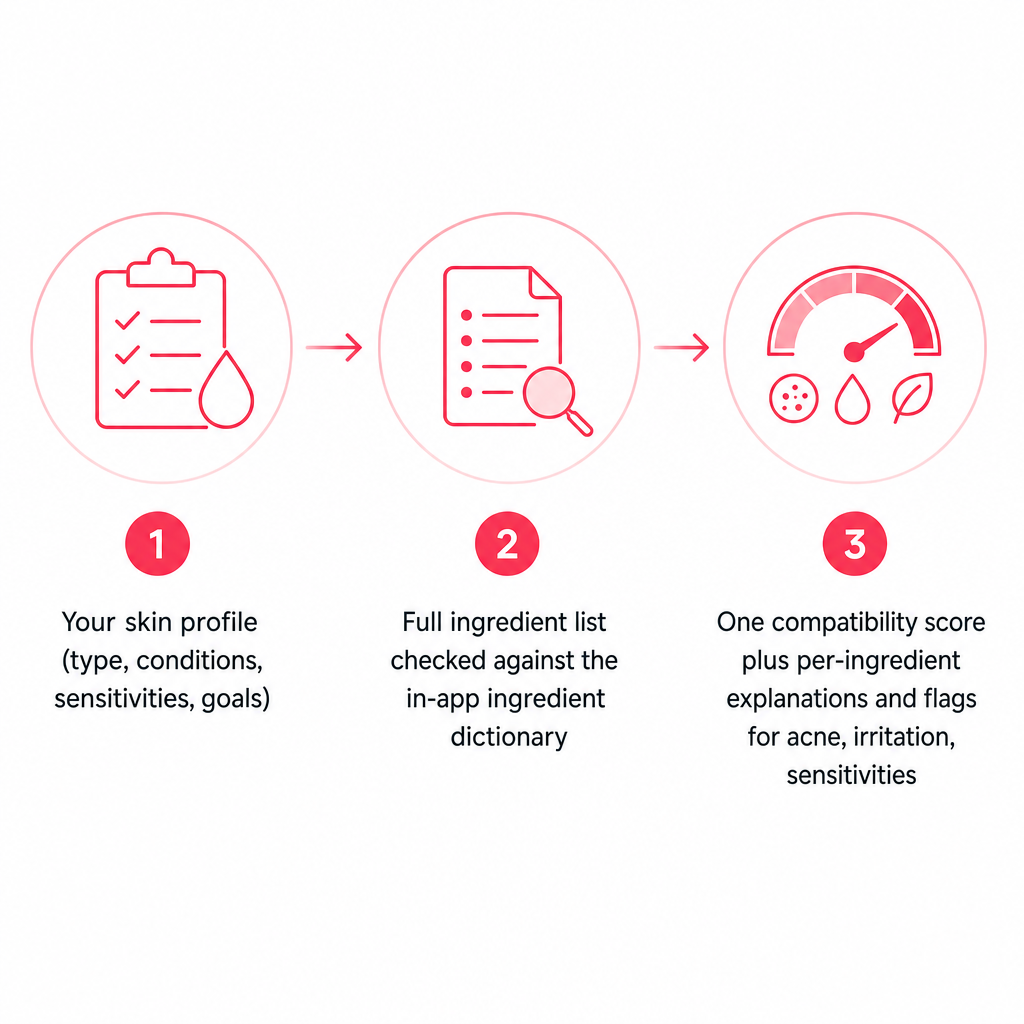
We build that answer in two layers at once. First, we take the product's full ingredient list and cross-check every ingredient against our in-app ingredient dictionary, returning a plain-language explanation of what each component is doing in the formula. Second, we distill all of that into a single compatibility score that reflects your skin, not a generic pass or fail for everyone.
You can decode any skincare ingredient list by pasting a product's label into our checker and immediately getting that one score for your profile, along with flags for acne, irritation, and specific sensitivities, plus explanations of when each ingredient might cause an issue.
The one decision the score helps you make
Every compatibility score exists to support a single choice: is this product worth putting on my face or body, given how my skin actually behaves? That decision simply looks different depending on who is asking.
- Beginners want to know: is this safe enough to try, and what should I watch for?
- Acne-prone users want to know: will this clog my pores or trigger breakouts?
- People managing fungal acne, rosacea, eczema, or seborrheic dermatitis want to know: does this formula contain known triggers I should avoid?
- Budget-minded shoppers want to know: if two products look similar, which one actually fits my skin better?
- Routine builders want to know: will this clash with what I already use, or slot in smoothly?
Our score is designed to answer these by weighing your skin type (oily, dry, combination, normal, sensitive), any specific conditions you set, and your declared sensitivities and goals. It is a lens applied to your situation, not one universal grade handed to everyone.
How the score works under the hood
The mechanism follows a clear sequence, and understanding it helps you trust the number instead of guessing at it.
Your personal skin profile
You start by telling us about your skin: type, tendencies such as easily irritated or breakout-prone, and any known conditions or ingredient sensitivities. The score is explicitly personal, so it shifts depending on whether you set your skin as oily versus dry, add a condition like fungal acne or seborrheic dermatitis, or prioritize goals such as barrier repair or brightening. That profile becomes the lens through which every ingredient gets evaluated.
Ingredient-level evidence
Next, the full ingredient list runs through our checker, which cross-references every component against the in-app dictionary and returns a per-ingredient breakdown. That covers basic functions such as humectant, emollient, surfactant, preservative, or fragrance, along with what current evidence suggests about each ingredient's potential to help or irritate different skin types.
Weighing benefits against risks for your skin
Once we understand both your profile and the formula, we weigh the two against each other. Beneficial ingredients for your concerns, such as gentle humectants for dryness or barrier-supporting components for sensitivity, count in a product's favor. Potential risks for your specific situation count against it, such as known fungal-acne triggers, ingredients often implicated in seborrheic dermatitis flare-ups, or compounds frequently associated with irritation in sensitive skin. We frame this as an interpretation of current evidence rather than a blunt safe-versus-toxic stamp, and we pair the result with the reasoning so you can see why an ingredient counts for or against.
Producing the single score
All of that ingredient-level detail is then distilled into one score for the product as a whole. That single number becomes your shortcut: instead of manually decoding twenty-plus ingredients, you get an easy-to-read verdict that still lets you drill into the why whenever you want. If you would rather learn the scoring logic in more depth, we walk through it in how a skincare compatibility score works.
What the score does and does not mean
A compatibility score is powerful precisely because it is narrow. Knowing its edges keeps you from over-trusting or under-using it.
What it does mean: it reflects how well a product is likely to perform on your skin profile rather than on an average person's; it integrates evidence about acne, irritation, and specific sensitivities, so it is more than "good for oily" or "good for dry" in isolation; and it is built as an aid for everyday choices like picking between products, sanity-checking a hyped launch, or assembling a routine that doesn't quietly stress your skin.
What it does not mean: it is not a medical diagnosis, not a guarantee you will never react, and not a substitute for patch-testing or professional care, especially with chronic skin disease. Dermatology guidance is firm on this. The American Academy of Dermatology recommends applying a new product to a small test spot twice daily for seven to ten days, on a site such as the inner arm or the bend of the elbow, and avoiding full-face use if you develop redness, itching, swelling, or other reactions. You can read their method in the AAD guidance on testing skin care products.
A score tells you whether a product looks reasonable for your skin. Patch-testing tells you how your actual skin responds.
Reading high, moderate, and low scores in real decisions
The number is only the headline; the practical value is in how you act on each band.
| Score band | What it usually signals | A sensible move |
|---|---|---|
| High | Aligns well with your type and goals, few obvious red-flag ingredients for you | Comfortable to prioritize when trying something new or building your core routine |
| Moderate | A mix of helpful and potentially risky ingredients for your situation | Try if you like, but go slow and patch-test carefully |
| Low | Notable misalignment, such as several acne or irritation triggers for people like you | Usually skip, or reserve for controlled experiments when options are limited |
Because we show why a product scored the way it did, you can view which ingredients were counted as positives or negatives for your skin. Over time that reveals patterns, like realizing that certain emulsifiers or fragrant components keep showing up in the products that irritate you. That insight is easy to put to work when you compare two skincare products side by side or when you find a skincare dupe that still fits your skin instead of an identical-looking swap that quietly reintroduces your triggers.
Why we use one personalized score instead of a generic grade
Most people feel buried under ingredient lists and conflicting online advice. Our approach turns that noise into one clear signal, always backed by explanation rather than mystery. The score is personal, changing as you adjust your skin type, conditions such as fungal acne or seborrheic dermatitis, and your goals. It sits on top of a full ingredient checker that explains what each component does and when it might cause trouble, so you are never handed a number you cannot interrogate. And it is positioned as an evidence-based interpretation rather than a simplistic safe-versus-unsafe rating, which keeps the guidance honest without tipping into fear-mongering.
Because we are independent and privacy-first, the score is meant to give you transparent reasoning without steering you toward particular brands. That makes it genuinely useful for comparing similar products, hunting for dupes that still suit your skin, and checking new launches against what you already own, always through the lens of your own compatibility. When you are ready to put the score to work across a full routine, you can build a skincare routine that actually fits your skin and let clash detection flag conflicts before they reach your face.
Frequently asked questions
What is a compatibility score for skincare, in simple terms?
It is a single rating that estimates how suitable a product's formula is for your skin, based on its ingredients and your skin profile, instead of a generic good-or-bad label. The same product can score differently for different people.
How does Macherre calculate my compatibility score?
We take the product's full ingredient list, cross-reference each ingredient against our in-app dictionary, then weigh benefits and risks according to your skin type, conditions, sensitivities, and goals to produce one score plus a plain-language explanation.
Can a high compatibility score guarantee I won't react?
No. A high score means the product looks well-matched to your profile with few known red-flag ingredients for people like you, but individual reactions are still possible. Patch-testing, and dermatologist care when needed, stay important for sensitive or condition-affected skin.
Why do my scores differ from someone else's for the same product?
Because the score is personalized, it changes with skin type, conditions such as fungal acne or seborrheic dermatitis, and sensitivities. One formula can be a great fit for oily, resilient skin and a poor choice for very sensitive or condition-affected skin.
How should I use the score when shopping or building a routine?
Treat it as a shortcut to spot likely good fits, likely problems, and maybe products that need caution. Favor higher-scoring products for everyday use, go slow with middling scores, and generally avoid low-scoring ones unless you have a strong reason and introduce them gradually with proper patch-testing.