How to Build an Azelaic Acid Skincare Routine for Redness, Acne & Texture
The Azelaic Acid Skincare Routine That Actually Works: Sequence, Pairings & an 8-Week Protocol
You have azelaic acid sitting on your shelf — maybe a 10% booster, maybe a 15% gel, maybe a prescription tube of Finacea or Azelex — and no clear instructions on where it fits between your cleanser, niacinamide serum, retinol, and SPF. The label tells you to apply twice daily. It doesn't tell you whether that means before or after vitamin C, whether to skip your BHA, or why your cheeks are flaking three days in. That's the gap this guide closes. An azelaic acid skincare routine done correctly will calm redness, clear inflammatory acne, and fade dark spots — but only if the sequence, frequency, and pairings are right.
Azelaic acid is a dicarboxylic acid that pulls four levers at once: it targets acne-causing bacteria, normalizes how skin cells turn over, calms inflammation, and inhibits the enzyme that makes pigment. That's the consensus from Dr Sam Bunting and WebMD. The catch: it's a slow active. Both Ulta and Paula's Choice frame meaningful results as occurring over weeks of consistent use, not days. What follows is the exact AM and PM placement, which actives to pair (and which to alternate), how to ramp frequency without triggering peeling, and an 8-week protocol you can start tonight.
Table of Contents
- What Azelaic Acid Actually Does to Acne, Rosacea & Dark Spots
- The Exact Order — Where Azelaic Acid Goes in Your AM and PM Routine
- Pairing Azelaic Acid With Retinol, Niacinamide, Vitamin C & BHA
- Tailoring the Routine to Rosacea, Fungal Acne & Sensitive Skin
- 10% vs 15% vs 20% — Picking the Right Strength and Spotting a Weak Product
- Your 8-Week Azelaic Acid Protocol — Week-by-Week With Troubleshooting
What Azelaic Acid Actually Does to Acne, Rosacea & Dark Spots
Azelaic acid is a dicarboxylic acid — a naturally occurring compound also produced by yeast that lives on human skin. Topically, it's used to treat acne, rosacea, and hyperpigmentation, a positioning Dr Sam Bunting and Paula's Choice both reinforce. What makes it unusual among skincare actives is that it doesn't pick one job. It runs four mechanisms in parallel, which is why a single product can sit at the center of routines built for very different skin concerns.
Antibacterial action against acne. Azelaic acid kills Cutibacterium acnes, the bacterium that drives inflammatory acne lesions. WebMD flags this antimicrobial effect as one of its core treatment mechanisms. Over weeks of consistent use, that bacterial reduction translates to fewer red, pus-filled pimples and a calmer inflammatory baseline overall.
Normalizes keratinization. Acne starts when dead skin cells fail to shed correctly and pile up inside pores, mixing with sebum to form clogs. Azelaic acid helps that turnover happen on schedule. Bunting frames this as moderate pore-clearing — not the aggressive comedolytic action you'd get from a 2% salicylic acid, but enough to prevent the formation of new clogs while existing ones clear. That's why it underperforms on deep, established cystic acne but excels at preventing the slow accumulation that causes daily breakouts.
Anti-inflammatory effect on redness and rosacea. This is where azelaic acid earns its dermatologist-favorite status. WebMD documents its ability to reduce blood-vessel dilation and calm the inflammatory cascade behind rosacea's papules and pustules. Kim Nichols, MD frames azelaic acid as ideal for skin where inflammation and redness are the primary concerns — and unlike most acne treatments, it actively calms reactivity instead of triggering it.
Inhibits tyrosinase to fade pigment. Tyrosinase is the enzyme that produces melanin. Block it, and the cascade that creates dark spots slows down. Paula's Choice calls pigment reduction azelaic acid's "top claim to fame" and compares its discoloration performance directly to vitamin C. Bunting echoes this for post-inflammatory hyperpigmentation, sunspots, and melasma. Combined with the antibacterial and anti-inflammatory effects, you get a single ingredient that treats acne and fades the marks acne leaves behind — a rare two-for-one in active skincare.
Who suits this active best? Nichols positions azelaic acid as "gentle enough for reactive skin that cannot tolerate retinoids or benzoyl peroxide" while still clearing acne and fading marks. Translation: rosacea, fungal acne–adjacent inflammation, sensitive skin, and post-acne discoloration are the four conditions where azelaic acid tends to outperform expectations. Where it underperforms: deep cystic acne where systemic retinoids or oral medications carry more weight, and severe melasma that needs layered prescription therapy.
If you're unsure whether your breakouts are bacterial acne, fungal acne (Malassezia folliculitis), or rosacea — and they look more alike than most people realize — running your current products through Macherre's fungal acne checker and ingredient analyzer is the fastest way to confirm azelaic acid is the right match before you commit eight weeks to it.
The Exact Order — Where Azelaic Acid Goes in Your AM and PM Routine
Every expert source — Nichols, Proven Skincare, Ulta, Paula's Choice — converges on the same sequence: cleanser → optional toner/essence → azelaic acid on dry skin → other water-based serums → moisturizer → SPF (AM) or retinoid (PM, alternate nights). The agreement is unusual in skincare, where ordering disputes are constant. Here it isn't a dispute.
The logic is straightforward. Azelaic acid is a treatment-stage active that needs direct contact with skin to penetrate. Heavier creams and oils applied afterward act as a seal, not a barrier. Apply it to dry skin — Nichols specifies dry, not damp — because residual moisture can dilute the active and make it slide instead of absorb. Use a pea-sized amount for the full face. More is not more; more is wasted product and a higher chance of stinging.

AM Routine
- Gentle, non-stripping cleanser. pH-balanced, no high-foam sulfates. The goal here is to clear overnight oil and residue, not strip the skin before you apply an active that already carries irritation potential.
- Optional hydrating toner or essence. Pat in and let absorb fully. Your skin should feel dry-touch before you move to step three — not damp, not tacky.
- Azelaic acid (pea-sized on dry skin). Wait 1–2 minutes for absorption. Proven Skincare recommends letting it soak in before the next layer; rushing this step is the most common reason readers report pilling or sliding.
- Optional layering serum. Niacinamide or vitamin C work synergistically here — Bunting's recommended morning stack for pigmentation and redness.
- Moisturizer. This is where you can use a well-formulated hyaluronic acid moisturizer to lock in hydration without competing with the actives below it.
- Broad-spectrum SPF 30+. Non-negotiable. Sun exposure undoes the pigment work that azelaic acid is doing — both Nichols and WebMD flag this as essential, not optional.
PM Routine
- Double cleanse if you wore SPF or makeup. An oil or balm cleanser first, then your gentle water-based wash.
- Optional hydrating toner. Same rules — pat in, let dry.
- Azelaic acid OR retinoid. Alternate nights if you use both (the pairing logic comes in the next section).
- Moisturizer. Richer than your AM choice if your skin is dry or compromised.
- Optional sleep mask or occlusive for very dry skin types or in winter.
Frequency starting point: Begin once daily, AM preferred for rosacea-prone readers. Nichols and Proven both anchor on once-daily start. WebMD notes prescription instructions typically allow up to twice daily as tolerated, but that's the ceiling, not the starting point. Push to twice-daily only after your skin has acclimated — usually around weeks 3–4 in the protocol below.
Apply azelaic acid to dry skin, not damp. A few extra seconds of patience after toner is the difference between a treatment that works and a treatment that slides off.
If you want to sanity-check the full stack before applying anything, dropping your cleanser, azelaic acid, moisturizer, and SPF into Macherre's routine builder runs clash detection across the whole sequence — so you catch the fragranced cream sabotaging your work before week three.
Pairing Azelaic Acid With Retinol, Niacinamide, Vitamin C & BHA
Azelaic acid is one of the most cooperative actives in skincare. Bunting explicitly recommends pairing it with vitamin C, niacinamide, and SPF as a "stellar morning routine" for pigmentation and redness. But cooperative doesn't mean "stack everything at once." The pairings split cleanly into three groups: synergistic (combine freely), cautious (separate by routine or alternate days), and alternative (azelaic acid replaces the harsher option rather than joining it).
Azelaic Acid Pairing Guide
| Active | Safe to Combine? | Best Timing | What to Watch For |
|---|---|---|---|
| Niacinamide | Yes — synergistic | Same routine, after AzA | None for most skin types |
| Vitamin C | Yes | AM, layered after AzA | Possible tingle on sensitive skin |
| Hyaluronic acid | Yes | Before or after AzA | None |
| Retinol / retinoid | Cautious | Alternate nights | Compounded peeling and dryness |
| BHA (salicylic acid) | Cautious | Different days only | Over-exfoliation, barrier damage |
| AHA (glycolic, lactic) | Cautious | Different days only | Compounded peeling |
| Benzoyl peroxide | Cautious | Different times of day | Doubled irritation |
| Peptides | Yes | Apply peptides after AzA | None |
| Centella / green tea | Yes — calming pair | Layer either order | Ideal for rosacea routines |
The cautious calls deserve unpacking. Nichols positions azelaic acid as the option for people who can't tolerate retinoids or benzoyl peroxide — meaning the typical use case is azelaic acid replacing those harsher actives, not joining them. If you're already on a retinoid and want to add azelaic acid for its pigment-fading work, alternate nights for the first four weeks before attempting same-night layering. AzA Monday, Wednesday, Friday; retinoid Tuesday, Thursday, Saturday; one rest night. WebMD documents burning, stinging, dryness, and peeling as common at azelaic acid treatment start; stacking it with another exfoliant compounds that effect into a barrier crisis that looks like a "bad reaction" but is really overuse.
The synergistic pairings have specific mechanistic logic. Niacinamide is anti-inflammatory and supports the skin barrier, so it actively buffers azelaic acid's irritation potential while reinforcing its redness-reduction work — they're pulling in the same direction. Vitamin C and azelaic acid hit pigment from two angles: vitamin C interferes with pigment production upstream, azelaic acid blocks tyrosinase. Bunting's recommended morning combo of azelaic acid + vitamin C + niacinamide + SPF is a high-yield pigment routine precisely because each ingredient is targeting a different point in the same pathway.
For fungal acne sufferers: pyrithione zinc and sulfur (the standard antifungal actives) can be used on alternate days or in separate routines, but never layer them with azelaic acid in a single application. The actives don't conflict chemically — the issue is cumulative irritation on already-inflamed skin.
If you'd rather not memorize a pairing table every time you add a product, Macherre's clash detection flags combinations like azelaic acid + multiple exfoliants the moment you build the routine.
Tailoring the Routine to Rosacea, Fungal Acne & Sensitive Skin
The canonical routine in the previous section is the baseline. Three skin profiles need targeted adjustments — get these wrong and you'll either underdose the active or trigger the exact reaction you were trying to treat.
Rosacea-prone skin
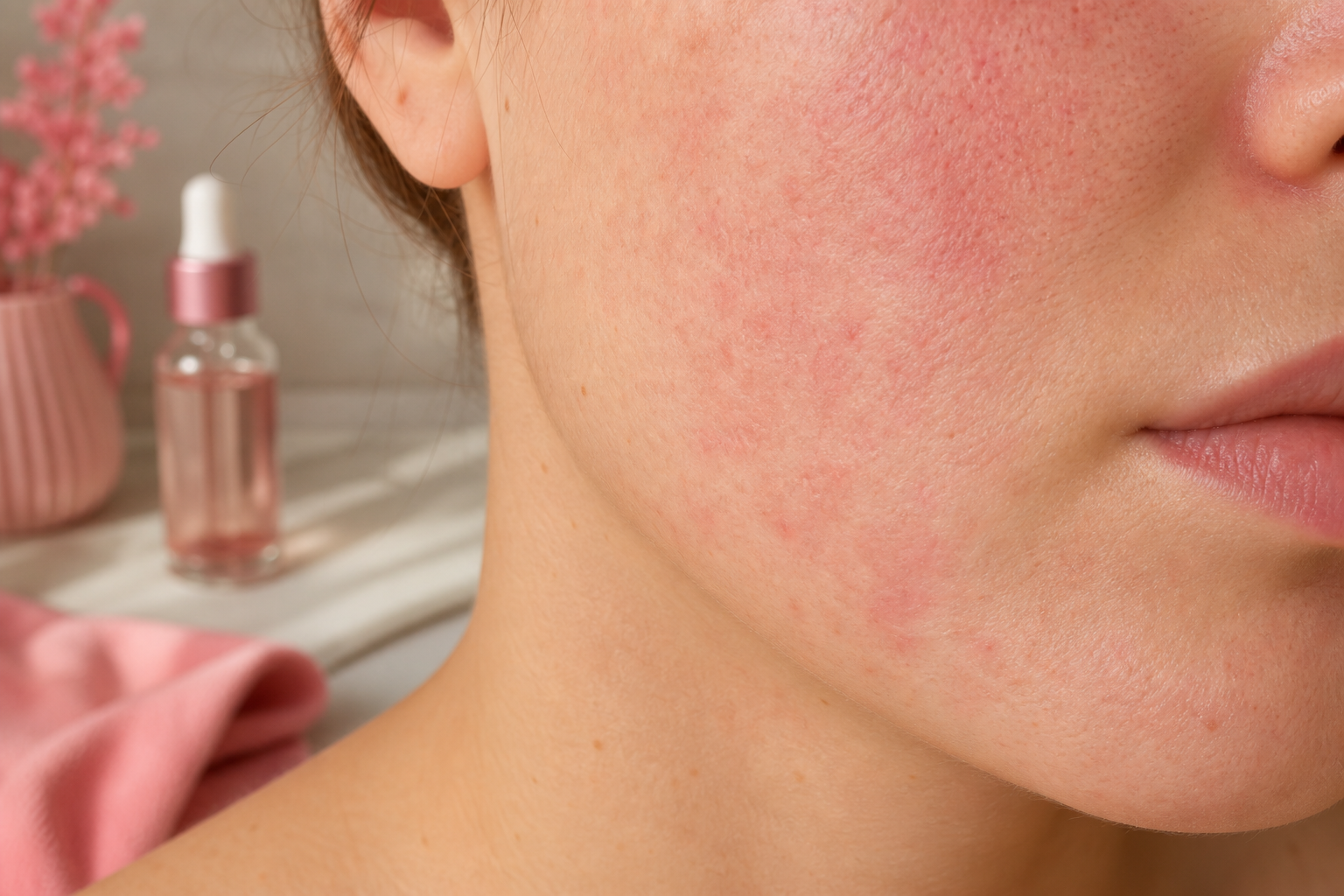
- AM preferred, once daily. Azelaic acid reduces blood-vessel dilation and calms the inflammatory cascade behind rosacea papules — WebMD specifically cites its rosacea efficacy, and Nichols frames it as ideal where inflammation is the primary concern.
- Pair only with calming actives. Centella asiatica, green tea, niacinamide. Never same-day BHA or AHA — the goal here is anti-inflammatory, not exfoliating.
- Skip fragrance and physical scrubs entirely. Both re-trigger flushing and undo the calming work azelaic acid is doing.
- Cool to lukewarm water only. Hot water dilates blood vessels, which is the exact problem you're trying to solve.
- SPF is the second active. Sun is the number-one rosacea trigger. Nichols flags SPF as non-negotiable alongside azelaic acid, and for rosacea specifically, mineral SPF often tolerates better than chemical filters.
Fungal acne (Malassezia folliculitis)
- Azelaic acid is fungal-acne safe and active. Its antimicrobial mechanism reduces Malassezia-driven breakouts in a way that most pore-clearing actives can't, because most exfoliants come in formulas that feed the yeast.
- AM + PM use is possible once acclimated. Start once daily as Nichols and Proven recommend, then ramp to twice daily after week three or four if tolerated.
- Audit every supporting product for esters, fatty acids, and most plant oils. These feed Malassezia and will undo azelaic acid's work no matter how diligent your application is. The breakouts that "won't quit" on a fungal-acne routine are almost always traced back to one ingredient in a moisturizer or sunscreen.
- Layer with pyrithione zinc on alternate days if breakouts persist past week four, but never in the same application.
- Verify your full routine against a fungal-acne–safe ingredient list — Macherre's fungal acne checker handles this automatically by scanning every INCI on your shelf.
Sensitive skin (no specific condition)
- Start every other day, not daily. WebMD documents burning, stinging, dryness, and peeling as common early side effects, and Proven specifically recommends starting at lower concentration and lower frequency to avoid them.
- Buffer if needed. Apply moisturizer first, wait five minutes, then apply azelaic acid over it for the first two weeks. This dilutes the active enough to reduce sting while you build tolerance. It's a temporary compromise, not a permanent protocol.
- Choose 10% over 15–20% for the first eight weeks. Paula's Choice's 10% booster is a typical starting strength and a good benchmark for "effective but tolerable."
- Skip every other exfoliant for the first four weeks to isolate azelaic acid's effect. You can't troubleshoot a reaction when you're running three actives simultaneously.
- For ultra-sensitive readers whose barrier is already compromised, consider stabilizing on ultra-gentle barrier-supporting alternatives for two weeks before introducing azelaic acid. A reactive barrier won't tolerate any active.
Macherre's skin-type filter lets you pull only the azelaic acid formulas vetted for rosacea, sensitive, or fungal acne–safe routines — instead of guessing from a marketing label that says "for sensitive skin" but contains five irritants.
10% vs 15% vs 20% — Picking the Right Strength and Spotting a Weak Product
The concentration split is clean. Over-the-counter products typically sit at 10% — Paula's Choice's 10% Azelaic Acid Booster is the reference standard for cosmetic-strength leave-on treatment. Prescription strengths run 15–20%, the range WebMD cites as clinically effective for acne. Anything below 10% is unlikely to deliver visible results on acne or rosacea, regardless of how the marketing frames it.
Azelaic Acid Strength Selection
| Concentration | Availability | Best For | Timeline | Notes |
|---|---|---|---|---|
| Under 10% | OTC, often in serums | Very mild redness | 8–12+ weeks for subtle change | Sub-therapeutic for acne/rosacea |
| 10% | OTC booster, serum, gel | Sensitive skin, beginners, PIH | 6–10 weeks | Standard cosmetic strength |
| 15% | Prescription (Finacea gel) | Rosacea, moderate acne | 4–8 weeks | Clinically studied for rosacea |
| 20% | Prescription (Azelex cream) | Acne, melasma, PIH | 4–12 weeks | Clinically studied for acne |
WebMD lists azelaic acid as available in cream, gel, foam, or lotion formats. Each behaves differently in a routine, and matching format to skin type matters as much as matching concentration to concern:
- Gel and foam formulas are lighter and absorb fast. Better for oily and acne-prone skin, and easier to layer under other AM products.
- Cream and lotion formulas are more emollient. The added cushion buffers irritation, which makes them the safer pick for rosacea and sensitive skin where the active needs to land softly.
- Suspension formulas like The Ordinary's 10% are textured and can pill under sunscreen. Apply alone, wait until fully absorbed, then layer — or if you're layering azelaic acid under makeup, build in extra absorption time before any base product.
The red flags when evaluating a product:
- Azelaic acid listed below humectants and emollients on the INCI list — that usually means it's below 5%, too dilute to do meaningful work no matter how the front of the package reads.
- "Azeloyl" derivatives like potassium azeloyl diglycinate. These are not the same molecule as azelaic acid. They're gentler and have their own merits, but they don't perform identically and shouldn't be evaluated against the same clinical evidence.
- No concentration disclosed on the label. Reputable brands say what's in the bottle. If a product hides the percentage, assume it's lower than you'd want.
- Marketing promising results in seven days. Every expert source — Ulta and Paula's Choice included — frames azelaic acid as a gradual treatment. Anything claiming overnight transformation is selling expectations the molecule can't deliver.
A 10% OTC azelaic acid serum and a 15% prescription gel are not the same product at different price points. They sit on different rungs of the clinical evidence ladder, and the only honest way to choose between them is to match strength to severity.
Macherre's ingredient scanner reads the INCI list, flags the actual position of azelaic acid in the formula, and gives a single compatibility score against your skin profile. The dupe finder also surfaces lower-cost 10% formulas with comparable concentration and stabilization to the higher-priced versions — useful when the difference between a $32 booster and a $14 alternative is brand premium, not chemistry.
Your 8-Week Azelaic Acid Protocol — Week-by-Week With Troubleshooting
The experts converge on a simple ramp: start once daily, increase to twice daily as tolerated. Nichols, Proven, and WebMD all anchor on that pattern. Results aren't immediate — Ulta and Paula's Choice both describe meaningful change as occurring with ongoing use over weeks. Here's exactly how to structure those weeks so you're not guessing at week three whether your peeling means "keep going" or "stop now."

8-Week Azelaic Acid Acclimation Protocol
| Phase | Frequency | Routine | Skin Response | Adjust If… |
|---|---|---|---|---|
| Week 1–2 | Every other day, AM | Cleanse → AzA → moisturizer → SPF | Mild dryness, light flaking, possible tingle | Severe burning: drop to 2x/week or buffer with moisturizer first |
| Week 3–4 | Daily, AM | Add niacinamide between AzA and moisturizer | Flaking subsides; texture smooths; redness eases | Persistent redness: audit other products for fragrance |
| Week 5–6 | Daily AM + 2–3x PM | AM as above; PM cleanse → AzA → moisturizer | Pimples reduce; rosacea bumps soften; pigment fades | Pigment unchanged: confirm SPF use; check concentration |
| Week 7–8 | AM + PM if tolerated | Full twice-daily; introduce retinoid alt PMs | Sustained redness reduction; PIH lightens; pores refine | No change by week 8: verify strength; consult derm |
The biggest mistake with azelaic acid is quitting at week 2 because of flaking. That peeling is your skin recalibrating, not a sign the product is wrong. Push to week 4 before you decide anything.
The protocol works if you work it. The reasons it stalls are predictable. Before week eight ends, run this checklist — most "azelaic acid doesn't work for me" stories trace back to one of these eight decisions.
- Am I using a pea-sized amount on dry skin? Nichols specifies pea-sized. More is not more — excess product wastes formula and increases irritation without improving results. If your face feels coated after application, you used too much.
- Is my SPF actually broad-spectrum, SPF 30+, and reapplied? WebMD flags sun protection as essential during azelaic acid treatment. Skipped or under-applied SPF cancels every gram of pigment progress you're making. This is the single most common reason "the pigment never faded."
- Have I stopped every other exfoliant for the first 4 weeks? Compounded irritation looks like a reaction to azelaic acid when it's really overuse of three actives running in parallel. Isolate first, layer later.
- Is my concentration appropriate for my concern? Under-10% formulas often underperform on acne and rosacea. If you bought a "brightening serum" with azelaic acid listed seventh on the INCI, you're not running a therapeutic dose.
- Am I confusing irritation with adjustment? Mild flaking and dryness in weeks 1–2 are documented adjustment responses, not failure. Burning that persists more than 30 minutes after application is a problem and warrants buffering or dose reduction. If you wear makeup over your routine, prepping skin properly before base products also reduces the sting that comes from layering foundation over still-active treatment.
- If pairing with retinol, am I alternating nights? Same-night layering before week four is the most common reason readers abandon both actives. Stagger first, combine later if you want — most people never need to combine same-night.
- Have I verified my supporting products? Run cleanser, moisturizer, and SPF through Macherre's ingredient analyzer. One fragranced cream or one Malassezia-feeding ester can sabotage eight weeks of consistent active use. Audit the supporting cast, not just the star.
- At week 8 with no progress, am I ready to escalate? If a 10% OTC formula hasn't moved the needle on rosacea or stubborn PIH after eight diligent weeks, the next conversation is with a dermatologist about 15% Finacea or 20% Azelex. Stepping up the concentration is the answer, not abandoning the active.
Macherre's shelf organizer tracks which products you've actually used during your 8-week ramp, and the skin-type review filter lets you see how others with rosacea, fungal acne, or sensitive skin responded to the exact formula in your stack. That's the difference between guessing whether to push through week three and seeing that fifty other rosacea users hit their breakthrough at week five.