best face wash for sensitive skin: The Best Face Washes for Sensitive Skin (and How to Verify Them Yourself)
Anyone with reactive skin knows the familiar sting: you buy a cleanser labeled "for sensitive skin," wash your face, and within minutes there's tightness, redness, or that unmistakable burn. The phrase on the front of the bottle is marketing, not a promise. Finding the best face wash for sensitive skin has less to do with trusting a label and everything to do with reading the ingredient list and matching it against what your own skin can tolerate. That's exactly the gap Macherre is built to close: instead of guessing, you scan or paste a formula and get a plain-language breakdown plus a single compatibility score tuned to your skin profile, so a "gentle" claim either holds up under scrutiny or it doesn't.
Think of this less as a shopping list and more as a method. Dermatologists broadly agree on what a sensitive-skin cleanser should and shouldn't contain, and Macherre turns those principles into something you can verify in seconds for any product on your shelf or in a store aisle.
Table of contents
- Why sensitive skin needs a gentler cleanser
- How Macherre turns an ingredient list into a compatibility score
- Verify any face wash yourself, step by step
- Sensitive and something else: acne-prone and seborrheic dermatitis
- Comparing cleansers and finding budget-friendly dupes
- Fitting your cleanser into a routine and patch testing
- Frequently asked questions
Why sensitive skin needs a gentler cleanser
Sensitive skin reacts more easily because its barrier is quicker to feel stripped, and cleansing is the step most likely to push it over the edge. Dermatologist guidance is consistent on the shape of a safe formula: simple, soothing, fragrance-free, hypoallergenic, and pH-balanced, with an emphasis on hydration rather than a squeaky-clean finish, according to dermatologist advice compiled by CNN Underscored.
The ingredients that tend to cause trouble are predictable. A dermatologist guide to choosing cleansers warns that chemical exfoliant cleansers containing salicylic, lactic, or glycolic acids, along with drying surfactants such as Sodium Lauryl Sulfate (SLS) and Sodium Laureth Sulfate (SLES), are frequently too harsh for sensitive and rosacea-prone skin, as explained by Dr Davin Lim. The same guide notes that acne-focused cleansers loaded with exfoliating acids are often unsuitable for people who irritate easily, even though those products carry their own kind of "active" appeal.
Texture matters too. Retailer skincare advice for sensitive and dry skin leans toward gentle, non-stripping formulas that prioritise moisture from the very first step, according to Boots skincare guidance. In practice that usually means cream, lotion, or micellar cleansers are better tolerated than heavy foaming or scrub-type washes, a pattern echoed in a dermatologist-led review that highlights micellar waters and gentle cream cleansers as sensible starting points when they avoid fragrance and harsh surfactants, as covered by The Guardian.
So the working definition of "best face wash for sensitive skin" isn't a single product. It's a formula that is gentle, fragrance-free, free of drying alcohols and aggressive surfactants, light on high-dose acids, and generous with hydrating and barrier-supporting ingredients like glycerin and ceramides. The remaining question is whether the bottle in your hand actually meets that bar.
How Macherre turns an ingredient list into a compatibility score
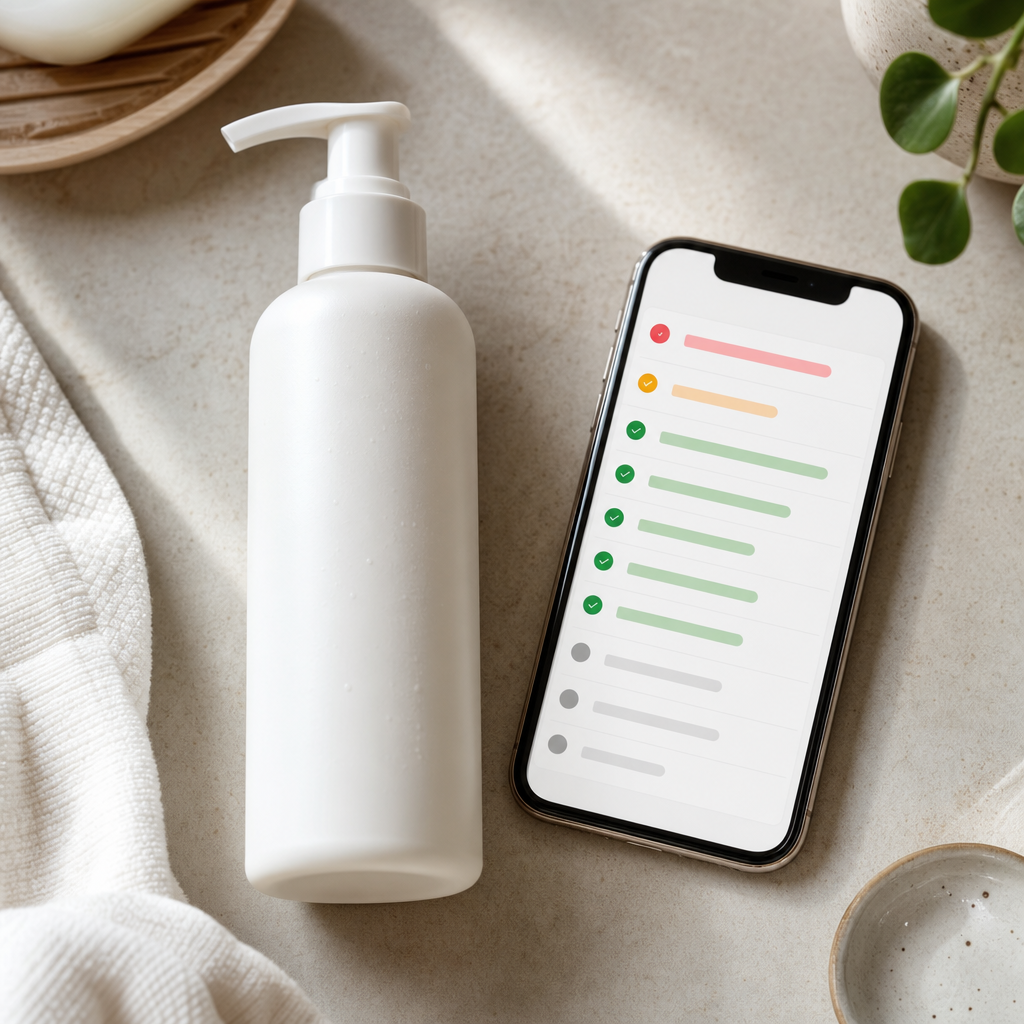
The promise on a package tells you what a brand wants you to believe. The ingredient list tells you what's actually in the tube. Macherre reads that list for you and translates it into two things: a per-ingredient breakdown in plain language, and a single compatibility score for the product.
The score combines your skin type, your sensitivities, and your goals into one signal of whether a product is worth trying, without asking you to learn chemistry first, as described on the Macherre homepage. Every ingredient gets its own explanation covering what it does, who it tends to help, and when it might cause issues, which is the part that matters most for reactive skin. Instead of scanning for a familiar irritant and hoping you spotted it, you get each component flagged and explained.
That guidance only becomes precise once you've told the app who you are. When you set up a skin profile as sensitive and log your conditions and known triggers, the analysis stops being generic. The compare tool, for example, can weight "personal fit" by factoring in ingredients you've flagged as triggers, sensitivities you've logged, and the actives relevant to your goal, as detailed on the Macherre compare tool. Fragrance, drying alcohols, common allergens, and your personally flagged triggers are surfaced directly, which is exactly the shortlist of things a sensitive-skin buyer needs to rule out.
One honest caveat: Macherre doesn't publish the exact thresholds behind the score, so nobody outside the app can tell you the precise cutoff where a formula flips from "sensitive-friendly" to "risky." What you can rely on is what the score represents and what the breakdown shows you ingredient by ingredient. The number is a starting signal; the breakdown is where you make the decision. Because the database is built to stay current with reformulations and stays independent of the brands themselves, the analysis reflects what's in the product now rather than what the marketing once said.
You can also decode any skincare ingredient list manually if a product isn't in front of you, pasting the INCI list to see the same plain-language explanations before you commit to buying anything.
Verify any face wash yourself, step by step
Here's where the label stops mattering and your own verification takes over. The workflow is short, and most of it takes seconds.
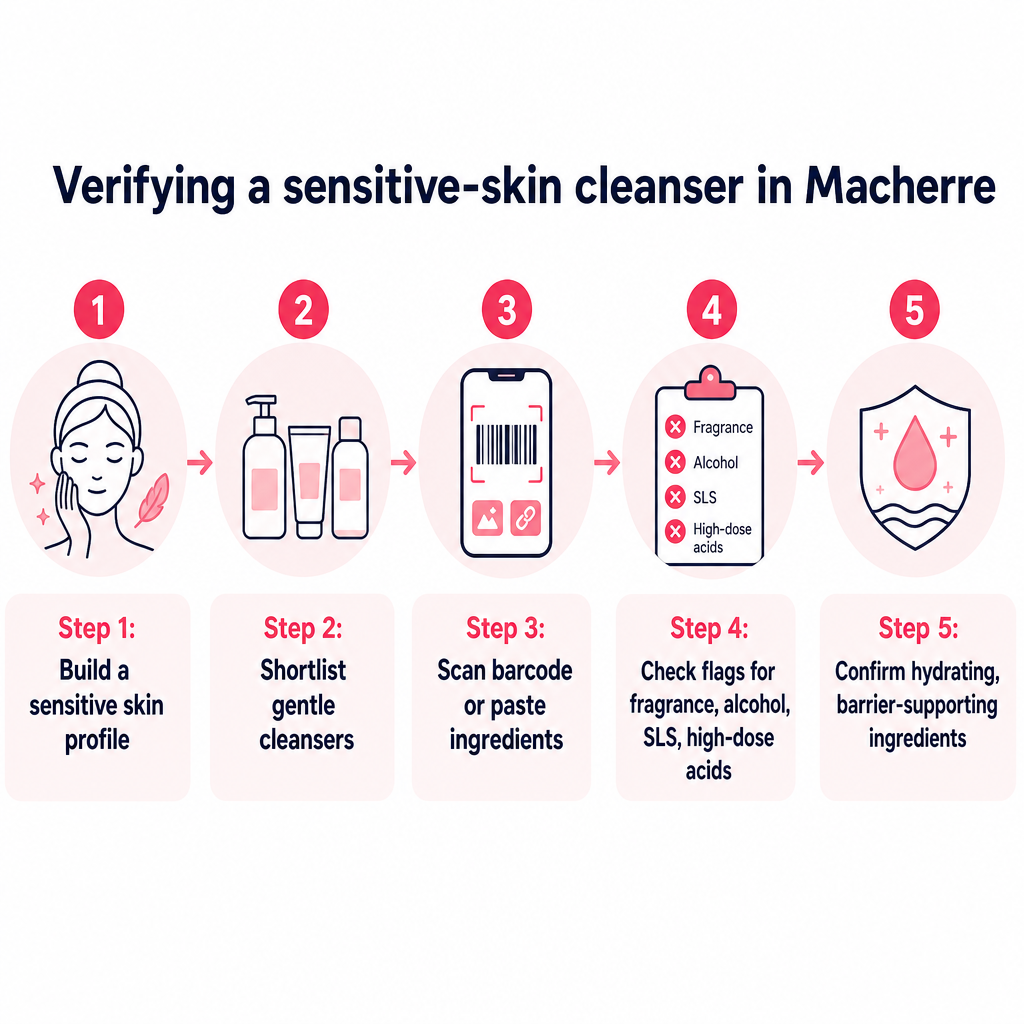
Build a sensitive-skin profile first. Set your skin type to sensitive and log any relevant conditions, such as rosacea, eczema, seborrheic dermatitis, or acne. If you already know certain irritants set you off, flag them by name, whether that's fragrance, SLS, or menthol. This is what makes the compatibility score and the ingredient flags mean something specific to you rather than something averaged across everyone.
Shortlist a few candidates in the app. Use search and filtering by skin type, concern, and ingredient to pull up cleansers that are described as gentle or suited to sensitive skin, as offered on the Macherre homepage. Treat this list as a set of starting points to test, not final answers.
Scan or paste each formula. For anything physically in front of you, the fastest path is the cosmetic barcode scanner for instant ingredient clarity, which pulls up the ingredient list and analysis without manual typing. Standing in a shop aisle, this turns any bottle into something you can vet before it reaches the counter. If you only have the ingredient list as text, paste it into the ingredient checker instead. Either way you get the per-ingredient breakdown and the compatibility score.
Map the dermatologist criteria onto what you see. This is the step that connects clinical guidance to the app's output. Check that fragrance and drying alcohols are absent or minimal using the surfaced flags. Scan for SLS or SLES and for high-dose AHAs or BHAs, and treat those as red flags if your skin is reactive or rosacea-prone, consistent with the dermatologist warning about harsh surfactants and exfoliating acids. Then look for the reassuring signs: hydrating and barrier-supporting ingredients such as glycerin and ceramides, which align with what dermatologists and retailers recommend for sensitive and dry skin. If a product survives that pass, it has earned a place on your test list.
Verification itself is effectively instant. The time you actually spend is on reading the breakdowns and weighing the trade-offs, which is time well spent when the alternative is buying blind and reacting on your face.
Sensitive and something else: acne-prone and seborrheic dermatitis
Sensitive rarely travels alone. Plenty of reactive skin is also breakout-prone, and plenty of people managing seborrheic dermatitis discover that "gentle" cleansers still set them off. The generic label can't tell those stories apart, but condition-specific checkers can.
If your skin is sensitive and acne-prone, the fear is usually that a rich, soothing cleanser will be too occlusive and end up contributing to breakouts. Rather than avoiding emollient formulas on principle, run the candidate through the pore-clogging (comedogenic) checker, which flags comedogenic ingredients so you can judge whether a cleanser's emollients or surfactants are likely to cause problems for you. This lets you keep the barrier-friendly benefits you need without gambling on clogged pores.
Seborrheic dermatitis is its own puzzle, because the triggers that flare it aren't the same as generic irritants. A cleanser can be fragrance-free and mild and still contain something that provokes a flare. The seborrheic dermatitis trigger checker exists precisely to catch those condition-specific issues, so you can vet a formula against known triggers rather than relying on a vague "suitable for sensitive skin" claim that was never written with your condition in mind.
One boundary worth stating plainly: these checkers help you screen products, not treat a skin condition. If you're managing rosacea, eczema, or seborrheic dermatitis medically, the checkers complement your care rather than replace advice about prescription treatment. What they do well is remove the guesswork from the cleansing step, which is where a lot of everyday irritation quietly begins.
Comparing cleansers and finding budget-friendly dupes
Once two or three cleansers have passed your verification, the decision becomes a comparison rather than a leap of faith. Lining products up side by side shows shared ingredients, unique ingredients, key actives, ratings, and sensitivities, so you choose based on formula rather than on which brand tells the better story, as described on the Macherre compare tool. The view highlights overlapping bases against meaningful differences, and it surfaces fragrance, drying alcohols, common allergens, and your personally flagged triggers in each product's column. For sensitive skin, that per-column irritant summary is often the deciding factor: two cleansers can look nearly identical until one reveals a fragrance blend the other left out.
The side-by-side product comparison is also where price pressure meets formula reality. Wanting a gentler alternative to an expensive cleanser is completely reasonable, and Macherre's dupe finder is built for exactly that. It surfaces cheaper or more accessible products that match the formula profile of a cleanser you already like, and it's designed to work alongside compare and the ingredient checker so you can evaluate a swap for both fit and safety.
The important discipline here is to treat a dupe like any other candidate. A cheaper formula that matches on paper still needs the same verification pass, because a small substitution in surfactants or the addition of a fragrance can change how your skin reacts. Run the potential skincare dupe through the same checks before you swap, and you get the savings without inheriting a new irritant. Save the versions that pass onto your shelves so you can track what you own, what you want to try, and how each one behaved, which keeps you from repeating a purchase that quietly disappointed you last time.
Fitting your cleanser into a routine and patch testing
A gentle cleanser can still cause trouble if the rest of your routine is doing heavy lifting elsewhere. Irritation is often cumulative: a mild acid in your cleanser plus a retinoid at night plus an exfoliating toner can add up to a reaction that no single product would trigger on its own. Adding your chosen cleanser to a routine that actually fits your skin lets you see how products work together and flags clashes and gaps before your face finds them for you. For sensitive skin, this context check is where you catch the combinations that overload the barrier.
Once the cleanser fits sensibly into your morning and evening lineup, the final safeguard is a patch test, and this is where clinical advice is worth following literally. Dermatologist guidance suggests trying a new product on a small area and watching for stinging, redness, or peeling over at least a week rather than judging it after a single wash, according to CNN Underscored. The way you use the cleanser matters as much as the formula: wash at most twice daily with lukewarm water using your fingertips instead of abrasive tools, and pat dry gently to avoid mechanical irritation, as recommended by Dr Davin Lim.
Keep notes as you go. Using shelves to log how each cleanser behaved over that observation window turns a vague memory into a record you can act on, and it makes the next decision easier because you're comparing your own documented reactions rather than starting from scratch. If a formula that scored well still stings, that outcome is data, and it feeds back into your profile and your next shortlist.
Frequently asked questions
What actually makes a face wash suitable for sensitive skin?
The consistent dermatologist criteria are gentleness and simplicity: fragrance-free, hypoallergenic, pH-balanced formulas that clean without stripping, with hydration prioritised from the first step. That usually rules out drying surfactants like SLS and SLES, high-dose exfoliating acids, drying alcohols, and strong essential oils, and it favours hydrating, barrier-supporting ingredients such as glycerin and ceramides. Rather than trusting the front label, verify the ingredient list against these criteria for the specific product you're considering.
Can I trust a product just because it says "for sensitive skin"?
Not on its own. "For sensitive skin" is a marketing description, not a standardised guarantee, and products carrying it can still include fragrance, drying alcohols, or surfactants that reactive skin dislikes. The reliable move is to read the ingredient list. Macherre's ingredient checker and barcode scanner surface each component's role and flag likely irritants, so you can confirm whether the claim holds up for your skin instead of assuming it does.
How does Macherre's compatibility score work for sensitive skin?
The score combines your skin type, logged sensitivities, and goals into a single at-a-glance signal of whether a product is worth trying. Once you set your profile to sensitive and flag your known triggers, the analysis weights those factors and surfaces fragrance, drying alcohols, common allergens, and anything you've personally flagged. Macherre doesn't publish the exact thresholds behind the number, so treat the score as a starting signal and read the per-ingredient breakdown to make the final call.
Foaming, cream, or micellar cleanser for reactive skin?
General guidance for sensitive and dry skin leans toward cream, lotion, and micellar formulas over heavy foaming or scrub-type washes, because they tend to clean without stripping the barrier. Texture is a helpful starting filter, but it isn't a guarantee on its own, since a cream cleanser can still contain fragrance or a surfactant you react to. Use texture to narrow your shortlist, then verify each candidate's ingredient list before deciding.
How long should I patch test a new cleanser?
Dermatologist advice points to observing a new product for at least a week, applied to a small area, and watching for stinging, redness, or peeling before committing to full-face use. Pair that with gentle usage habits: no more than twice daily, lukewarm water, fingertips rather than tools, and gentle patting to dry. Logging the results on your Macherre shelves keeps a record you can compare against future products.
What if a cheaper dupe reacts differently than the original?
That can happen, because a dupe matches a formula profile but may differ in specific surfactants or added fragrance. Treat every dupe as a fresh candidate: run it through the ingredient checker or barcode scanner, compare it side by side with the original to spot the differences, and patch test before swapping fully. If it reacts, note that outcome so your profile and future shortlists get sharper over time.
The practical starting point is quick. Set up your sensitive-skin profile, filter for a few gentle cleansers, then scan or paste each one and read the breakdown against the criteria above. Run the pore-clogging or seborrheic dermatitis checker if either applies to you, compare your finalists, and patch test the top pick while logging how it feels. That sequence replaces the label's promise with your own evidence, which is the only version of "best" that actually protects your skin.