
How To Build A Skincare Routine For Beginners
Starting skincare feels harder than it should, mostly because the internet hands you a twelve-step ritual before you've even figured out what your skin is doing. Here's the reassuring version: learning how to build a skincare routine for beginners takes three products, about five to ten minutes twice a day, and roughly the cost of one modest cleanser, one moisturizer, and one sunscreen per month. With that simple base, most people see visible improvements in texture, dryness, and mild breakouts within six to eight weeks. Everything else is optional tuning you add later, once your skin is comfortable. We built Macherre to help you make those decisions without a chemistry degree, so this guide walks you through the exact base routine, when to add extras, and where our tools do the heavy lifting.
Table of contents
What a realistic beginner routine actually looks like
The goal of a first routine is not glass skin. It's a stable barrier that stays healthy, reduces obvious issues like dryness, oiliness, and mild breakouts, and leaves room to add targeted treatments later. Dermatology organizations consistently recommend cleansing, moisturizing, and daily sun protection as everyday habits, not occasional "skin days."
The time cost is small: five to seven minutes in the morning, five to ten at night. The money cost is smaller than most beginners expect. A dermatologist-style minimum viable routine needs only three core products, and it can be built with budget-friendly options when you prioritize how a formula functions over how it's branded.
That three-part base is the whole plan for now:
- A gentle cleanser, used twice daily.
- A moisturizer matched to your skin type, used twice daily.
- A broad-spectrum SPF 30 or higher every morning on all exposed skin.
Actives like vitamin C or retinoids come later, added gradually and only after the basics feel comfortable. If you already own a shelf of products, you don't have to guess whether they belong here. Scanning them with our cosmetic barcode scanner for ingredient clarity gives you a compatibility score and a plain-language breakdown before you decide what stays.
Prerequisites checklist before you build anything
A good routine starts with an honest read of your skin, not a shopping cart. Run through these five checks first.
- Identify your current skin state. Is your skin mostly dry, normal, combination, or oily? Do products often sting or leave redness? Do you have a known condition like fungal acne, rosacea, eczema, or seborrheic dermatitis? Knowing this changes which formulas are safe for you.
- Watch for red-flag situations. Rapidly changing moles or patches, severe cystic acne, raw or weeping skin, intense itching that disrupts sleep, or sudden rashes after medication or illness all mean you should see a dermatologist before experimenting. In those cases, a routine follows medical advice, not trial and error.
- Inventory what you already use. List your current cleanser, toner, serums, moisturizers, sunscreen, and makeup. Scan each one to see what it actually contains and whether anything you own is likely working against you.
- Set one primary goal. Pick a single focus: fewer breakouts, calmer redness, less dryness and flaking, or smoother texture and faded mild dark spots. One goal keeps your product list short and appropriate instead of an overwhelming mix.
- Set a realistic budget. For most people the starting point is one cleanser, one moisturizer, and one sunscreen. Budget-focused dermatology guidance leans on gentle, fragrance-free formulas and reliable sun protection rather than luxury branding, so confirm you can access those options where you live.
If you already suspect a condition is involved, our seborrheic dermatitis trigger checker flags ingredients that commonly worsen flares, and our pore-clogging (comedogenic) checker does the same for acne-prone skin. Running your existing products through them first often explains a breakout you couldn't otherwise place.
The step-by-step build
Step 1 – Lock in the three-step base
Cleanse, moisturize, protect. That's the safest starting structure for beginners.
For cleansing, choose a gentle, fragrance-free cleanser matched to your skin type and wash with lukewarm water when you wake up, before bed, and after heavy sweating. Skip rough physical scrubs. When you're choosing a cleanser, our ingredient checker that decodes any skincare ingredient list helps you avoid harsh surfactants, high alcohol, or known irritants for your specific concern.
For moisturizing, apply a formula suited to your skin type onto slightly damp skin to lock in hydration. Oily and combination skin usually prefers lightweight gels or lotions; dry or compromised skin does better with richer creams. Filter by concern and let the compatibility score steer you away from formulas likely to clog pores or trigger dermatitis.
For protection, apply a broad-spectrum SPF 30 or higher to all exposed skin every morning. Daily sun protection matters for preventing premature aging and skin cancer, not just for beach days. If a recommended sunscreen is expensive or unavailable in your country, our tool to find a skincare dupe in seconds locates alternatives with a similar profile.
At this point your routine is simply: AM cleanser, moisturizer, sunscreen; PM cleanser, moisturizer. Run that through our routine creator that fits your skin so the clash detection can confirm nothing overloads a single ingredient or duplicates an active.
Step 2 – Decide whether you need extras
Once the base feels comfortable for two to four weeks with no persistent burning, peeling, or worsening breakouts, you can consider optional steps.
A hydrating toner or essence is a nice-to-have, not a requirement; if you add one, keep it alcohol-free and skip strong exfoliating acids for now. A treatment serum such as niacinamide for redness and oil, hyaluronic acid for hydration, or vitamin C for brightening is worth introducing one at a time, watching your skin for two to three weeks before adding another. An eye cream is often unnecessary if your face moisturizer is gentle enough for the eye area; if you use one, apply a small amount with your ring finger and avoid strong fragrance near the eyes.
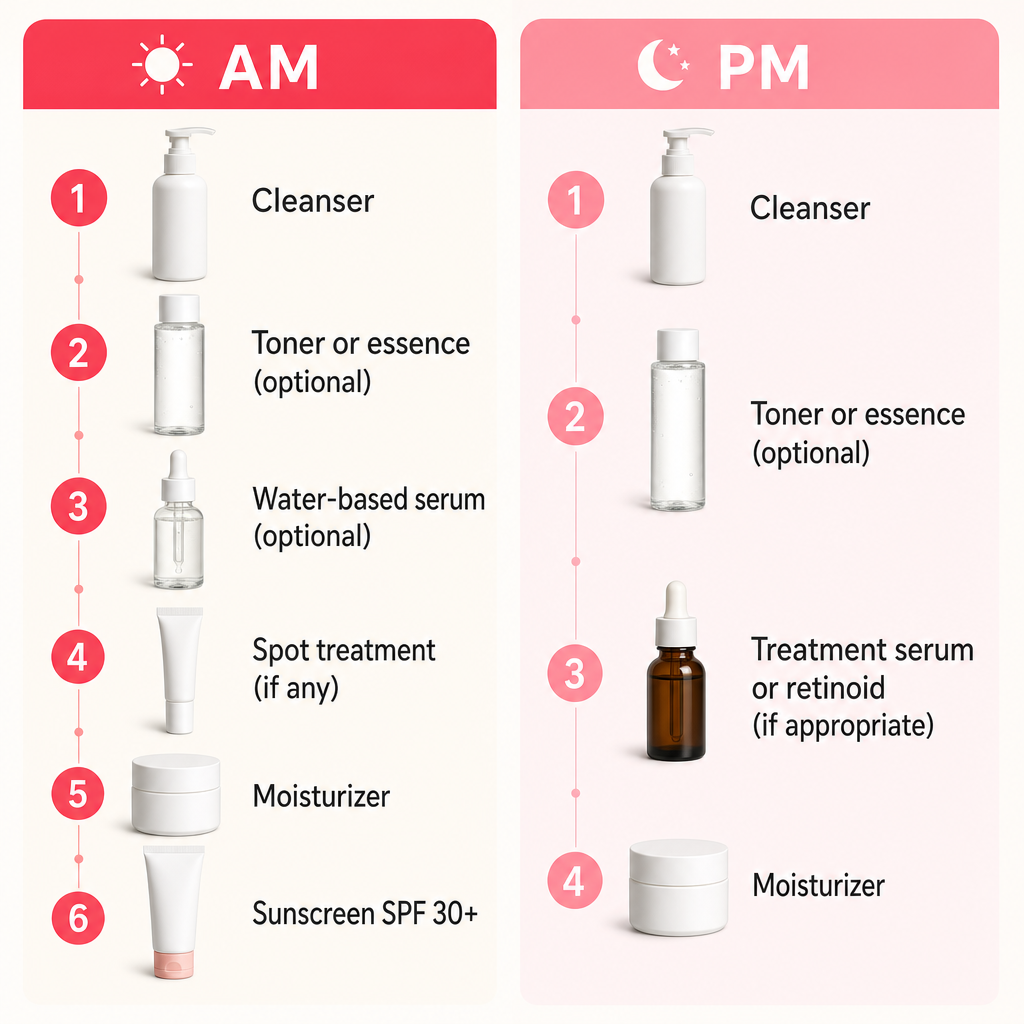
Step 3 – Get the layering order right
Order matters for both effectiveness and comfort. The standard beginner sequence is:
AM: cleanser, then toner or essence if used, then water-based serums, then any spot treatment, then moisturizer, then sunscreen.
PM: cleanser (double cleanse if you wore heavy makeup or sunscreen), then toner or essence if used, then treatment serums or retinoids if appropriate, then moisturizer.
Apply targeted treatments right after cleansing, then seal with moisturizer, and finish the morning with sunscreen. Dragging products into this order in the routine creator lets the clash detection flag problem pairings, like strong exfoliating acids stacked with retinoids in the same routine.
Step 4 – Introduce actives slowly
Strong actives carry more risk when used carelessly, so go conservative:
- Patch test first. Apply a small amount to a discreet area such as behind the ear for several nights before using it on your whole face. Intense burning, swelling, or a rash means stop and seek advice.
- One new active at a time. Starting several potent ingredients together makes it impossible to tell what caused a reaction.
- Limit exfoliation. Keep chemical exfoliation to once or twice a week in the evening, and skip it entirely if your barrier is compromised or inflamed. Daily strong exfoliation damages the barrier.
- Treat retinoids as night-only. Beginners often start no more than two to three nights a week, buffered with moisturizer, and never alongside acids. With eczema, rosacea, or severe acne, discuss retinoids with a dermatologist rather than self-prescribing.
Use the ingredient checker to confirm the type and strength of an active, such as glycolic versus lactic acid or the percentage of niacinamide, so you can adjust accordingly.
Step 5 – Monitor and adjust
A routine is a feedback loop, not a fixed prescription. Do a weekly check-in on oiliness, dryness, breakouts, redness, and new sensitivity. When you change a product, swap rather than stack: find a lower-cost or lower-trigger alternative with our dupe finder, or compare two skincare products side by side to choose one instead of layering both. Scan anything new before you buy to avoid impulse purchases that could disrupt what's working. And give a tolerable, mildly helpful product six to eight weeks before deciding it doesn't work, because consistency over weeks matters more than constant switching.
Common mistakes and how to fix them
Too many products, too soon. Piling on toners, serums, masks, and peels raises the risk of irritation and barrier damage. Return to the three-step base for two to three weeks, then reintroduce one product at a time with clash detection watching.
Over-cleansing and over-exfoliating. Wash gently, twice daily plus after heavy sweating, with lukewarm water and no rough scrubs. Cut exfoliating acids to one or two evenings a week, or stop if you see redness or stinging.
Skipping sunscreen. This is the non-negotiable morning step. If layering feels heavy, a moisturizer with built-in SPF 30 or higher works as a dual-function shortcut that budget-focused guidance supports.
Ignoring an active condition. Random actives can inflame rosacea, eczema, or seborrheic dermatitis. Run your routine through the relevant condition checker, and if flares persist despite a gentle routine, pause new actives and see a dermatologist.
Chasing hype over function. Understand what an ingredient actually does before buying the viral version. A functional, fragrance-free, non-comedogenic formula usually beats a complicated claim.
When to keep it simple and when to see a dermatologist
You can confidently build and adjust a routine yourself when your concerns are mild, your skin tolerates a gentle cleanser, moisturizer, and sunscreen without lasting burning or redness, and you're not using prescription-strength treatments unsupervised. That's exactly the range our routine builder, ingredient checker, and condition-specific tools are designed for.
Bring in a professional first when acne is nodular, cystic, painful, or scarring; when you suspect rosacea, psoriasis, or severe eczema; when you have persistent unexplained rashes, pigment changes, or lesions; or when you're considering high-strength retinoids, chemical peels, or combining several medicated products. In those situations, use Macherre as a support layer to understand prescribed products, organize them, and avoid clashes, not as a replacement for medical care.
Frequently asked questions
How many steps should a beginner routine have?
Start with a three-step core: cleanser, moisturizer, and sunscreen. Add optional steps only once your skin comfortably tolerates the basics.
How long until I see results?
For texture, oiliness, and mild breakouts, expect noticeable changes within six to eight weeks of consistent use. Pigment issues and deeper wrinkles take longer.
Do I need a different routine for morning and night?
Yes. Morning focuses on protection with sunscreen, night on repair. The cleanser and moisturizer can be the same, but retinoids and most exfoliants are night-only.
Is toner necessary for a beginner?
No. A hydrating toner can be pleasant, but it isn't essential if your cleanser is gentle and your moisturizer is effective.
How do I know if a product is too strong for me?
Persistent burning, stinging, peeling, or worsening redness are the signals. Reduce frequency, remove other actives, and check the ingredients in Macherre. If irritation continues, stop and consult a professional.