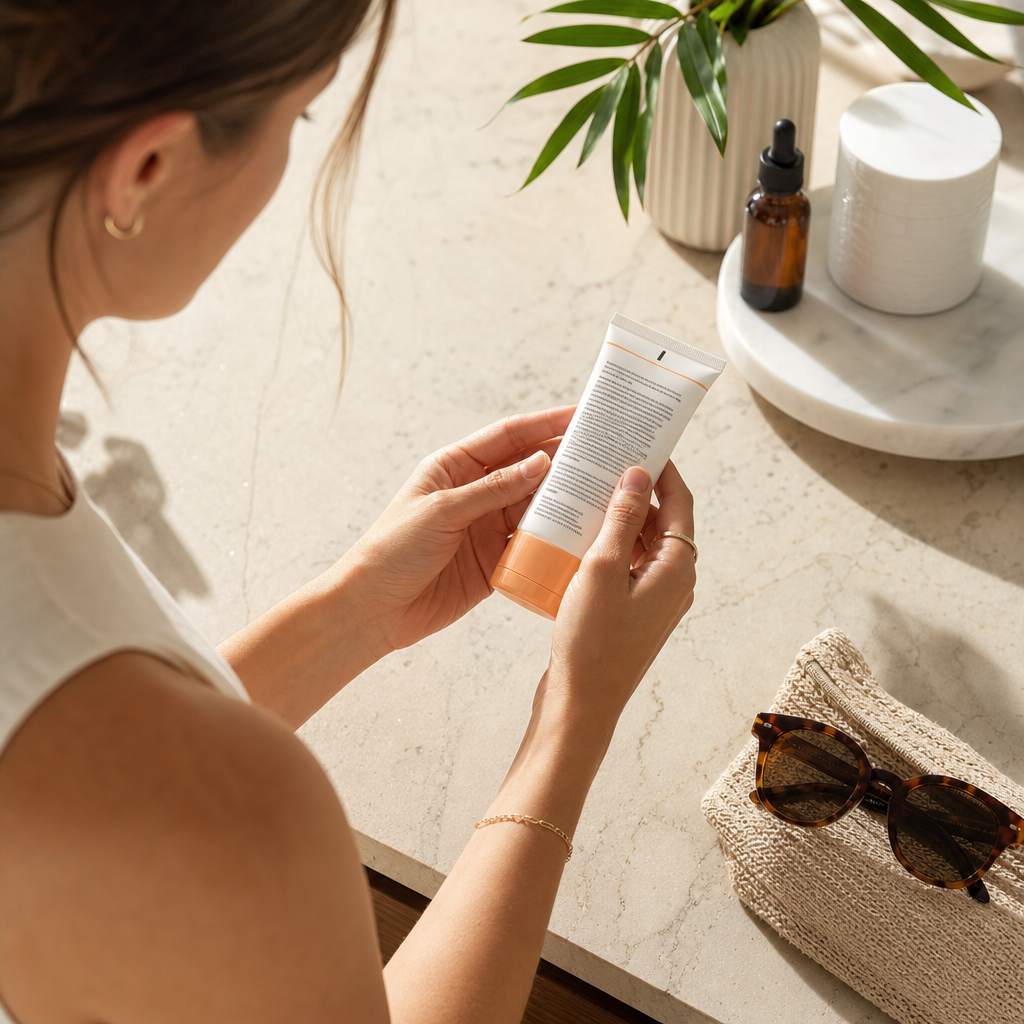
How to Decode a Sunscreen Ingredient List Step by Step
A sunscreen ingredient list stops feeling cryptic the moment you break it into three plain questions: which ingredients actually protect your skin, what the rest of the formula is doing, and whether anything in there is worth a second look for your own skin. That is the whole method of how to decode a sunscreen ingredient list, and it works far better than judging a product by a single "clean" or "chemical-free" claim on the front. Read the protection information first, then read the cosmetic INCI list as a formula rather than a lineup of suspects.
Ingredient flags and ratings are informational only. They cannot confirm a product will cause or prevent breakouts, diagnose a skin condition, determine individual safety, or provide pregnancy clearance. For allergies, eczema, persistent acne, rosacea, or other medical concerns, talk to a qualified clinician.
Table of contents
What a sunscreen ingredient list actually contains
Most sunscreen labels carry two related sections rather than one. There are the active ingredients, which are the UV filters that protect skin from ultraviolet radiation, and the inactive ingredients, which cover everything else in the formula: solvents, emollients, humectants, film-formers, preservatives, fragrance components, and texture agents. For products regulated as sunscreens in the United States, the FDA separates active UV-filtering ingredients from inactive formulation ingredients such as water or oils.
That split is the foundation of reading any sunscreen. If you can tell the protective ingredients apart from the base, the rest of the label becomes a texture-and-tolerance decision instead of a chemistry exam. One caveat worth keeping in mind: sunscreen is regulated differently around the world. Depending on the market it may be treated as a cosmetic, a medicine, or a combination product, which means permitted filters, ingredient names, and label layouts vary by country. Read the local label on the product in your hand and follow its directions.
Check the protection claims before the INCI list
Here is the part people skip. The ingredient list shows which filters a formula contains, but it does not replace the tested protection claims printed elsewhere on the package. Those claims do the heavy lifting, and three of them matter most.
SPF mainly describes protection against sunburn, which is tied largely to UVB exposure. It is not a time multiplier. SPF 30 does not mean thirty times longer in the sun without reapplying; the FDA explains SPF relates to the amount of UV exposure rather than simply duration. Broad spectrum is the claim that signals protection against both UVA and UVB, since SPF alone does not fully describe UVA coverage. And there is no such thing as waterproof sunscreen. Where water-resistance claims are permitted, the label should state whether the product stays effective for 40 or 80 minutes during swimming or sweating, and reapplication is still required after swimming, sweating, or towel drying.
For everyday selection, the American Academy of Dermatology recommends broad-spectrum sunscreen with SPF 30 or higher and water resistance. Once those boxes are checked on the front of the pack, the ingredient list becomes about fit and feel rather than whether the product protects at all.
Find the UV filters first
Start at the active ingredients section if the product has one, because those ingredients are what directly provide UV protection. The filters you see cluster into a few recognizable groups.
| UV-filter group | Examples you may see |
|---|---|
| Mineral filters | Zinc oxide, titanium dioxide |
| Organic filters common in sunscreens | Avobenzone, octocrylene, octinoxate, octisalate, homosalate, oxybenzone |
| Filters used in some international formulas | Bemotrizinol, ecamsule, other regionally permitted filters |
The exact permitted list depends on the market, and the FDA lists zinc oxide and titanium dioxide among commonly used sunscreen actives alongside several organic filters. A product built on zinc oxide, titanium dioxide, or both is usually called a mineral sunscreen; one without those two filters is usually called an organic-filter sunscreen, often labeled "chemical" in everyday language.
Those categories describe the filters, not the whole formula, and that distinction trips a lot of people up. A mineral sunscreen can still contain fragrance, botanical extracts, silicones, emollients, or preservatives. An organic-filter sunscreen can be fragrance-free and built for sensitive skin. So the filter type is a starting point, not a verdict on how the product will feel or whether it suits you.
Read the supporting ingredients as a formula
Once the filters are identified, read the remaining INCI names as a connected formula instead of a list of isolated dangers. Each category has a job.
Solvents and the base. Water, alcohols, glycols, and other solvents dissolve or disperse the formula. Their effect depends on the finished product: a lightweight sunscreen may lean on volatile solvents for a fast-drying texture, while a cream uses water, oils, waxes, and emulsifiers for a richer feel.
Humectants. Glycerin, propanediol, butylene glycol, and hyaluronic acid or sodium hyaluronate attract and hold water in the outer skin. They often add a hydrated feel, but they do not tell you whether the product will feel greasy or pill under makeup.
Emollients and oils. Caprylic/capric triglyceride, squalane, esters, plant oils, and fatty alcohols soften skin and improve spreadability. An emollient is not automatically pore-clogging. Comedogenicity references are estimates, and the finished formula, concentration, amount applied, and your individual response all matter.
Silicones and film-formers. Silicones such as dimethicone improve slip and smoothness, and film-formers help the product stay evenly distributed, which can support water resistance or wear. The trade-off is that a long-wearing formula can also feel heavier or harder to remove.
Emulsifiers, stabilizers, and preservatives. Emulsifiers keep water and oil blended; stabilizers and chelating agents protect texture and performance over time; preservatives such as phenoxyethanol, sodium benzoate, or potassium sorbate help prevent microbial growth in water-containing products. These rarely get marketed as hero ingredients, but they hold the product together. A preservative being present does not make a product unsuitable. The real question is whether a specific ingredient is a known personal trigger for you.
Fragrance and aromatic ingredients. Scan for fragrance or parfum, essential oils, aromatic plant extracts, and any listed fragrance allergens your local rules require. Fragrance tells you nothing about whether a sunscreen works, but a fragrance-free formula is worth prioritizing if you already know fragrance irritates your skin.
What ingredient order can and cannot tell you
For ordinary cosmetic ingredients, labels generally list ingredients from the greatest amount to the least. That gives order some useful signal, but the exceptions matter as much as the rule. Ingredients present at 1% or less may generally appear in any order after the ingredients above 1%, fragrance may be grouped under a single "fragrance" or "flavor" entry, and sunscreens regulated as drug products may list their UV filters separately as actives ahead of the inactive cosmetic ingredients.
So order gives context, not a percentage. If glycerin sits near the front, it may be a substantial part of the formula. If a botanical extract sits near the end, it is probably present at a lower level. What order cannot do is prove that a top-listed ingredient is better or more effective, and it cannot reveal the product's tested SPF, UVA performance, stability, or water resistance. Those come from testing, not from reading.
Screen for ingredients that match your skin goals
With the structure clear, you can finally screen for what you specifically care about.
If your skin is sensitive, investigate fragrance and parfum, essential oils, anything you already know you react to, high-alcohol formulas if they dry or sting you, and stacks of multiple botanical extracts if your skin is reactive. "Mineral" is not automatically irritation-free and "chemical" is not automatically irritating; the best choice depends on the full formula and your own tolerance.
If you are acne-prone or worried about congestion, read the whole formula rather than rejecting a product over one comedogenicity rating. Esters, oils, and waxes may carry reference ratings, but those do not predict breakouts with certainty. You can run a formula through our pore-clogging ingredient checker as a screening aid, treating flags as prompts to investigate rather than proof a sunscreen will clog you.
If you manage fungal-acne or seborrheic-dermatitis concerns, keep those as separate screening questions. Our fungal-acne ingredient checker screens for potential Malassezia-related trigger matches, while our seborrheic-dermatitis trigger checker screens for potential seborrheic-dermatitis flags. Neither diagnoses a condition or guarantees a product is suitable, and a formula can pass one screening while failing for an unrelated reason.
Finish is a goal too. For a lightweight feel, look for water or water-like solvents near the top, lightweight emollients, volatile ingredients, gel-forming agents, and fewer heavy oils and waxes. For a richer, more moisturizing feel, look for humectants paired with emollients, occlusives, silicones, fatty alcohols, and barrier-supporting ingredients. A rich sunscreen can suit dry skin and feel heavy on oily skin, so finish is a practical decision criterion, not a sign one product is universally better. None of these clues replace testing the product on your own skin, since finish also shifts with how much you apply, humidity, makeup, and reapplication.
One more layer: an ingredient can carry a recognized irritancy or sensitization concern without irritating everyone. Risk depends on concentration, frequency of use, leave-on versus rinse-off exposure, barrier health, existing allergies, and how ingredients interact in the finished product. To translate unfamiliar INCI names into plain-language functions and context, our cosmetic ingredient dictionary is an interpretation resource, not a diagnostic or medical-safety tool.
A worked example and a reading framework
Imagine a sunscreen lists: Water, glycerin, zinc oxide, caprylic/capric triglyceride, dimethicone, silica, tocopherol, phenoxyethanol. A reasonable first read: water is the base, glycerin is a humectant, zinc oxide is the mineral UV filter to confirm against the active-ingredient section and protection claims, caprylic/capric triglyceride is an emollient for spreadability, dimethicone is a silicone for slip and skin feel, silica is a texture or oil-absorbing component, tocopherol is vitamin E acting as an antioxidant, and phenoxyethanol is the preservative.
That read is useful, and it still does not tell you whether the sunscreen is right for you. You would weigh the broad-spectrum claim, SPF, water resistance, finish, any personal triggers, and how your skin actually responds. That is why a consistent order of questions helps when you compare two products:
- Protection claim: Is it broad spectrum, and what SPF does it carry?
- Active UV filters: Which filters are used, and do they match your preferences?
- Formula structure: Is the base lightweight, rich, silicone-heavy, oily, or gel-like?
- Known personal triggers: Does it include fragrance, essential oils, or things you already avoid?
- Skin-specific flags: Any comedogenic, fungal-acne, or seborrheic-dermatitis screening flags worth investigating?
- Real-world use: Will you apply enough and reapply as directed?
How to inspect a sunscreen formula with Macherre
When you are ready to look at a complete formula, our free skincare ingredient checker is the place to paste it. The current web checker accepts a comma-separated INCI list, matches ingredients against its database, collapses recognized INCI synonyms into a canonical entry, and shows each matched ingredient's function, category, comedogenicity reference, and irritancy reference. You can open individual ingredient details, and it works without signing up. It is a stateless web lookup, so pasted lists are not tied to a skin profile or kept as persistent product history.
To be clear about scope: the web checker does not produce a personal compatibility score based on a skin profile. Barcode scans, saved shelves, profiles, product tracking, and routine features live in the Macherre app where implemented. If an ingredient does not match, the usual culprits are a spelling slip, an outdated or alternate INCI name, a trade name, a proprietary blend, or a label that combines several materials into one line. In those cases, search the canonical name in our ingredient dictionary.
There are hard limits to what any INCI list reveals. It cannot tell you the exact concentration of every ingredient, whether a sunscreen will prevent your individual breakouts, whether a product is medically suitable for a diagnosed condition, whether you are allergic to something, the tested SPF or UVA performance, whether it will pill under your makeup, whether it is safe during pregnancy, or whether one sunscreen will beat another in real use. The list is best used to ask sharper questions. "This formula contains fragrance, which I usually avoid" is a sound personal call. "This fragrance-containing sunscreen is unsafe for everyone" is not something the ingredient list can support. When you want two formulas lined up, our product comparison tool does the side-by-side, and you can browse specific listed formulas in our skincare product catalog.
Frequently asked questions
What is the most important part of a sunscreen ingredient list?
Identifying the UV filters comes first, but the tested SPF, broad-spectrum status, water-resistance claim, and directions matter just as much. SPF mainly describes sunburn protection, while broad spectrum addresses both UVA and UVB.
Are mineral sunscreens better for sensitive skin?
Zinc oxide and titanium dioxide formulas are often suggested for sensitive skin, but no sunscreen is automatically right for everyone. Check the whole formula for fragrance, known triggers, texture preferences, and your own tolerance.
Does a high comedogenicity rating mean a sunscreen will cause acne?
No. A comedogenicity rating is a reference flag, not a prediction of a breakout. Concentration, the complete formula, how much you apply, and your own skin response all matter.
Can Macherre give me a personal sunscreen compatibility score?
The free web ingredient checker gives ingredient-level matches, functions, categories, and comedogenicity and irritancy references. It is stateless and not connected to a skin profile, so it does not return a personal compatibility score.
Can an ingredient checker confirm a sunscreen is safe during pregnancy?
No. Ingredient screening tools do not provide pregnancy clearance. Take pregnancy-related skincare questions to a qualified healthcare professional.