Ingredients That Trigger Fungal Acne to Watch For
If you have been scanning ingredient lists hunting for the single "bad" line that broke you out, here is the honest answer: there isn't one. The ingredients that trigger fungal acne aren't a fixed blacklist you can memorize. Fungal acne is a casual name for Malassezia folliculitis, an itchy, acne-like eruption tied to Malassezia yeast that naturally lives on everyone's skin. The yeast is lipophilic, so it thrives in lipid-rich, warm, humid, occlusive conditions. That is why screening focuses on certain fatty acids, oils, esters and fatty alcohols rather than one villain ingredient. But a flag only tells you to look closer at the full formula and how you use the product. It never confirms that a flare will happen, and it can't confirm the condition in the first place.
Table of contents
Which ingredient categories actually get flagged
Malassezia is associated with lipid-rich environments, so laboratory research and cosmetic screening systems pay attention to lipid-derived ingredients. The key word is investigate. An ingredient's presence does not prove it will cause a flare. The outcome depends on the ingredient's structure, its concentration, the rest of the formula, whether the product is rinsed off, how long it sits on skin, and how your own skin responds.
These are the categories most often worth a second look:
| Ingredient category | Examples or context | How to read the flag |
|---|---|---|
| Fatty acids | Long-chain fatty acids and derivatives | Often treated as potential lipid substrates in conservative screens. |
| Plant and vegetable oils | Coconut, olive, avocado and similar | A fatty-acid profile can trigger a flag, but concentration and format still matter. |
| Esters | Emollient and esterified fatty acid esters | Esters vary widely; one is not equivalent to every other. |
| Fatty alcohols | Cetyl, cetearyl, behenyl and similar | Chemically different from drying alcohols; this is not an irritation warning. |
| Surfactant esters | Polysorbate 60, for example | Labeled context-dependent, not automatically problematic. |
Treat these as screening categories, not a medical blacklist. The relationship between Malassezia and cosmetic lipids is complex, and lab findings do not directly predict how a finished product behaves on a given person.
The ingredients worth investigating one by one
A few ingredients show up constantly in fungal-acne conversations, and each one illustrates why a universal "safe" or "unsafe" list falls apart.
Coconut oil contains a range of fatty acids, which is why it comes up so often. Our fungal acne checker flags coconut oil in a Malassezia context and describes it as having a rich C12–C14 fatty acid spectrum. That is a caution signal, not proof that every coconut-oil product will worsen your skin. Just as important: coconut-derived ingredients are not automatically identical to coconut oil. The exact INCI name, any chemical modification, the concentration and the role in the formula all change the picture, so check the specific ingredient instead of rejecting everything containing the word "coconut."
Polysorbate 60 is an emulsifier and surfactant. Our screen presents it as an ester surfactant that is context-dependent. That wording matters: it means the ingredient deserves investigation, not that it will definitely trigger Malassezia folliculitis.
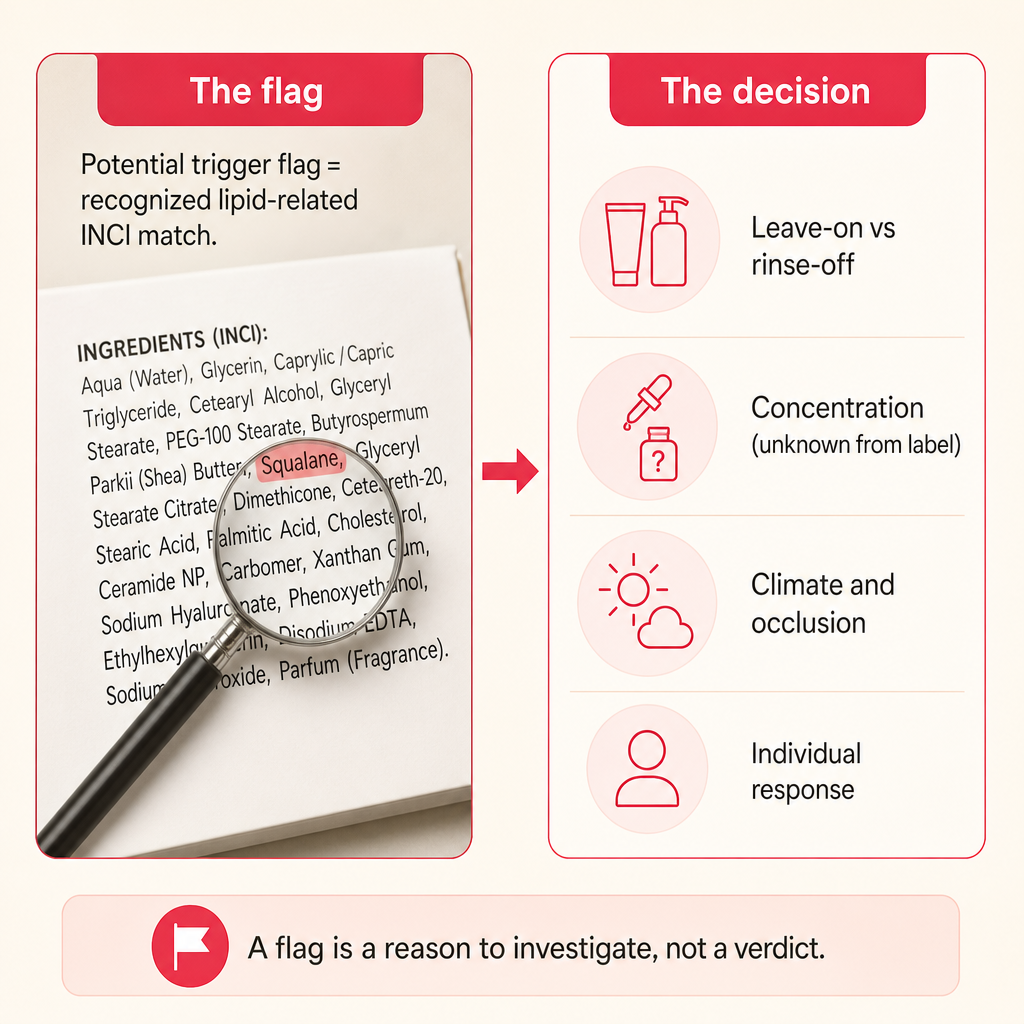
Squalane is a lightweight emollient that adds slip and reduces water loss. We currently display it as "often tolerated—verify individually." That phrasing is the whole point of this article in miniature. Someone may tolerate one squalane formula and react to another because of the broader ingredient blend, occlusion or an entirely different cause.
Fatty acids, esters and fatty alcohols can hide in a long list without the word "oil" ever appearing. They show up as emollients, texture modifiers, emulsifiers and stabilizers. One caution worth repeating: do not confuse fatty alcohols with drying alcohols. Cetyl alcohol, cetearyl alcohol and behenyl alcohol are fatty alcohols used for texture and emulsion stability. Ethanol and alcohol denat. are different ingredient types entirely. A fungal-acne screen and an irritation screen answer different questions.
Why Malassezia cares about lipids at all
Malassezia yeasts depend on external lipid sources. They cluster in sebaceous areas of the skin and interact with lipids through enzymes such as lipases. That dependence explains why oils, fatty acids and lipid-derived ingredients dominate fungal-acne screening discussions in the first place.
The mechanism is not "oil feeds fungus, so every oil is bad." Different Malassezia species behave differently, and a single laboratory observation does not establish that a finished product will cause a flare in normal use. Your skin barrier, sebum production, local humidity, how occlusive the product is, its concentration and your personal susceptibility all shape the result. DermNet lists high sebum production and occlusion from emollients and sunscreens among possible risk factors, alongside heat, humidity and sweating. Malassezia folliculitis also commonly appears as small, uniform itchy bumps or pustules, often without comedones, and it can mimic acne vulgaris, bacterial folliculitis or steroid acne. That overlap is precisely why an ingredient screen cannot confirm the condition.
What to check beyond the ingredient name
An ingredient flag is one input, not a decision. Five pieces of context do most of the work:
- Leave-on versus rinse-off. A moisturizer, sunscreen or styling product stays on skin far longer than a cleanser. A cleanser can contain a flagged ingredient yet be washed off quickly. That doesn't guarantee tolerance, but contact time genuinely matters.
- Concentration. Labels rarely disclose percentages. Ingredients near the top of an INCI list are usually present at higher amounts than those near the end, but the list can't reveal every concentration or the final effect on skin.
- The complete formula. A product with one potential trigger can still be tolerated. Equally, a product with no recognized flag can cause trouble if the trigger isn't in the database, the formula changed, the name didn't match, or the reaction has another cause.
- Occlusion and climate. Heavy, occlusive products often feel more problematic in hot, humid weather or on areas that sweat. Hair products, sunscreens, rich creams and makeup can also transfer to the forehead, hairline, neck or upper back.
- Other possible diagnoses. Uniform itchy bumps are not automatically fungal acne. The condition can resemble bacterial folliculitis, acne vulgaris and steroid acne, and it may coexist with ordinary acne or irritation. Persistent, spreading or recurrent symptoms deserve assessment by a qualified healthcare professional rather than an ingredient screen.
How to screen an INCI list and read the result
Our fungal acne ingredient checker is built as a first-pass Malassezia screen for cosmetic ingredient lists. The current free web checker accepts a pasted, comma-separated INCI list of up to 100 names, matches recognized names against current potential-trigger classifications, separates recognized matches from unmatched names, and shows labels such as potential trigger, not flagged or not found. It provides context for recognized ingredients, including fatty acids, oils, fatty alcohols, esters and related lipid-derived components.
One detail shapes how you should use it: the web checker is stateless. It analyzes the pasted list rather than connecting the result to any saved skin profile, and it does not produce a personal compatibility score. Its flags are informational screening data, not a diagnosis, a certainty of breakout, an individual safety determination or pregnancy clearance.
Here is a plain-language reading of each outcome:
| Checker result | What it means | What it does not mean |
|---|---|---|
| Potential trigger | The recognized INCI name matches a current Malassezia-focused caution class. | Proof the product will cause fungal acne. |
| Not flagged | No current trigger flag was found for that recognized ingredient. | A guarantee the product suits you or that every ingredient was identified. |
| Not found / unmatched | The name was not matched by the checker. | That the ingredient is safe, inactive or irrelevant. |
| Context-dependent | Classification depends on structure, use or available evidence. | That the ingredient is universally harmful. |
After a screen, use the Macherre cosmetic ingredient dictionary to review what an ingredient generally does, and when a product is in our skincare product catalog, inspect the actual formula rather than judging it from one line. Keep the intent straight, too: the pore-clogging checker looks for comedogenicity reference flags, while the seborrheic dermatitis checker addresses a related but separate screening question. A product can pass a Malassezia screen yet still feel too heavy, or carry a lipid-related flag without ever clogging a pore.
Should you avoid every oil and ester
Usually, no. Broad avoidance strips out useful emollients and makes a routine harder to tolerate, not easier. A more defensible approach is to read the full INCI list, note whether the flagged ingredient sits in a leave-on or rinse-off product, think about how that product behaves in your climate, and change one product at a time so you can actually tell what helped. Resist the urge to treat an ingredient classification as a prediction of your personal response, and seek clinical advice if bumps are persistent, itchy, painful or spreading.
When a product looks suspicious, comparing it against another formula is often more useful than chasing a product marketed as "fungal-acne safe." Our side-by-side comparison tool lets you line up two formulas and see where they actually differ, which tends to answer the real question faster than a label claim does.
Frequently asked questions
What are the main ingredients that trigger fungal acne?
The categories most often investigated are certain fatty acids, oils, esters, fatty alcohols and other lipid-derived ingredients. Coconut oil is one example currently flagged by our Malassezia screen. A flag signals potential relevance, not a guaranteed reaction.
Is squalane safe for fungal acne?
Squalane is not universally safe or unsafe. We currently label it "often tolerated—verify individually," so review the full formula and watch your own response instead of relying on a universal list.
Is fungal acne actually acne?
"Fungal acne" is an informal term for Malassezia folliculitis. It is not the same as acne vulgaris, though the two can look alike or occur together. Malassezia folliculitis often shows uniform, itchy follicular bumps and typically lacks comedones.
Can an ingredient checker diagnose fungal acne?
No. A checker can screen a cosmetic INCI list for potential trigger matches, but it cannot diagnose Malassezia folliculitis or confirm that a product will cause or prevent a flare. Diagnosis may require clinical assessment and, when appropriate, microscopy or other testing.
Does "not flagged" mean a product is fungal-acne safe?
No. "Not flagged" only means no current recognized flag was returned for that ingredient. Concentrations may be unknown, formulas change, names may not match, and individual responses differ.