Niacinamide vs Hyaluronic Acid: Which One Does Your Skin Actually Need?
You're standing in front of a wall of serums — or scrolling through a feed of them — and the same two ingredients keep showing up. Niacinamide. Hyaluronic acid. Both promise hydration. Both appear in every dermatologist-approved list. Both cost under twenty dollars in most drugstore lines. So the natural conclusion is that you grab both, layer them, and call it a routine.
That conclusion is wrong often enough to be worth interrogating. The niacinamide vs hyaluronic acid question isn't really about which one is "better" — it's about which one solves the problem your skin actually has right now. And the honest answer is that they solve completely different problems on completely different timelines.
A randomized trial in the International Journal of Cosmetic Science found 4% niacinamide reduces sebum excretion within 4 weeks. Separate clinical work published in the Journal of Clinical and Aesthetic Dermatology shows topical hyaluronic acid increases skin hydration by up to 96% over 8 weeks. Those are not equivalent ingredients dressed up in different bottles. They do different jobs, hit different targets, and disappoint you in different ways when you pick the wrong one.
This guide gives you a way to choose — not a both-are-amazing handwave.
Table of Contents
- Why These Two Ingredients Get Lumped Together
- What Niacinamide Actually Does Under Your Skin
- What Hyaluronic Acid Actually Does Under Your Skin
- Head-to-Head: When You Pick One, When You Stack Both
- How to Layer Them So They Actually Work
- Your Buying Checklist
Why These Two Ingredients Get Lumped Together (And Why That's Costing You Results)
The confusion is understandable. The niacinamide vs hyaluronic acid comparison is unavoidable because both ingredients keep showing up in the same routines, the same recommended-by-dermatologist lists, and the same "must-have for healthy skin" articles. Marketing copy uses identical words for both — plumping, hydrating, barrier-supporting, glow. If you've never opened a dermatology textbook, of course they read as interchangeable.
They aren't. The mechanism gap between them is enormous.
Hyaluronic acid is a humectant. It's a long sugar chain — a glycosaminoglycan — that physically binds water molecules. According to dermatologist Mona Gohara, MD, quoted in Women's Health, HA can hold "up to 1,000 times its weight in water." It does not change how your skin functions. It does not signal your cells. It adds water to the outer layers of skin and holds it there. That's the entire job.
Niacinamide is a bioactive form of vitamin B3. It penetrates the stratum corneum and acts as a signaling molecule — it tells your skin cells to produce more ceramides and free fatty acids, regulates how much oil your sebaceous glands pump out, and dampens inflammatory signaling. A review in Dermatologic Surgery documents niacinamide's role in increasing stratum corneum lipids and reducing transepidermal water loss. It doesn't add anything to your skin. It changes what your skin does.
Here's the analogy that makes this stick: hyaluronic acid is like watering a plant. Niacinamide is like improving the soil so the plant retains water on its own. Both are useful. But if your soil is the actual problem, no amount of watering fixes it long-term — you'll just keep watering forever.
The cost of choosing wrong is real and predictable:
- Buy HA when your real problem is excess oil and congestion, and you've spent money on a product that won't reduce a single breakout. Your skin will look momentarily plumper and still get shiny by 2pm.
- Buy niacinamide when your real problem is dehydration after a flight, a dry winter, or an over-stripped barrier, and your skin will still feel tight twenty minutes after application. You'll abandon it at week 3 thinking it doesn't work.
- Buy both without understanding the distinction and you'll build a seven-step routine that doesn't fix the one thing actually wrong with your face — because you treated symptoms in parallel instead of identifying the cause.
This problem gets worse the moment you stop thinking about ingredients and start thinking about formulas. A "niacinamide serum" might contain 5% niacinamide — or it might contain 0.5% niacinamide buried under fragrance, alcohol denat., and twelve filler ingredients. A "hyaluronic acid serum" usually lists three or four HA derivatives but no concentrations and no molecular weight data. The ingredient on the front of the bottle and the ingredient doing the work inside the bottle are not always the same thing. This is the gap that ingredient scanning closes — and it's why skincare for combination skin, where the wrong product reads as the right product, fails so frequently.
Hyaluronic acid waters your skin. Niacinamide changes how your skin holds water in the first place. They are not interchangeable — and treating them like they are is why most routines stall.
What Niacinamide Actually Does Under Your Skin (And Who Genuinely Needs It)
Niacinamide is a small, stable, water-soluble form of vitamin B3 that penetrates the stratum corneum and behaves more like a signaling molecule than a topical cosmetic. It's effective at low concentrations, well-tolerated even by sensitive skin types, and one of the few actives that holds up alongside almost any other ingredient in your routine. Here's what it's actually doing once it's on your face.
1. It regulates how much oil your skin makes.
A randomized controlled trial published in the International Journal of Cosmetic Science found that 4% niacinamide significantly decreased sebum excretion rate and casual sebum levels over 4 weeks in subjects with oily skin. The mechanism isn't surface-level — niacinamide influences sebaceous gland activity, reducing the volume of oil being produced in the first place. In plain language: less oil pumping out means less shine by midday, less congestion forming under the surface, and less of the "I cleansed at 7am and I'm greasy by lunch" cycle. This is niacinamide for oily skin doing its actual clinical job.
2. It strengthens your skin barrier structurally.
A study in Dermatologic Surgery using 2% niacinamide over 4 weeks showed increases in ceramide and free fatty acid levels in the stratum corneum, and decreases in transepidermal water loss (TEWL). Translation: niacinamide tells your skin cells to manufacture more of the natural lipids that hold the skin barrier together. A stronger barrier means less reactivity to weather changes, less stinging from active ingredients, and less of the random redness that flares for no obvious reason.
3. It calms redness and inflammation.
Dermatology authors at U.S. Dermatology Partners describe niacinamide as "a powerful anti-inflammatory" useful in rosacea, acne, atopic dermatitis, and pigmentary disorders. The mechanism is interruption of inflammatory cytokine signaling — visible redness typically softens within roughly 2 weeks of consistent use. This is the reason niacinamide for rosacea keeps showing up in dermatology-led recommendations even when stronger anti-redness actives exist.
4. It fades hyperpigmentation and evens tone.
A split-face trial published in the Journal of Cosmetic Dermatology found 4% niacinamide as effective as 4% hydroquinone for melasma after 8 weeks, with fewer side effects. Niacinamide blocks the transfer of melanosomes from melanocytes to surrounding skin cells — so existing pigmentation fades and new pigmentation forms more slowly. If your concern is post-acne dark spots, sun damage, or uneven tone, this is the mechanism that explains why niacinamide is one of the best skincare products for brightening recommendations.
5. It makes pores look smaller — but not the way the ads claim.
Be honest with yourself here: niacinamide does not anatomically shrink pore openings. Most "pore-shrinking" results come from reduced sebum filling and smoother surrounding skin texture, as documented in the IJCS sebum work and reviewed critically in the Journal of Dermatological Science. The visual improvement is real. The mechanism marketing claims — that the pore itself contracts — is not well-supported by imaging data. Marketing claims of dramatic shrinkage exceed what the clinical evidence actually shows.
Who genuinely benefits from niacinamide: oily skin, combination skin, acne-prone skin (including fungal acne, since niacinamide is Malassezia-safe), rosacea, post-inflammatory hyperpigmentation, and anyone using retinoids or exfoliating acids who needs help calming the irritation those actives produce. The effective niacinamide concentration range is 2–5%, per the Cosmetic Ingredient Review Expert Panel's assessment of leave-on products. Higher is not better — concentrations at or above 10% increase the risk of flushing and stinging, especially in rosacea-prone skin, without proportional clinical benefit.
What Hyaluronic Acid Actually Does Under Your Skin (And Who Genuinely Needs It)
Hyaluronic acid is a glycosaminoglycan — a long sugar chain — that already exists naturally in your skin, joints, and connective tissue. Topically applied, it sits in the stratum corneum and binds water. The EU Scientific Committee on Consumer Safety (SCCS) opinion on hyaluronic acid and sodium hyaluronate confirms it's endogenous to skin and well-tolerated across all cosmetic concentrations and molecular weights. Here's what hyaluronic acid benefits actually deliver, mechanism by mechanism.
1. It binds enormous amounts of water at the skin's surface.
The headline figure — HA holds up to roughly 1,000 times its weight in water — comes from dermatologist Mona Gohara, MD. Applied to damp skin, an HA molecule pulls and holds water into the outer skin layers. This is why your skin looks visibly plumper, smoother, and dewier within minutes of application. It's not a slow-build effect. It's a same-application visible change, which is part of why HA outsells almost every other hydration ingredient on the market.
2. It measurably increases skin hydration over time.
Clinical work in the Journal of Clinical and Aesthetic Dermatology shows topical HA produces skin hydration increases of up to 96% after 8 weeks. That's not just an instant surface effect — it's a cumulative change in stratum corneum water content. Your skin holds more water at week 8 than it did at week 1, assuming consistent use.
3. It softens the appearance of fine lines.
Hydrated skin cells expand slightly, filling out the surface. JCAD data shows wrinkle depth reductions of up to 40% with consistent HA use, depending on formulation and molecular weight. Be clear about what this is: a hydration effect, not a collagen-rebuilding effect. Stop using HA and the plumping fades within days. It's a real result, but a maintenance-dependent one.
4. Different molecular weights do different jobs.
This is the part most articles skip and the reason hyaluronic acid molecular weight matters when you're choosing a formula. Low-molecular-weight HA (~50–300 kDa) penetrates more deeply into the epidermis and influences fine lines and elasticity. High-molecular-weight HA (>1,000 kDa) stays on the surface, forming a film that reduces TEWL and creates that immediate plumping effect. The best formulas use multiple weights together. A serum that lists only "hyaluronic acid" with no molecular weight detail or no derivatives like sodium hyaluronate and hydrolyzed hyaluronic acid is a black box — you don't know what depth it's working at.
5. It boosts how well your other products work.
A hydrated stratum corneum absorbs subsequent actives more evenly. HA applied first creates the moisture base that helps niacinamide, peptides, and retinoids distribute and penetrate properly. Dermatologist Kristina Collins, MD, describes HA as the go-to when skin feels "dry, tight, or dull" — exactly the conditions that also reduce how well your other treatments work.
Who genuinely benefits from HA: dry skin, dehydrated skin (even oily skin can be dehydrated — the two are not opposites), sensitive skin, mature skin, anyone with a compromised barrier from over-exfoliation, and anyone in low-humidity climates, air-conditioned offices, or frequent-flyer territory. This is hyaluronic acid for dry skin at its most useful. Effective use levels sit at 0.1–2% depending on molecular weight, per JCAD formulation data. Higher than 2% gets sticky without proportional benefit.
The catch — and this is where most HA users go wrong — is that HA must be applied to damp skin and sealed with a moisturizer or occlusive. Applied to dry skin in low humidity with nothing on top, HA can pull water from the deeper skin layers upward and worsen dehydration, according to U.S. Dermatology Partners. This is the single most common HA mistake and the reason "HA didn't work for me" reviews exist in such volume.

Head-to-Head: When You Pick One, When You Stack Both
The "use both" answer is lazy. Sometimes one ingredient is genuinely more important and the other is optional. Sometimes both are essential but only when applied in the correct layers. The table below maps the most common skin scenarios to a clear priority for the niacinamide vs hyaluronic acid decision. The stars indicate priority weight, not a rating — the higher-star column tells you which ingredient to spend on first when budget or routine simplicity matters.
| Your Primary Concern | Niacinamide Priority | Hyaluronic Acid Priority | Stack Both? |
|---|---|---|---|
| Oily + congested skin | ★★★ | ★ | Only if also dehydrated |
| Dry + tight skin | ★ | ★★★ | Yes |
| Combination (oily T-zone, dry cheeks) | T-zone | Cheeks | Yes, zoned |
| Acne-prone, inflamed | ★★★ | ★★ | Yes |
| Rosacea / persistent redness | ★★★ | ★★ | Yes, gently |
| Fungal acne / seb dermatitis | ★★★ | ★★ | Yes, with caution |
| Hyperpigmentation / melasma | ★★★ | ★ | Optional |
| Mature skin / fine lines | ★★ | ★★★ | Yes |
| Sensitive / compromised barrier | ★★ | ★★★ | Yes |
A few patterns repeat across these rows, and they're worth surfacing because they're how you make this decision for any concern not listed.
Niacinamide wins when the problem is the skin's behavior. Oil overproduction, inflammation, pigment formation, weak barrier output — these are functional problems. Your skin is doing something it shouldn't, or not doing something it should. HA cannot fix a function it doesn't touch. This is the answer to niacinamide or hyaluronic acid for oily skin in nine cases out of ten.
Hyaluronic acid wins when the problem is the skin's water content. Tightness, flakiness, dullness, fine lines that look worse when you haven't slept — these are hydration problems, not function problems. Niacinamide will support hydration eventually, via barrier repair, but it won't put water into your skin tonight. Hyaluronic acid for dehydrated skin is genuinely the faster, more direct answer.
The "use both" cases share a clear pattern: the skin has both a functional issue and a hydration issue at the same time. Inflamed acne being treated with drying actives. Mature skin losing both plumpness and barrier output. Rosacea complicated by chronic dehydration. In these cases the two ingredients are not redundant — they're sequential. HA goes on damp skin first to hydrate; niacinamide layers on top to reprogram.
Combination skin should think in zones rather than full-face compromise. A single all-over product matched to your dry cheeks will under-treat your shiny T-zone; matched to your T-zone, it will leave your cheeks tight and flaky. The practical fix is zoning — HA-richer layers on cheeks, niacinamide-led products overall, with occlusive moisturizer concentrated on the dry zones. The same logic underlies any skincare for combination skin approach that actually works in practice rather than only on paper.
Fungal acne is more nuanced than the internet usually says. The standard warning is that HA "feeds fungal acne," but that's not quite accurate. Pure hyaluronic acid is not a lipid substrate for Malassezia — the yeast that drives fungal acne hyaluronic acid anxiety. According to the Journal of Dermatological Science on Malassezia ecology, the actual risk comes from what's bundled with HA — fatty acid esters, certain plant oils, lanolin, and creamy occlusives commonly used to make HA serums feel luxurious. A clean, water-based HA serum is generally fine. A creamy HA moisturizer often isn't. This is exactly the kind of formulation-level distinction that ingredient scanning solves — and exactly the reason the ingredient on the bottle is less important than the rest of the formula.
If your skin's problem is how it behaves, niacinamide is the answer. If your skin's problem is how much water it's holding right now, hyaluronic acid is the answer. The mistake is treating these as the same problem.
How to Layer Them So They Actually Work (The Application Mistakes That Waste Both)
Both ingredients work — but only if you use them right. Most "this didn't work for me" stories come down to two specific errors: applying HA to dry skin in a dry room, and stacking niacinamide so high it triggers flushing. The application order below respects how each ingredient actually behaves, and it's the answer to how to layer niacinamide and hyaluronic acid without wasting either one.
Step 1: Cleanse, then stop towel-drying too soon.
HA needs water to bind. Pat your skin so it's damp — not dripping, not dry. You have roughly 30 seconds of usable dampness before evaporation kicks in and your face is dry again. If you cleanse and then walk around for two minutes deciding which serum to use, you've already lost the application window. The dampness is the active ingredient as much as the HA is.
Step 2: Hyaluronic acid goes on first.
Apply HA serum to damp skin in a thin layer. Two or three drops, pressed in rather than rubbed. This is when the molecule binds water — from your skin's surface dampness and from ambient humidity around you. Dermatology sources, including Women's Health and U.S. Dermatology Partners, consistently confirm this application order. Skip the damp-skin step and HA may pull water from your deeper skin layers upward, leaving you more dehydrated than you started. That single mistake — hyaluronic acid damp skin ignored — accounts for most of the negative reviews you'll read on any HA product.
Step 3: Niacinamide layers next.
Apply niacinamide serum or treatment after HA absorbs — about 60 seconds. Niacinamide doesn't need damp skin, doesn't care much about pH, and is compatible with most other actives. The long-standing internet myth that niacinamide and vitamin C cancel each other out is not supported by current formulation research. Modern technical reviews, including CIR's niacinamide assessment and reviews in the Journal of Dermatological Science, indicate the two are stable and compatible at the pH ranges used in actual cosmetic products. The original concern came from extreme-temperature, extreme-pH conditions that don't exist in your bathroom. Niacinamide also plays well alongside retinol and AHAs/BHAs — in fact, it often offsets the irritation those cause.
Step 4: Seal the deal with a moisturizer or occlusive.
This is non-negotiable for HA. Without an occlusive on top, the water HA bound starts evaporating, and in low-humidity environments the entire effect reverses on you within an hour. A ceramide-containing moisturizer is ideal because ceramides reinforce niacinamide's barrier work — you're stacking two complementary mechanisms instead of one. If your skin is very dry, an oil or balm on top of the moisturizer locks it down further. The same logic applies when you prep skin for makeup — sealing hydration is the difference between makeup that sits well and makeup that grabs onto dry patches by hour three.
Step 5: Match your patience to the ingredient.
HA gives you visible plumpness in minutes and measurable hydration improvement over 2–8 weeks. Niacinamide is slower. Redness and sensitivity improvements show up around 2 weeks. Sebum control, hyperpigmentation fading, and texture changes typically need 4–8 weeks of consistent use to become visible — that timeline holds across the IJCS sebum trial, the Journal of Cosmetic Dermatology melasma work, and the Dermatologic Surgery barrier study. If you abandon niacinamide at week 3 because "nothing's happening," you stopped one week before the clinical data says it was supposed to start showing.
The mistakes to avoid:
- Buying a niacinamide product at 10%+ thinking more is better — irritation risk goes up without efficacy gain, per the CIR assessment and U.S. Dermatology Partners
- Using HA without a moisturizer on top in winter or in air-conditioned environments
- Skipping niacinamide because you "already use vitamin C" (they coexist fine at the pH levels used in real products)
- Choosing a sticky 5% HA serum thinking it'll outperform a properly formulated 1% — stickiness is not the same as efficacy
Hyaluronic acid applied to dry skin in a dry room can dehydrate you. Niacinamide stacked above 5% can flush you. Both ingredients fail the same way — when "more" replaces "right."
Your Buying Checklist: Pick the Right Bottle, Not the Loudest Marketing
The bottle in your hand right now is almost certainly not just niacinamide or just hyaluronic acid — it's a formula containing 15 to 25 ingredients, and the active you bought it for may or may not be present at a concentration that actually does anything. Use this checklist before you spend money. Each box you check brings you closer to a product that works on the timeline its clinical evidence supports.
Buy NIACINAMIDE first if you can check 3 or more of these:
- My skin is shiny by midday or I have visible congestion
- I have persistent redness, rosacea, or post-acne dark spots
- I'm using a retinoid or exfoliating acid and need help with irritation
- I have fungal acne or seborrheic dermatitis (niacinamide is safe across both)
- My budget allows one bioactive and I want one that changes how my skin behaves
Buy HYALURONIC ACID first if you can check 3 or more of these:
- My skin feels tight or looks dull within an hour of cleansing
- I see fine lines that look worse when I'm tired or dehydrated
- I live in a dry climate, run heating/AC, or fly often
- My barrier is compromised from over-exfoliation or stripping cleansers
- I want a visible result tonight, not in 6 weeks
Buy BOTH if:
- I checked 2+ boxes in each list above
- I'm willing to apply them in the correct order (HA on damp skin first, then niacinamide, then moisturizer)
- My routine includes actives that benefit from both inflammation control and hydration
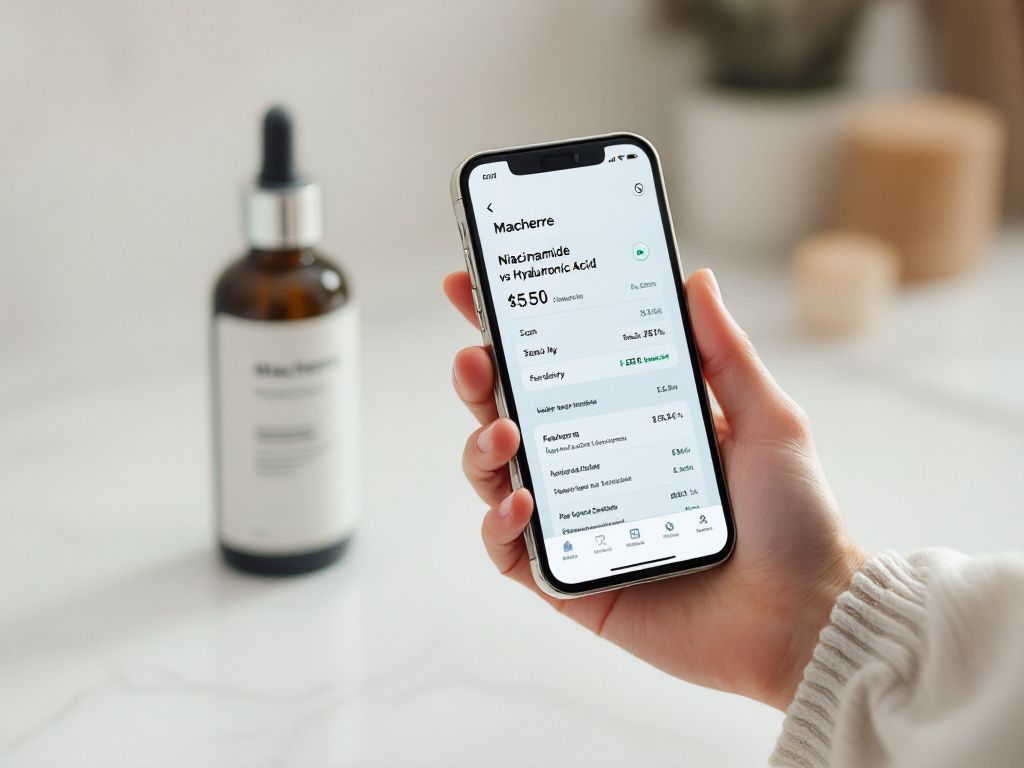
Before you tap "buy," run this 4-step check:
1. Scan the product. A 5% niacinamide claim on the front of the bottle means very little if niacinamide is the 12th ingredient on the back. A scanner-based ingredient breakdown shows you where each active sits in the list and flags products where the headline ingredient is present at concentrations too low to do anything clinically meaningful. The front-of-bottle claim and the actual formula are different documents.
2. Verify the concentration. For niacinamide, the niacinamide concentration target is 2–5% — the CIR Expert Panel's reviewed-and-safe range for leave-on products, and the same range supported by efficacy trials. For HA, the hyaluronic acid percentage target is 0.1–2%, and you also want a formula that uses multiple molecular weights rather than a single one. A formula that says "hyaluronic acid" once on the ingredient list with no derivatives (sodium hyaluronate, hydrolyzed hyaluronic acid, sodium hyaluronate crosspolymer) is working at only one depth, no matter what the marketing claims.
3. Check for clashes in your existing routine. A clash detector flags whether your new product conflicts with what you're already using — for example, a niacinamide treatment formulated at low pH alongside a retinoid you applied 10 minutes earlier, or an HA cream paired with an occlusive that triggers fungal acne flares. This is where most routines silently fail: not because any single product is bad, but because two reasonable products fight each other in the same routine.
4. Filter reviews by your skin type. A five-star niacinamide serum review from someone with dry skin tells you almost nothing if your skin is oily and acne-prone. Reviews filtered by skin type, sensitivities, and concerns are the only reviews actually relevant to your decision — and they're the reason a 3.5-star average for someone with rosacea-prone skin can still be the right product if the rosacea reviewers are giving it five stars. The same filtering logic applies to the best skincare products for brightening — a brightener that wrecks dry skin can still be the right call for an oily, hyperpigmentation-focused user.
The best skincare ingredient is not the trendy one, the expensive one, or the one with the most viral videos behind it. It's the one that solves what your skin is actually doing wrong — and proves it within the timeline that ingredient's clinical evidence supports. Niacinamide will not hydrate you tonight. Hyaluronic acid will not regulate your oil in six weeks. Buy what fits the problem. Use what fits the rules. Verify what fits the formula. The bottle that does all three is the one worth your money — and it's almost never the one with the loudest label.