Privacy-First Skincare Apps Compared
A privacy first skincare app should help you understand cosmetic ingredients without asking for more personal information than a feature actually needs. That sounds obvious, but it is where most scanner tools quietly diverge. Pasting an INCI list into a web checker only needs the list itself. Saving products, scanning barcodes, building a routine, or tailoring guidance to your skin type needs an account and, usually, a profile. The honest question when you compare apps is not which one has the biggest product database or the boldest score. It is which one gives you useful formula information, explains what that information means, and makes its data practices easy to understand.
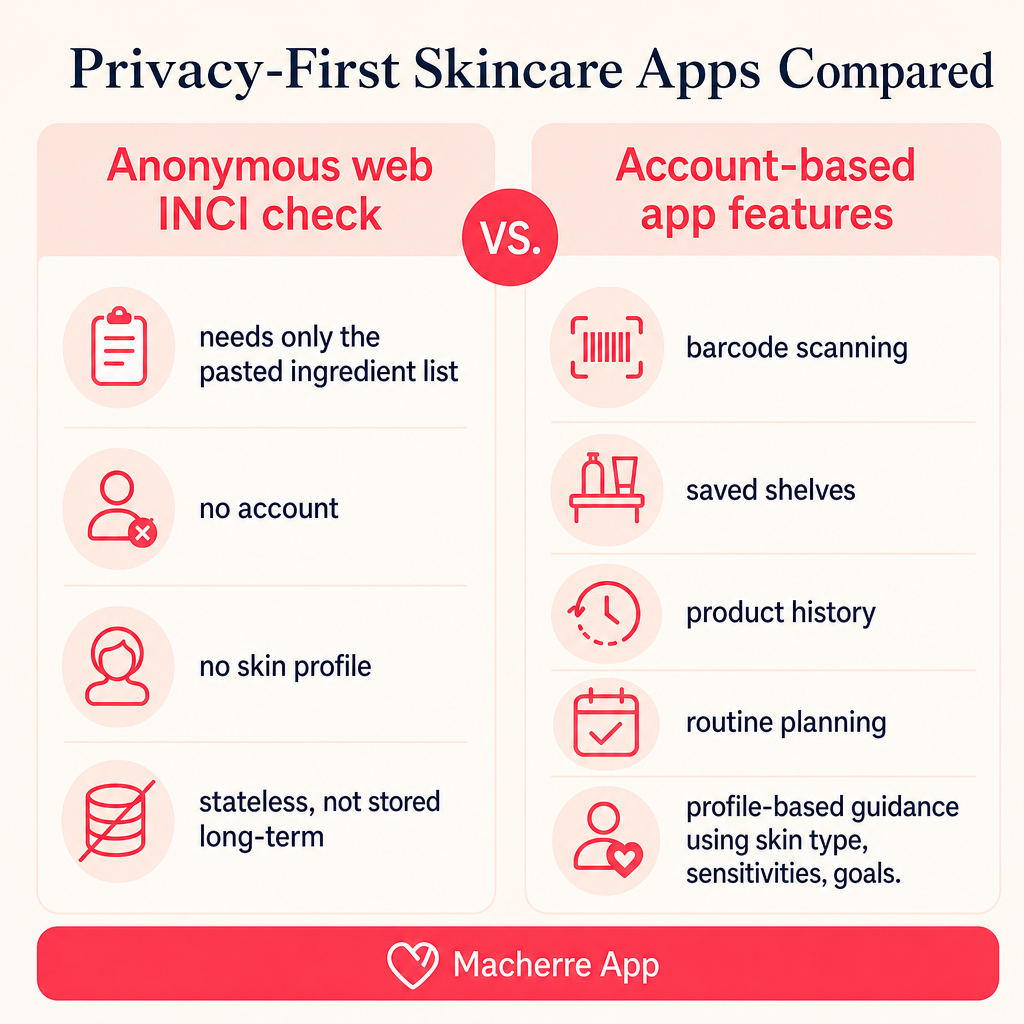
We built Macherre around that split on purpose. Our free web ingredient checker is a stateless lookup for cosmetic INCI lists: paste a comma-separated list, get per-ingredient matches with plain-language functions, comedogenicity, irritancy, and functional categories, no signup and no profile attached. Persistent features like saved shelves, barcode scanning, product history, comparisons, and routine planning live in the app, where creating an account is a deliberate choice. This guide walks through how to judge any skincare app on privacy grounds, why ingredient analysis genuinely works without a skin profile, and where the line sits between a helpful screening flag and a medical claim.
Table of contents
What "privacy-first" actually means in a skincare app
"Privacy-first" is not a certification anyone issues or a badge you can trust at face value. It is a design claim, and a claim is only worth as much as the behavior you can observe. So instead of taking the phrase on trust, test it against questions you can actually answer by using the tool.
For a skincare or cosmetics app, the useful questions cluster around what the feature truly requires. Can you inspect an INCI list without creating an account? Is a pasted ingredient list tied to your identity or skin profile, or does it vanish after the lookup? Which features genuinely need saved personal data, and which merely ask for it? Can you use barcode scanning without handing over permissions the feature does not need? Are skin type, sensitivities, allergies, and routine history stored, and if so, can you delete them? Does the service explain how long it keeps anything, and does it separate educational ingredient screening from anything resembling medical advice?
These are not arbitrary. They map onto established data-protection principles. The European Commission describes data minimisation as collecting only the personal data necessary for a stated purpose, and recommends clear, plain-language information about how data is processed.
A privacy-first skincare app keeps anonymous ingredient interpretation separate from optional personalisation wherever the feature allows it.
That separation is the practical heart of the idea. Personalisation is not the enemy of privacy. Collecting profile data for a feature that would work fine without it is.
Why cosmetic INCI analysis works without a skin profile
It can feel counterintuitive that a tool could tell you something useful about a product without knowing anything about you. The reason is that the useful information lives in the label, not in your personal data.
Cosmetic products generally carry an ingredient declaration, and under U.S. cosmetic-labeling rules those ingredients are normally listed in descending order of predominance. That ordered list gives a checker everything it needs to identify each ingredient, name its commonly recognised function, and surface reference flags. So a checker can answer real questions: what is this ingredient usually used for, is it a humectant or an emollient or a preservative or a surfactant, does reference data associate it with comedogenicity or irritancy, is it hiding in the database under a synonym, and is the formula worth investigating further for a concern you already have. None of that requires your name, your skin type, or your medical history.
Our free web checker works exactly this way. It accepts a comma-separated cosmetic INCI list and returns per-ingredient matches with plain-language functions, comedogenicity, irritancy, and functional categories. It is free, requires no signup, and runs as a stateless lookup that is not tied to a profile. That makes it well suited to a quick, low-data formula check while you shop. What it deliberately does not do is hand back a personal compatibility score from that pasted list, because a score tuned to you would require knowing something about you.
Ingredient lists have their own limits too. Items near the top are generally present in greater proportion than those further down, but a label does not reveal every concentration, manufacturing variable, or how a finished formula behaves on a specific person. The FDA notes that cosmetic ingredients are not generally pre-approved before marketing, apart from certain color-additive rules, and that companies remain responsible for product safety under labelled or customary use. In other words, a label is a strong starting point for interpretation, not a safety verdict.
How to judge a skincare app against privacy criteria
The fastest way to compare apps is to score each one against the task you actually need done, then check how much data it demands to do it. The table below lists the criteria worth verifying in any skincare app, next to how our own web and app experience currently behaves.
| Decision criterion | Why it matters | How Macherre currently works |
|---|---|---|
| Anonymous INCI checking | Lets you investigate a formula without creating a personal record | Our free web checker needs no signup and runs as a stateless lookup |
| Per-ingredient explanation | Helps beginners read a label instead of trusting one verdict | The checker explains each matched ingredient's function, category, comedogenicity, and irritancy |
| Web and app kept separate | Stops an anonymous lookup from silently creating a profile | The web tool is for pasted INCI; saved scans, shelves, barcode scans, and routines live in the signed-in app |
| Personalisation controls | Skin type and sensitivities are more personal than an ingredient list | Profiles, saved products, and routine features are app functions, not part of the anonymous web result |
| Data minimisation | A feature should not demand profile data it does not need | The web checker keeps a stateless INCI lookup apart from persistent app features |
| Stated limits | A flag is not proof a product will or won't cause a reaction | Our ratings do not account for concentration, the full formulation, or individual skin |
The distinction to hold onto is that privacy-first does not mean feature-free. Barcode scanning, shelves, comparisons, and routines are all genuinely useful. Privacy-first simply means those persistent or sensitive features should be optional, purposeful, and transparent rather than switched on by default.
What our free web checker does and does not do
It helps to be precise about the web checker, because its value comes partly from what it refuses to pretend. Treat it as a cosmetic ingredient interpretation tool, not a full personal assessment.
It can match individual names from a pasted INCI list, collapse recognised synonyms into a single canonical entry, explain common functions in plain language, show reference comedogenicity and irritancy scales, group ingredients into functional categories, and point you toward deeper detail in the ingredient dictionary. It works across skincare, makeup, haircare, body care, lip products, and sunscreen, since all of them carry INCI lists.
What it cannot establish is just as important. It cannot tell you whether a product is safe for you specifically, whether it will cause a breakout, whether you have an allergy or a skin disease, or whether a product is suitable during pregnancy. It does not know the exact concentration of every ingredient or how the complete formula will behave on your skin. Those are not gaps we are hiding; they are the natural boundary of reading a label. Use the checker to investigate a formula, and treat a reference flag as a reason to look closer, never as a medical conclusion.
Why a single compatibility score needs more data
A single compatibility score is genuinely handy inside the app, especially once you have chosen to create a profile and want guidance shaped by your skin type, sensitivities, and goals. It compresses a lot of ingredient reasoning into one number you can compare across products. That compression is the point, and also the catch.
A score is an interpretation, so it should be read as informational data rather than a diagnosis, a guarantee that breakouts will or won't happen, proof of individual safety, pregnancy clearance, or a substitute for a dermatologist. And because the score reflects you, producing it requires processing information about you. An app cannot tailor a result to your skin profile without storing some profile data. That is not inherently a privacy problem; it becomes one only when you are not told what is kept and why. The sensible pattern is to start with the formula itself for a low-data decision, and opt into profile-based scoring when the personalisation is worth the trade.
Screening specialised concerns without confusing them
One quiet privacy and accuracy trap is mixing up different screening purposes. The same formula can earn different flags depending on the question you ask, so keeping those questions separate matters.
We run distinct checks for distinct concerns. The fungal acne checker flags potential Malassezia-trigger matches, which is screening, not a diagnosis of fungal acne. The seborrheic dermatitis checker surfaces potential trigger flags for that specific concern, and it should never be read as proof a product causes or treats seborrheic dermatitis. The pore-clogging checker highlights ingredients carrying comedogenicity references, but it cannot predict whether a finished product will clog your pores.
Each of these is most useful as a filter that narrows what to investigate next. Read the result alongside the full formula, whether the product is leave-on or rinse-off, how much you use, and your own history. For persistent irritation, suspected allergy, eczema, rosacea, acne, or seborrheic dermatitis, a clinician is the right call, not an app flag.
Choosing the least data-intensive tool for the job
The cleanest way to protect your data is to match the tool to the task and stop there. Picture deciding between two moisturisers. You can copy both INCI lists into an anonymous checker first. The result might show that one contains more fragrance components, that both lean on humectants, or that one carries an ingredient with a higher comedogenicity reference. That alone can narrow your choice without revealing anything about your skin. If you then want to save both, view them side by side, or slot a winner into a routine, an account starts to earn its keep.
A quick way to decide which layer you need:
- Reach for the anonymous web checker when you only want to decode a list, you are shopping without needing saved history, or you want a fast explanation of unfamiliar INCI names and their reference flags.
- Reach for the app with an account when you want to scan barcodes, save products to shelves, compare the same items repeatedly, organise a multi-step routine, or get guidance that draws on your skin profile and goals.
- Favour transparent interpretation over a bigger list by preferring a tool that explains how its flags are produced, separates ingredients from finished products, acknowledges concentration and formulation limits, and tells you what happens to pasted or saved data.
That last point is where a comparison usually gets decided. A large product database helps you find a formula. Transparent interpretation helps you understand what the result means, and a comedogenicity reference still does not prove a product will break you out, just as the absence of a flag does not guarantee it will suit you. When you are ready to move from reading about ingredients to inspecting a real label, our free ingredient checker is the place to start.
Frequently asked questions
What is a privacy first skincare app?
A privacy-first skincare app collects only the data a feature needs, explains what it stores, and keeps anonymous ingredient analysis separate from optional personal features. It should also be honest about the limits of cosmetic screening rather than presenting flags as medical certainty.
Can I use Macherre without creating an account?
Yes. Our free web ingredient checker accepts a pasted cosmetic INCI list without signup and returns per-ingredient information. It runs as a stateless lookup that is not tied to a skin profile.
Does the web checker give a personal compatibility score?
No. The web checker returns ingredient matches, functions, categories, comedogenicity, and irritancy information. A personalised compatibility score depends on a skin profile, which lives in the app rather than the anonymous web tool.
Are Macherre's scores medical or diagnostic?
No. Scores and flags are informational screening data. They do not diagnose acne, eczema, rosacea, fungal acne, or seborrheic dermatitis, and they do not guarantee individual safety or predict breakouts.
Can I check makeup and sunscreen, not just skincare?
Yes. Cosmetic INCI analysis also works for makeup, haircare, body care, lip products, and sunscreen. Keep in mind that leave-on and rinse-off products can behave differently on skin, so read results in that context.