What a Skincare Ingredient Scanner App Really Does
A skincare ingredient scanner app takes the confusing, technical ingredient list on a bottle and turns it into a clear buy-or-skip decision for your skin. Instead of staring at a wall of Latin names, you get two things at once: a plain-language explanation of what every ingredient does, and a single compatibility score tuned to your skin type, conditions, and goals. In Macherre, that is the whole point—we read the label so you don't have to translate chemistry before you shop.
The decision underneath every purchase is deceptively simple: will this formula help your skin, hurt it, or do nothing? That is the gap a good scanner closes, and it is where we focus.
Table of contents
What a skincare ingredient scanner app actually is
At its core, a skincare ingredient scanner app is a diagnostic layer on top of product labels. It reads the full INCI list—the ingredient list printed on the packaging—matches each name against a structured database, and returns human-readable explanations of what every ingredient is, what it does, and where it might cause trouble.
Our ingredient checker does exactly this, then goes one step further. It accepts the full list from any cosmetic or skincare product, cross-references each ingredient against our in-app dictionary, and returns two outputs together: individual ingredient explanations and a single compatibility score built around your own skin profile. Rather than a generic pass/fail, that score weighs your skin type—oily, dry, combination, normal, or sensitive—alongside specific conditions such as fungal acne or seborrheic dermatitis, plus your personal sensitivities and goals.
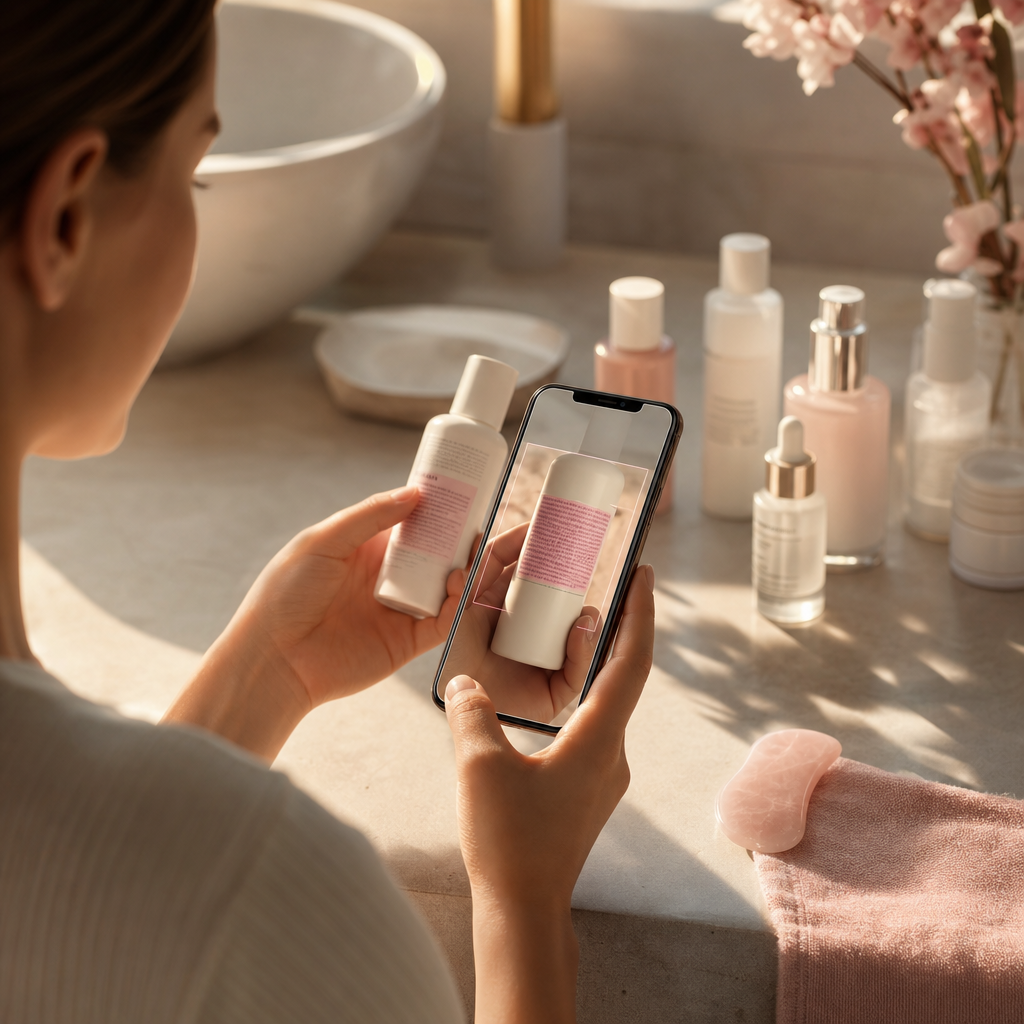
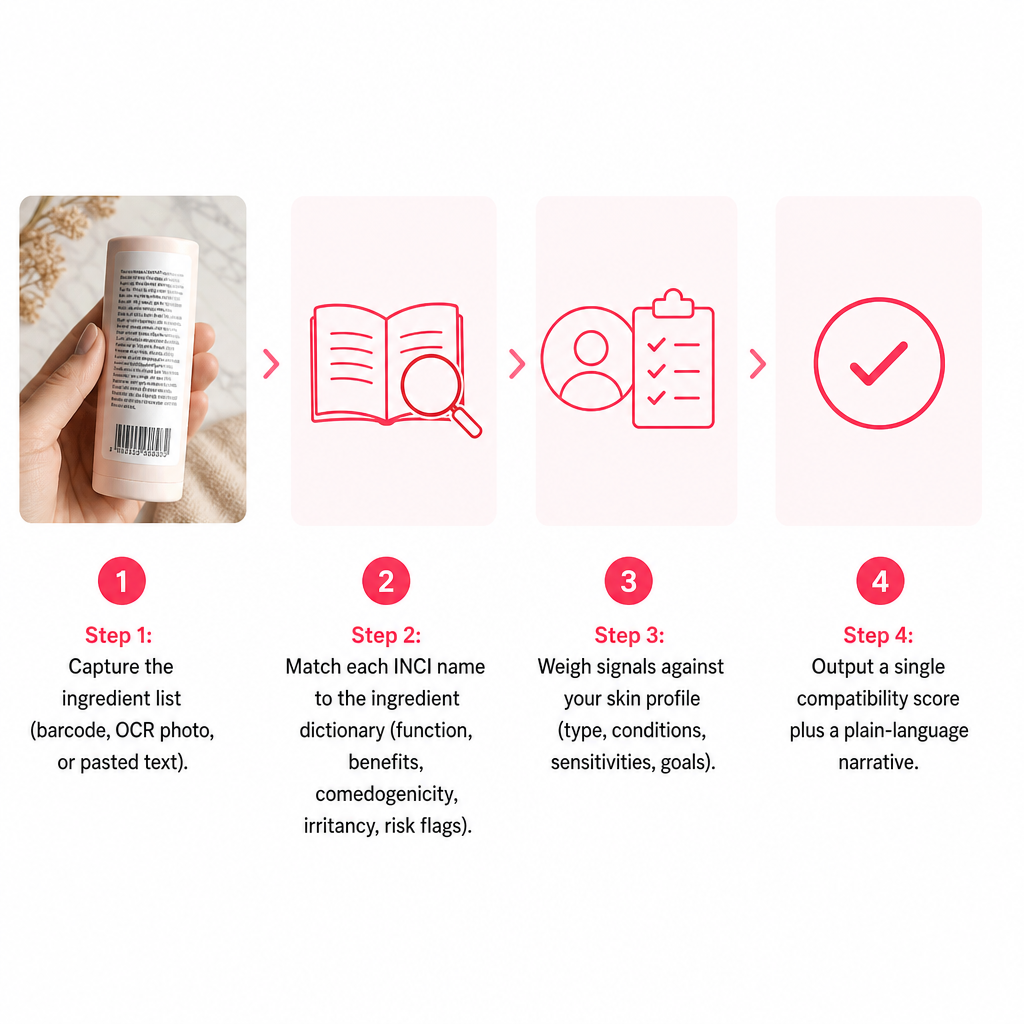
There is no single way you have to feed a product in. You can scan a barcode with our cosmetic barcode scanner to pull a product record and its full analysis in seconds. You can paste a comma-separated ingredient list into the online checker to decode something that isn't in the database yet. Or you can use the camera and OCR inside the app to capture a label and convert it into a readable, analysable list. All three paths land on the same place: a per-ingredient breakdown and a compatibility score.
Why scan instead of just reading the label
When you pick up a product, three questions sit underneath the purchase. What is this formula actually doing for my skin? Is anything in here likely to cause problems for my specific skin type and conditions? And does it make sense alongside everything else I already use?
Most shoppers can't answer those from the label alone. Ingredient lists mix functional ingredients like emollients, surfactants, and preservatives with marketing actives such as vitamin C, niacinamide, and retinoids, then quietly fold in potential triggers—certain fragrances, specific fatty acids, drying alcohols—all in one long string of technical names. The order carries information, the names rarely look like what they do, and nothing on the packaging tells you whether a flagged ingredient is a real concern for you or a non-issue.
Our scanner sits between you and that complexity. It converts the list into a narrative that explains what supports your skin, what may push back, and how serious each concern actually is, then compresses the whole picture into one score: likely a good fit, marginal, or a poor match. For beginners, that replaces guesswork with a clear recommendation. For enthusiasts, it turns ingredient research from an hour of manual cross-checking into a few seconds of structured analysis. If you want the longer walkthrough, we cover it in how our ingredient checker works.
How the scanner works under the hood
Reading and structuring the list
The app first needs the formula. A barcode scan matches the product to a stored record and pulls its INCI list. Manual input lets you paste a comma-separated list from a retailer page or the label. Image capture uses OCR to turn a photo of the ingredient panel into text. Commas and order matter here: each comma-separated item is treated as a distinct INCI name, and the original sequence of the formula is respected, because order hints at how much of each ingredient is present.
Once captured, every name is matched against our ingredient dictionary. That dictionary ties each recognised ingredient to its function in the formula—emollient, surfactant, humectant, preservative—along with its benefits and common use cases, signal scores such as comedogenicity and irritancy, and known risk flags like fungal-acne triggers where current data supports them.
Turning ingredient data into signals
For each ingredient, a few signals surface. Comedogenicity and congestion risk come from our pore-clogging checker, which flags ingredients associated with blackheads, whiteheads, and comedonal acne, then rolls those findings into the product's overall score. Irritancy potential is highlighted so sensitive-skin users can spot likely triggers faster. Fungal acne risk comes from screening the list against current Malassezia trigger classifications as a first filter. On top of that, ingredients are tagged with condition-specific traits—barrier support, oil control, brightening, soothing—so they can be matched against what you are trying to achieve.
Connecting signals to your skin profile
This is the part that separates a personal scanner from a generic one. Signals are interpreted through your profile, not an abstract average. We combine your skin type, your conditions and concerns—acne, fungal acne, seborrheic dermatitis, rosacea, hyperpigmentation, eczema, redness—and the ingredients you personally prefer to avoid.
Those inputs decide how heavily each signal counts. A borderline comedogenic emollient may be perfectly fine for dry, non-acne-prone skin, but gets down-weighted sharply for someone prone to clogged pores. A potential Malassezia trigger might be a mild note for a user with no fungal acne history and a significant red flag for someone actively managing it. The same ingredient, different weight.
Distilling it into a score and narrative
The final step is summarisation. We weigh every ingredient-level signal—function, benefits, comedogenicity, fungal-acne risk, irritancy—against your profile to produce a single compatibility score and a narrative explaining which ingredients support your goals, which may push back, and how serious each concern is in context. The score is deliberately not a universal grade: the same product can score differently for two people because it is tuned to individual profiles. If you want the scoring logic in more depth, we break it down in how a compatibility score works.
How to read and use your scan results
A scanner is only as useful as your ability to read it. Three habits make the output genuinely decision-ready.
First, read the compatibility score before the raw flags. Pore-clogging, fungal-acne, and irritancy flags can look alarming in isolation, but they are designed to be read in the context of the score, not as standalone verdicts. The score tells you whether the product is broadly compatible, whether a flagged ingredient is minor, moderate, or major, and whether something might still be fine in limited use—an occasional spot treatment, say—versus a clear skip. This keeps you from over-reacting to a single ingredient that is benign at low concentration or harmless for your skin type.
Second, match the formula to your goals, not just your fears. The narrative highlights support as well as risk: what hydrates, brightens, soothes, or protects, next to what might clog or irritate. A product that scores well and carries strong actives aligned with your goals—antioxidants, barrier-supporting lipids, gentle exfoliants—can be far more valuable than a "clean-looking" formula that does nothing. Our product comparison tool lines up shared and unique ingredients side by side so you choose on formula quality rather than marketing. And if something looks promising but sits slightly off your profile, the dupe finder surfaces similar formulas that fit your skin—and your budget—more comfortably.
Third, consider routine fit and clashes. A product that looks good alone can still disrupt a balanced routine. Our routine builder applies the same ingredient-level data and compatibility logic to spot when you are doubling up on strong actives like acids or retinoids, combining potential irritants more often than your skin tolerates, or layering products that are individually fine but collectively drying or congesting. That shifts the question from "is this product okay?" to "does this product belong in my routine, with everything else I'm already using?"
Risks, limits, and common misconceptions
A scanner is a strong guide, not a replacement for medical care or for watching how your skin actually behaves. We position tools like the fungal acne checker as a first filter, not a diagnosis or a guarantee, and a few limits are worth keeping in mind.
Databases are extensive but not omniscient. New ingredients, proprietary blends, and rare actives may not have mature signal data yet; unmatched names are separated and shown transparently rather than quietly ignored. Presence is also not the same as concentration—an ingredient that carries risk at high levels might appear only in trace amounts, which is why the score and narrative weigh overall formula context instead of reacting to any single name. Individual reactions still vary, too: a highly compatible product can occasionally irritate, and a lower-scoring one can suit someone else, because this guidance is probabilistic rather than absolute. Finally, medical conditions need proper diagnosis. Screening for fungal acne or seborrheic dermatitis triggers helps you choose products; it does not substitute for a dermatologist. You can explore condition-specific screening with our seborrheic dermatitis trigger checker as a product-selection aid, not a clinical verdict.
Used well, a scanner cuts avoidable risk and confusion. Pair it with patch testing, gradual introduction, and honest attention to how your skin responds over a few weeks.
Why our scanner works differently
Macherre is an independent, privacy-first skincare and cosmetics platform, and that stance shapes how the scanner behaves. Every product you look up resolves into both a per-ingredient breakdown and a single compatibility score, so the analysis is quick to skim yet detailed enough to trust. The whole thing is built around your skin profile, conditions, and sensitivities instead of blanket "safe" or "unsafe" labels, which makes it far more useful if you are managing acne, fungal acne, rosacea, eczema, or seborrheic dermatitis.
The barcode scanner mode is built for real-world shopping—scan a product, see its ingredient-based analysis, and check your personal fit while you're standing in the aisle. And because comparison, routine building, dupe finding, and the specialised checkers all sit on the same ingredient backbone, the guidance stays consistent across everything you use. The result isn't just a scanner but a decision system: labels and product details become personalised, context-aware recommendations about what belongs on your skin and in your routine.
Frequently asked questions
What is a skincare ingredient scanner app in simple terms?
It's an app that reads a product's full ingredient list, matches each ingredient to a database, and explains in plain language what every component does and where it might cause trouble—so you can decide without a chemistry background.
How is our scanner different from basic ingredient-checker websites?
We do the same decoding step, then connect the analysis to your personal skin profile and distil it into a single compatibility score and narrative, rather than handing you a one-size-fits-all grade.
Do I have to type ingredients in manually?
No. You can scan a barcode, photograph a label using OCR, or paste a list manually. All three paths lead to the same per-ingredient breakdown and compatibility score.
Can it check for fungal acne and pore-clogging ingredients?
Yes. The fungal acne checker screens ingredient lists against current Malassezia trigger classifications, and the pore-clogging logic flags ingredients linked to congestion, folding both into your product's compatibility score.
Is the compatibility score a guarantee a product will work for me?
No. The score is a personalised estimate based on known ingredient signals and your profile—a strong guide, not a promise. Patch test and watch how your skin actually responds over time.