Skincare Ingredient Checker: How It Works
A skincare ingredient checker reads the ingredient list printed on a product, translates every component into plain language, and shows you which ones may help, irritate, or work against your goals. That is the short version. In Macherre, we take that same analysis one step further: we connect it to your skin profile and distil it into a single compatibility score, so any product becomes a clear buy-or-skip decision instead of a wall of Latin names. This guide walks through what a skincare ingredient checker actually does, how it works under the hood, how to read its output, and where its limits sit.
Table of contents
What a skincare ingredient checker actually does
At its core, a skincare ingredient checker is an interpretation engine for INCI lists, the official ingredient names printed on cosmetic packaging. Instead of asking you to search every unfamiliar chemical, it matches each entry against a curated database and returns three things.
The first is function: what the ingredient is there to do, such as humectant, emollient, preservative, or UV filter. The second is benefit: what it is commonly used for, like hydration, barrier support, brightening, or acne control. The third is concern: the risks it may carry, from irritancy and allergy history to pore-clogging potential and fungal-acne triggers.
Our checker presents all of this in everyday language and, crucially, frames it around whether the formula fits your skin, sensitivities, and goals rather than an abstract average shopper. For a beginner, that means understanding a product with no chemistry background. For an ingredient-conscious user, it means quickly confirming whether a formula meets your standards, such as steering clear of known fungal-acne or pore-clogging triggers.
The decision you're really making
Running a scan is not just "learning more about a product." You are deciding whether that formula deserves a place in your routine given your skin and your appetite for risk. Each scan helps you answer a few practical questions.
Does this product meaningfully support my current goals, whether that is hydration, calming, anti-acne, or anti-ageing? Does it contain ingredients likely to irritate or inflame my skin type or condition? And does the overall formula read like a safe experiment, a calculated risk, or something to skip entirely?
We support that decision by folding ingredient-level signals into your skin profile and collapsing them into one compatibility score, with clear commentary on what supports you and what may push back. That framing matters most for conditions like fungal acne or seborrheic dermatitis, where a single trigger can quietly undo the benefits of an otherwise excellent product. If you want the ground-level version first, our explainer on what a skincare ingredient checker is and why routines need one covers the basics.
How a skincare ingredient checker works under the hood
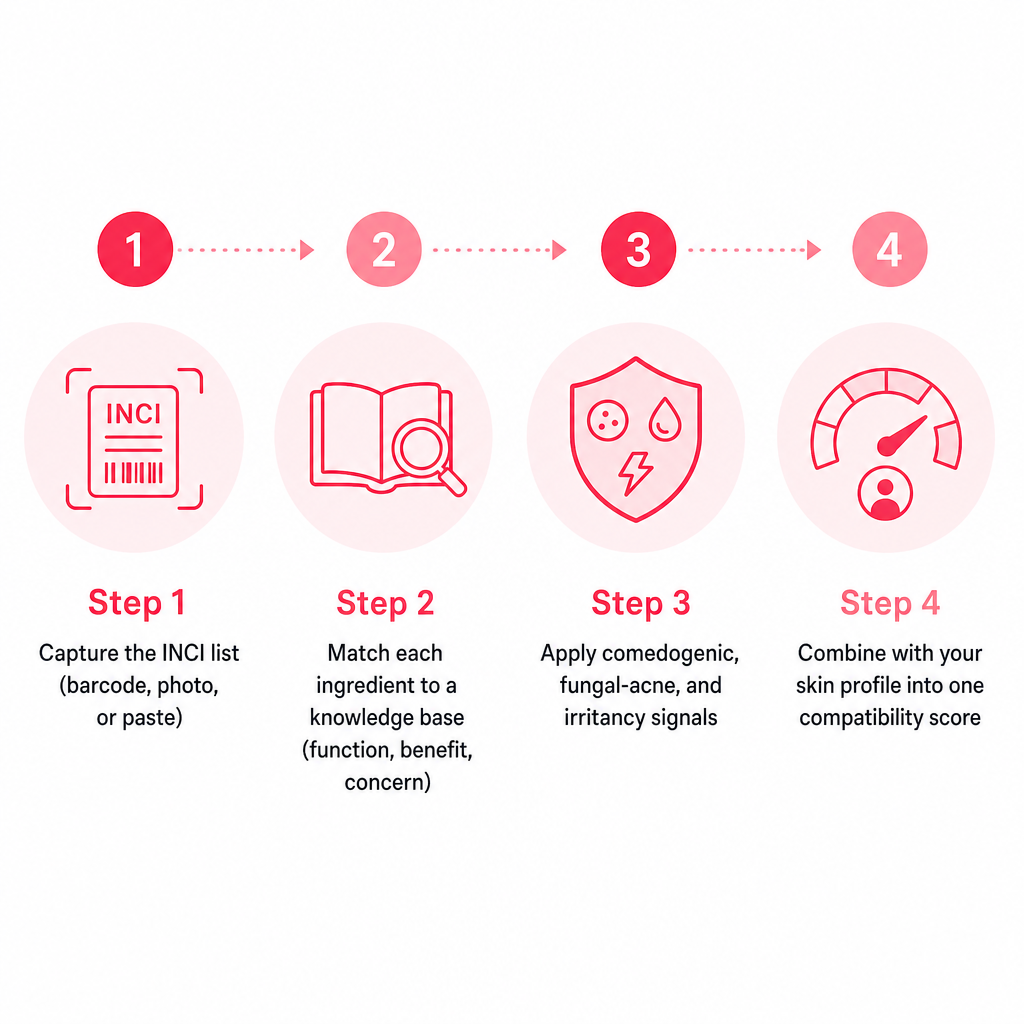
The mechanics are less mysterious than the results can feel. A checker moves through capture, matching, and scoring, layering specialist signals along the way.
Reading the label: barcode, photo, or pasted list
Everything starts with capturing the exact INCI list. In Macherre, you can scan the barcode to pull a stored ingredient list, take a photo of the label so OCR (optical character recognition) turns the printed text into a searchable list, or paste a list copied from a retailer or brand page. Whichever path you use, the cosmetic barcode scanner and label reader feed the same analysis engine, and the checker then processes each ingredient entry one by one.
Matching each ingredient against a knowledge base
Every name from the label is matched against a database holding known functions, typical uses, and risk tags. For each match, we surface the function (humectant, emollient, surfactant, fragrance component), the benefits (supports hydration, strengthens the barrier, brightening active), and any concern signals (may be comedogenic, common allergen, possible fungal-acne trigger). Presenting these in plain language lets you read a formula as a story rather than a string of unfamiliar terms.
Comedogenicity and pore-clogging signals
One major axis is comedogenicity: how likely an ingredient is to clog pores and contribute to blackheads, whiteheads, or acne. Most checkers use a variant of the standard 0 to 5 comedogenic scale. A 0 means no observed pore-clogging, 1 to 2 signals low to moderate risk, and 3 to 5 indicates an increasing likelihood of clogging in susceptible people.
Those ratings largely originate from dermatology studies, often rabbit-ear assays run at high ingredient concentrations, which means they can overstate risk compared with how the same ingredient behaves at low percentages in a finished product. Our pore-clogging checks flag higher-rated ingredients but keep that context visible: a flag is a signal, not a promise that a product will break you out. The practical value for acne-prone users is spotting formulas that stack several high-risk ingredients together, where congestion becomes more likely. Our pore-clogging (comedogenic) checker is built for exactly that read, and our guide on how to spot pore-cloggers instantly goes deeper on the scale.
Fungal acne (Malassezia) heuristics
Fungal acne, more precisely Malassezia folliculitis, behaves differently from classic comedonal acne and responds to different triggers. Checkers built for it screen labels for components that feed Malassezia yeast, especially free fatty acids and esters with carbon chain lengths roughly in the C11 to C24 range (lauric, myristic, palmitic, stearic, and oleic acids), plus many plant oils, butters, and certain polysorbate emulsifiers.
We apply Malassezia heuristics drawn from dermatology literature and community research, then label each flagged ingredient with a risk tier. This matters because Malassezia cannot make its own fatty acids; it relies on those supplied by your products and sebum. A formula rich in these food sources can worsen fungal acne even when it looks harmless for traditional acne, which is why a product can be acne-safe yet risky for Malassezia-driven breakouts.
Irritancy, allergy, and general safety context
Beyond acne, a checker tracks irritancy potential and allergy history for common cosmetic ingredients. Databases often draw on published irritancy indices and reported allergenic reactions to surface ingredients that frequently trigger contact dermatitis or redness, or that are strongly sensitising for a subset of users, such as some fragrance components and preservatives. We tag these as concerns and explain whether an ingredient is a theoretical risk or something routinely troublesome for sensitive skin.
Collapsing the data into a product-level view
Reading ingredient by ingredient is useful, but the real payoff is summarising the whole formula. We take every signal (function, benefits, comedogenic rating, fungal-acne triggers, irritancy flags) and weigh it against your skin profile to produce a single compatibility score plus a narrative that explains what supports your skin, what may push back, and how serious each concern really is. That lets you compare two serums with near-identical marketing and see why one suits you better. Our deeper breakdown of what an ingredient checker actually tells you unpacks each of these signals in turn.
How our tools turn checks into decisions
A checker is strongest when it doesn't sit alone. We connect ingredient analysis to a set of tools built to help real people act, not just collect data. Because every tool draws on the same ingredient knowledge base, your skin profile and preferences carry from one decision to the next.
The routine creator uses ingredient analysis to detect clashes across your whole routine, such as multiple strong exfoliants or overlapping irritants, rather than judging one product in isolation. The dupe finder leans on the same data to surface alternatives with similar functional profiles but different risk or price, while the side-by-side comparison tool lets you line two products up and see where they diverge. For sensitive conditions, the seborrheic dermatitis trigger checker targets the repeated irritants and barrier-disruptors that matter most there. The point of the ecosystem is continuity: one scan can feed a routine, a swap, or a dupe search without you starting over.
How to interpret what the checker tells you
A good checker makes trade-offs visible instead of dumping a red-flag list on you. When you read a Macherre analysis, a few criteria keep it in perspective.
Net benefit versus net risk. Ask whether the core actives and supportive ingredients offer clear benefits that outweigh the realistic risks flagged for your skin type. A product might pair a highly effective brightening agent with a mild potential irritant; the value is seeing that trade-off upfront rather than after a breakout.
Type and severity of the flags. One pore-clogging signal from a single ingredient at low concentration is not the same as several high-rated comedogenic ingredients clustered together. Likewise, a mild irritancy note differs from an ingredient with a strong allergy history in the literature.
Fit with your specific condition. If you have fungal acne, ingredients that feed Malassezia carry extra weight. If you manage seborrheic dermatitis or eczema, repeated irritants and barrier-disruptors may matter more than a single comedogenic flag.
Your risk tolerance. Some people are happy to test a yellow-flag product with careful patch testing; others prefer to avoid any non-essential risk. Our job is not to dictate your choice but to make clear what you are saying yes or no to.
Risks and limitations worth knowing
No checker is perfect, and knowing its limits keeps you from over- or under-reacting.
Context and concentration are the big one: many comedogenic ratings come from high-concentration studies on animal skin and can exaggerate risk relative to a diluted, well-formulated product. Data is also incomplete, since not every ingredient has robust published evidence on comedogenicity, irritancy, or fungal-acne risk, especially newer molecules and proprietary complexes. Individual variation means a "1" or "2" on the comedogenic scale can still trouble a small subset of people. Formula interaction matters too, because soothing components can offset potential irritants in ways an ingredient-only model struggles to capture.
The most important boundary is medical. An ingredient checker is not a diagnostic tool and does not replace a dermatologist, allergist, or other health professional. We build Macherre for cosmetic ingredient education and personal product discovery, not for diagnosis or treatment decisions.
What this looks like in real life
Three common scenarios show the checker earning its keep.
An acne-prone shopper eyes a rich moisturiser. The checker highlights several ingredients rated 3 to 4 for comedogenicity plus heavy plant oils with a history of clogging pores in acne-prone skin. For an oily, breakout-prone profile the compatibility score drops, and the narrative points toward alternatives with lower pore-clogging signals.
A fungal-acne sufferer considers a serum marketed as non-comedogenic. Despite the label, the checker flags multiple fatty acids and esters in the C11 to C24 range along with polysorbate emulsifiers that feed Malassezia. The fungal-acne check marks it high-risk, sparing the user a product that is acne-friendly on paper but wrong for their condition.
A sensitive-skin beginner assembles a first routine. The routine builder reads across several products and surfaces a pattern of overlapping exfoliants and repeated irritants. Swapping one product for a gentler suggested alternative lowers the total irritancy load without giving up the core goals of hydration and mild brightening.
Frequently asked questions
What exactly is a skincare ingredient checker?
It is a tool that reads a product's INCI list, explains what each ingredient does, and flags potential benefits and risks such as pore-clogging, irritancy, allergy history, and fungal-acne triggers.
Do ingredient checkers replace patch testing or dermatologists?
No. They offer education and decision support based on ingredient data, but they do not diagnose, treat, or guarantee how your skin will respond. Patch testing and professional care still matter.
How does Macherre decide a product's compatibility score?
We combine ingredient-level signals (function, benefits, comedogenicity, fungal-acne risk, irritancy) with your skin profile and summarise the overall fit into a single score plus a plain-language explanation.
Can a product be safe for acne but bad for fungal acne?
Yes. Ingredients that do not clog pores can still feed Malassezia yeast and drive fungal-acne flares, which is exactly what fungal-acne-focused checks are designed to catch.
Why do some well-loved products still get flagged?
Flags reflect average risk from published data and community experience, not guarantees. Some people tolerate higher-risk ingredients well, while others react to ingredients most consider safe.