
What a Skincare Ingredient Checker Actually Tells You
Ask "what does a skincare ingredient checker tell you" and the honest answer is this: it tells you what is actually inside a product, what each ingredient is doing, which components are likely to clash with your skin, and how well the whole formula fits you overall, usually summarized as a single compatibility score. Underneath that convenience is a real decision you are trying to make. You are not curious about chemistry for its own sake. You want to know whether this jar, tube, or bottle is a good, low-risk addition to your routine given your skin type, sensitivities, and goals. A checker exists to answer that in plain language instead of leaving you to guess from marketing copy.
Table of contents
The decision hiding behind the scan
Before you scan a single label, there is a quieter question sitting underneath the curiosity. Can this product realistically help my skin goals without triggering my issues? Does it fit alongside what I already use, or is it likely to overload, irritate, or clog? And is the formula genuinely different from what I already own, or just a rebranded version of the same base?
An ingredient checker turns a dense INCI label into decision-ready information. It reads the full list and translates it into human categories such as hydrators, occlusives, exfoliants, fragrances, and preservatives. In our case, the checker decodes that list and then layers on a single compatibility score tuned to your skin profile rather than a generic pass or fail. The point is to ground the decision in your own skin, not someone else's average.
So instead of trusting a claim like "non-comedogenic" or "for sensitive skin," you get a structured answer to a very practical question: should this go on my face, and how often?
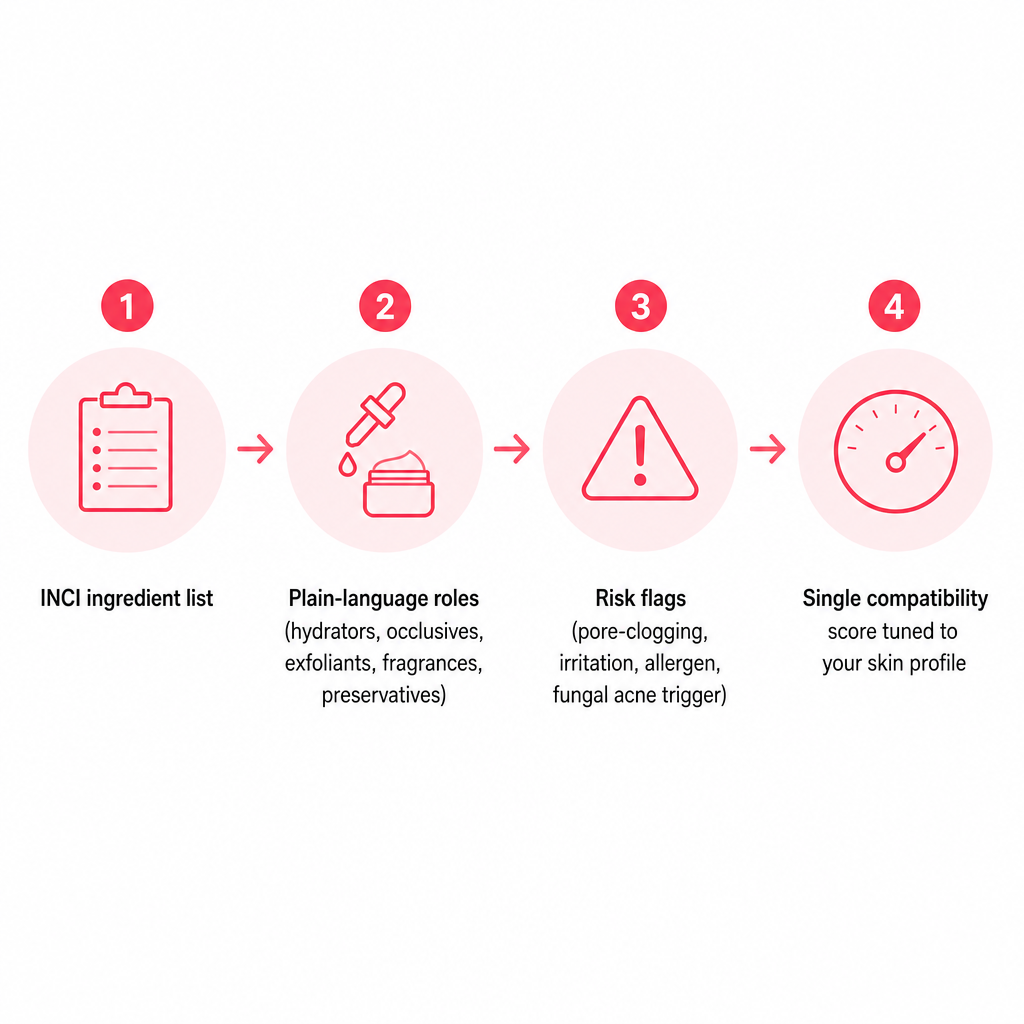
What a skincare ingredient checker actually does
At a technical level, the tool does a few specific things in sequence. It reads the product's full INCI list, the standardized ingredient names printed on the label. It matches each ingredient against an internal dictionary that stores known roles, benefits, and risk signals. It flags ingredients associated with issues such as pore-clogging, irritation, allergies, or fungal acne triggers. Then it rolls those ingredient-level signals into an overall compatibility score for your skin profile and presents the result in language you can act on, not just numbers or red dots.
Our core ingredient checker accepts a full list from any cosmetic or skincare product, cross-references every ingredient against our ingredient dictionary, and returns two layers at once: a plain-language explanation of what each ingredient is doing, and a single compatibility score tuned to your skin type, sensitivities, and goals. Paste any product's ingredient list and you immediately see that score, targeted flags for acne, irritation, and specific sensitivities, plus readable notes on what each ingredient does and when it might cause an issue.
That is the real answer to the question. A checker tells you what each ingredient is there for, which ingredients are more likely to help you, which are more likely to hurt you, and how that balance plays out for your particular skin when viewed as one complete formula rather than a list of isolated names.
From INCI list to compatibility score
The interesting part is the mechanism that gets you from an unreadable label to a number you can trust.
Translating INCI into plain language
Most ingredient lists are written in INCI, a standardized naming system that is genuinely hard to interpret without chemistry knowledge. The checker takes those names and sorts them into recognizable roles: humectants that pull water into the skin, emollients that soften and smooth, occlusives that form a barrier and reduce water loss, surfactants and cleansing agents, active ingredients like exfoliating acids or retinoids, fragrance components and essential oils, and preservatives that keep the product stable. Once you can see that structure, a wall of unfamiliar names becomes a formula with a clear shape and purpose.
Screening for pore-clogging and acne risk
One of the most common worries is whether a product will clog pores or worsen breakouts. Our pore-clogging checker scans the full ingredient list and evaluates each component for its tendency to block pores and feed blackheads, whiteheads, and comedonal acne. It matches ingredients against comedogenicity data and occlusive behavior, mapping them to a 0 to 5 style scale where higher values indicate greater pore-clogging potential.
Those per-ingredient signals are then interpreted in the context of your skin. A moderately comedogenic ingredient can be flagged more strongly if you are very breakout-prone, while the same ingredient may be less concerning for someone with robust, dry skin. All of it feeds the compatibility score, so you are not just told "this ingredient is risky," you are told whether the formula is a reasonable fit for your congestion-prone skin. If you want the deeper mechanics, our explainer on how the pore-clogging checker works walks through the scoring logic in detail.
Screening for fungal acne triggers
For anyone dealing with fungal acne, the key question shifts. It is no longer about bacteria and pores but about whether a product contains ingredients that might feed Malassezia yeast. A fungal acne checker is built for this narrower, crucial problem: it screens the INCI block against a current list of potential Malassezia triggers, separates recognized ingredients from unmatched names, and shows which components may support fungal acne and which are less likely to contribute.
This matters because many common emollients and esters are perfectly fine for ordinary acne yet problematic for fungal acne. A dedicated screen keeps you from treating "acne" as one undivided category, which is exactly the mistake that stalls a lot of routines.
Combining signals into a single score
Pore-clogging risk, irritancy, fungal triggers, potential allergen flags: each is useful, but all of them at once can be overwhelming. So the checker aggregates them into a single, skin-profile-aware compatibility score. In our tool, that score reflects your skin type, sensitivities, and goals rather than a generic verdict. A formula heavy in occlusives might score well for dry, barrier-compromised skin but less well for severely congestion-prone skin. A product loaded with strong exfoliating acids might score differently for someone already running multiple actives. That final layer is what moves the tool from ingredient encyclopedia to genuine decision aid.
General checks versus specialized ones
Different people ask different versions of the same question, so the experience splits into focused tools built on one shared ingredient dictionary and scoring engine.
The general checker decodes any skincare ingredient list and surfaces an overall compatibility score plus readable explanations of each ingredient's role and potential concerns. The pore-clogging checker concentrates on congestion risk and rolls comedogenic signals into an acne-aware score. The fungal acne checker screens specifically for ingredients currently classified as potential Malassezia triggers, which makes fungal acne management far less of a guessing game.
All three run the same underlying mechanism, reading ingredients, matching them to internal data, and converting them into risk and benefit signals, but each narrows the lens so a specific concern gets a cleaner answer. Beyond the checks themselves, the output from one run can feed the rest of your workflow: a routine builder with clash detection to see how a product sits alongside what you already use, a side-by-side comparison when two contenders look similar, and a dupe finder when you want the same formula at a friendlier price. One scan can quietly shape an entire routine.
How to read what the checker tells you
The tool hands you data, but the decision still lives in your context. A few practical criteria help you read the result well.
Start with the overall compatibility score as a summary of how likely this is to fit your skin. Higher generally means better alignment with your profile and goals; lower means more ingredients that conflict with your sensitivities or concerns. Then look at the type and strength of the risk flags. A single mildly comedogenic ingredient in a rinse-off cleanser matters less than several high-risk occlusives in a leave-on cream if you are acne-prone. A handful of potential fungal triggers may be fine for someone who does not have fungal acne but disqualifying for someone who does.
Next, consider the pattern across your whole routine. If several products each carry moderate pore-clogging risk, the cumulative load can matter more than any single item, and the same is true for layered exfoliants or repeated irritant exposure. Finally, weigh the flags against your primary goal. If calming redness is the priority, a product that scores modestly overall but contains well-supported soothing agents can still earn a place, especially when pore-clogging and fungal triggers are minimal. If clearing congestion is the goal, pore-related signals should carry more weight than a mild fragrance flag. Because you see both the headline score and the reasons behind it, you can make trade-offs instead of forcing every product into a yes or no.
Where an ingredient checker stops
Even a well-built checker has limits, and knowing them keeps the tool in its lane as a guide rather than a stand-in for medical advice.
Patch testing and personal history still matter. Risk ratings are built from patterns and data, not from your specific immune system. An ingredient with a low irritancy signal can still bother a small group of people, and one with high comedogenic potential might be perfectly tolerable in a particular formulation. The checker shows you where to be cautious; your skin confirms it.
Concentration and context are only partly visible. Most labels do not disclose exact percentages, so the tool can infer rough emphasis from ingredient position and known use ranges, but it cannot fully replace real formulation detail. And it is not a diagnostic tool. It exists for cosmetic education and product selection, not for diagnosing or treating disease. Persistent reactions, severe acne, or inflammatory skin conditions still deserve medical evaluation, even when the checker helps you sidestep obvious triggers. Used with those caveats in mind, it turns ingredient transparency into something you can actually act on, no chemistry degree required.
Frequently asked questions
Does a skincare ingredient checker tell me if a product is safe?
No tool can call a product universally safe. What a good checker can do is show which ingredients are more or less likely to irritate, clog pores, or trigger fungal acne for you, and summarize that fit in a compatibility score you can weigh against your own history.
Can I rely only on the compatibility score?
The score is a helpful summary, but read it alongside the ingredient-level breakdown and your personal experience. Two products can share a similar score yet differ in where the risk sits, whether that is pores, irritation, or fungal triggers.
Is "non-comedogenic" on the label the same as passing a pore-clogging checker?
Not necessarily. Marketing terms are not standardized, while a pore-clogging checker evaluates each ingredient against comedogenicity data and aggregates those signals into a congestion-aware view tailored to your acne risk.
How does a fungal acne checker differ from a regular acne check?
A fungal acne checker screens specifically for ingredients currently classified as potential Malassezia triggers, while a general acne check leans more on pore-clogging and irritation. They surface different mechanisms behind breakouts, which is why one can pass while the other flags a problem.
What does an ingredient checker tell you that a simple avoid-list cannot?
It reads the whole formula, the mix of helpful and risky ingredients, their typical roles, and how they align with your skin profile, rather than just scanning for a few banned names. That makes the decision about whether to use a product more nuanced and far more personal.