
Ingredient Checker Skincare
An ingredient checker skincare tool is a digital app or website that reads a product's full ingredient list, matches each name against a database, and translates the results into plain guidance on what every component does and where it might cause trouble. At Macherre, our Ingredient Checker does exactly this for any product in seconds, then adds a single compatibility score tuned to your skin.
That one-line definition hides a lot of useful mechanics, and it also hides a few traps that leave people more anxious than informed. Below we walk through what these tools actually are, how the category breaks down into distinct types, why they matter if your skin is fussy or your budget is tight, and what to weigh before you trust any verdict on the screen.
Table of contents
- What an ingredient checker skincare tool is and how it works
- The main types of checker, and where Macherre sits
- Why this matters when your skin has specific demands
- What to weigh before you trust a verdict
- Your next move with a product you already own
- Frequently asked questions
What an ingredient checker skincare tool is and how it works
Strip away the branding and every ingredient checker does the same core job: it lets you look up the ingredients in a beauty product and understand whether they suit your skin. That is how Healthline frames the category, and it matches what most people are really after — a way to see past the marketing on the front of the bottle and read the list on the back with some confidence.
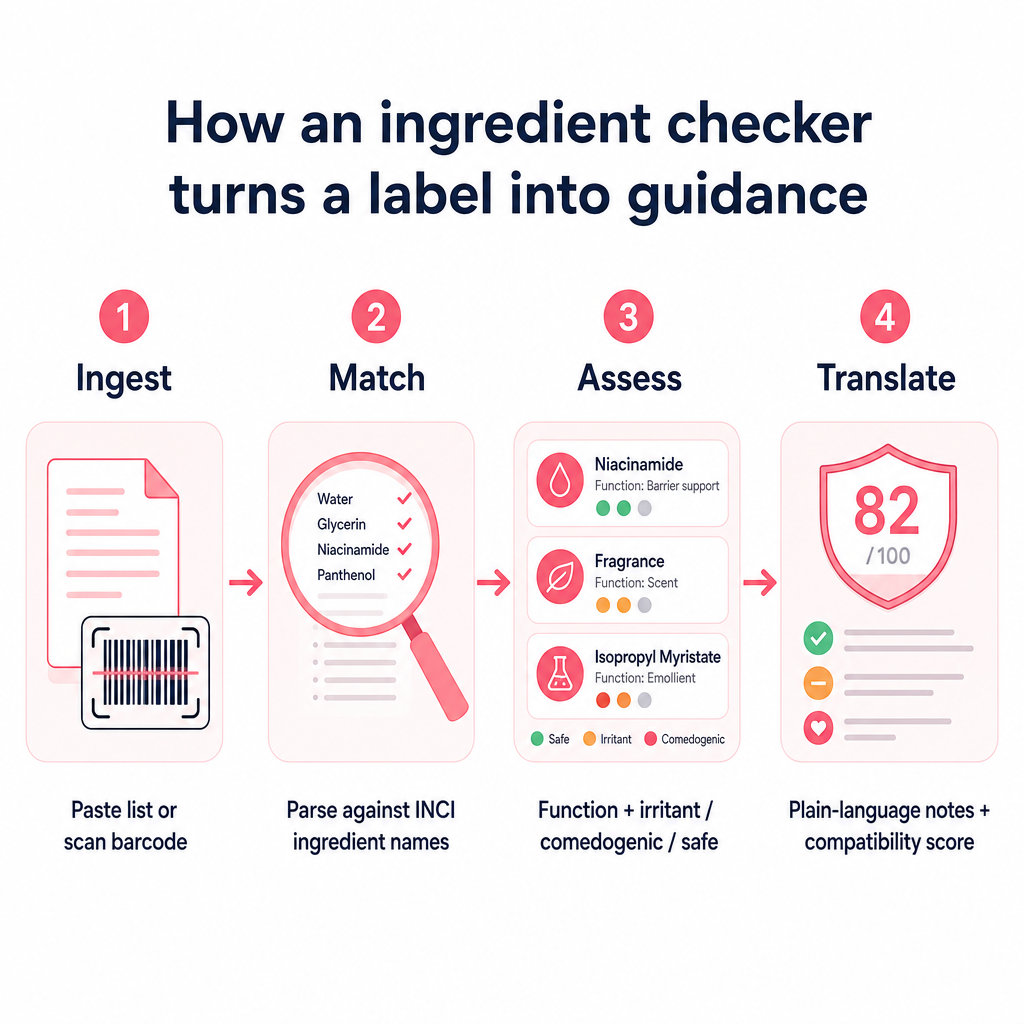
The mechanism is more consistent than the interfaces suggest. First the tool ingests an ingredient list, either from text you paste or from a scan of the packaging. Then it parses each entry, ideally against standardized INCI names — the official International Nomenclature of Cosmetic Ingredients labels printed on packaging rather than the friendly marketing names on the front. COSMILE Europe, an official European database covering close to 30,000 cosmetic ingredients, is built around exactly this INCI-first logic and lets you search by the name that appears on the label or carton. Any serious checker has to parse those names correctly or the whole analysis falls apart.
Once the names are matched, the tool applies its rules. Some flag potential irritants, allergens, and comedogenic ingredients. Others, as sites like Geekandchic describe, deconstruct a full list one entry at a time and show each ingredient's function — humectant, emollient, preservative, active — alongside a note on whether it is considered irritating, pore-clogging, or generally safe. The output is usually a per-ingredient breakdown, sometimes topped with a product-level rating.
Our Ingredient Checker follows this shape and then extends it. It accepts a full list from any cosmetic or skincare product, cross-references every ingredient against our in-app ingredient dictionary, and returns two layers at once: a plain-language explanation of what each ingredient is doing, and a single compatibility score that reflects your skin type, sensitivities, and goals rather than a generic pass or fail. If you would rather not type, our cosmetic barcode scanner for instant ingredient clarity pulls the stored list from the packaging so you can go straight to the breakdown. That combination of manual entry and scanning is now a baseline expectation — Spanish outlet Glamour highlights that modern cosmetic apps let you analyze lists from a photo or a barcode precisely because people want the shortcut.
The main types of checker, and where Macherre sits
Not every tool that calls itself an ingredient checker does the same thing. It helps to see the category as a few distinct shapes, because knowing which one you are using explains what you can reasonably expect from it.
The simplest is the ingredient dictionary: you search a single ingredient and read about it. COSMILE Europe works this way, returning what an ingredient is, how it is used, and safety information grounded in scientific and regulatory data. This is authoritative and precise, but it answers one ingredient at a time — you still have to assemble the picture for a whole product yourself.
Next is the list analyzer, where you paste an entire INCI list and receive a table summarizing each ingredient's role, irritation potential, and comedogenicity, often drawn from published research and established scales. This is far quicker for judging a real product, though as Geekandchic notes, those ratings are still simplifications of complex science.
Then there are barcode and photo-based apps, which remove the typing entirely by reading the packaging and running the analysis automatically. The trade-off is that they depend on the product already existing in a database with an accurate list attached.
Macherre pulls these shapes together rather than picking one. You get full-list analysis through our ingredient checker that decodes any skincare list, barcode-driven speed through the scanner, and an in-depth ingredient dictionary underneath both. On top of that we run condition-specific modules that most generic checkers do not attempt: a pore-clogging (comedogenic) checker for acne-prone skin and a seborrheic dermatitis trigger checker for skin that reacts to yeast-feeding esters and oils. And because a single product rarely lives alone, our routine creator that fits your skin applies the same ingredient intelligence at the routine level, flagging clashes between actives that shouldn't be layered.
Two things set our approach apart. The compatibility score is personal — it reflects oily, dry, combination, or sensitive skin plus specific conditions and your own sensitivities, rather than issuing one universal grade for everyone. And we are independent and privacy-first: not tied to a brand or retailer, so the assessment isn't shaped by who wants to sell you something.
Why this matters when your skin has specific demands
Most people don't open an ingredient checker out of idle curiosity. They open it because something stung, broke out, or flared, and they want to know what in the bottle was responsible. Healthline points out that many users reach for these tools precisely because they have sensitive skin or specific concerns and want to avoid known triggers such as fragrance or particular irritants.
For a beginner, the value is mostly about cutting through language. A label reads like chemistry homework, and the front of the pack reads like an advertisement; a checker sits in between and tells you, in ordinary words, that this ingredient is a humectant pulling water into the skin and that one is a preservative keeping the formula stable. That translation is the whole point, and it is why our plain-language breakdowns are aimed at people with no chemistry background who still want to make an informed choice.
For skin with a diagnosis or a stubborn pattern, the demands go deeper. Comedogenicity matters enormously to acne-prone users, and reactions to it vary from person to person. Someone with fungal acne or seborrheic dermatitis needs to know whether a formula contains ingredients that can feed Malassezia yeast — a level of nuance a generic green-or-red rating simply cannot deliver. This is where condition-aware checking earns its place, and where our dedicated seb-derm and pore-clogging modules do work that a one-size-fits-all score cannot.
Budget-conscious shoppers get a different kind of leverage. Once you understand which ingredients actually make a formula work for your skin, you can look for the same profile elsewhere. Our dupe finder uses ingredient-based similarity to surface alternatives with comparable profiles, so you can chase the formula rather than the packaging. And when you're torn between two options, our side-by-side product comparison lines up their ingredients, functions, and compatibility scores so the meaningful differences stand out instead of the marketing.
What to weigh before you trust a verdict
A compatibility score is a starting point for a decision, not the end of one. A few criteria separate a checker you can lean on from one that will quietly mislead you.
Data quality and scientific basis. The strongest ingredient information uses standardized INCI naming and rests on scientifically verified, regulator-aligned data, which is exactly the standard COSMILE Europe demonstrates. Ask whether a tool parses the real names on the label and whether its risk logic is built on evidence rather than folklore. We translate lab-grade ingredient information into everyday language, and we treat our scores as interpretations of current evidence, not as arbitrary verdicts.
Independence. A rating means less when the tool profits from steering you toward particular products. Brand-agnostic assessment is the reason our analysis can point away from a product as readily as toward it.
Personalization. A generic safety rating ignores that suitability depends on your skin. Estelabelleza makes the sharper point that suitability also depends on concentration, formulation, and individual tolerance, not merely whether an ingredient is present at all. A checker that scores for your specific profile respects that reality; a universal grade cannot.
Honesty about limits. This is the criterion people skip. Healthline is explicit that ingredient checkers are informational tools and do not replace advice from a dermatologist or other health professional. Estelabelleza adds a warning worth taking seriously: some apps over-alert, labeling widely used and regulated ingredients as dangerous without context about dose or formulation, which leaves users anxious and confused rather than better informed. The evidence does not support treating every flagged ingredient as automatically unsafe.
So the honest framing is this: use a checker to understand what ingredients do and to spot patterns — the same irritant showing up across three products you reacted to. Do not use it as a diagnosis. If a skin issue is serious or persistent, a dermatologist should lead, with checker insights as supporting information. We offer orientation-level, educational guidance grounded in ingredients; we don't hand out diagnoses or treatment plans, and that boundary is a feature, not a shortcoming.
Your next move with a product you already own
The most useful thing you can do with all of this is small and concrete: pick one product currently sitting on your shelf and run it through the checker. Read the compatibility score, then read the per-ingredient notes underneath it, because that is where the reasoning lives. If your skin is acne-prone or reactive, send the same product through the pore-clogging or seborrheic dermatitis checker for a condition-specific read. Once you know how that one product behaves, the routine creator shows how it fits alongside everything else you use — and whether anything clashes. If you want a fuller walk-through of the mechanics behind the score, our explainer on the skincare ingredient checker goes deeper on how it decodes a product.
Frequently asked questions
What exactly does an ingredient checker tell me about a skincare product?
It breaks the ingredient list down entry by entry, explaining each component's function and flagging whether it is a potential irritant, allergen, or comedogenic ingredient, as Healthline and Geekandchic describe the category. Many tools, ours included, top that per-ingredient detail with a product-level result. With Macherre you also get a compatibility score matched to your skin profile plus a plain-language note on what each ingredient is doing and when it might cause issues.
Can an ingredient checker tell me if a product is safe for my medical condition?
Not definitively. Healthline is clear that these tools are informational and are not a substitute for professional medical advice, and Estelabelleza cautions that risk ratings can oversimplify the underlying science. A checker is excellent for understanding ingredients and spotting patterns, but suitability also depends on concentration, formulation, and your own tolerance. For a serious or persistent condition, a dermatologist should lead, with checker insights as support.
How does Macherre's compatibility score differ from a simple good or bad rating?
A universal rating gives every user the same grade for a product. Our score is personal: it weighs your skin type, specific conditions such as fungal acne or seborrheic dermatitis, and your individual sensitivities and goals. It is presented as an interpretation of current evidence rather than a blunt safe-or-toxic label, and it is paired with the reasoning so you can see why an ingredient counts for or against a product on your skin.
Is barcode scanning more accurate than typing ingredients manually?
Scanning isn't inherently more accurate — it's faster and less error-prone for you, since it pulls the stored list rather than relying on your typing. Glamour notes that photo and barcode input became standard because people want that convenience. The analysis itself is identical either way. Scanning depends on the product already being in the database with a correct list, so manual entry remains the reliable fallback for newer or niche products.
Can ingredient checkers help with fungal acne or seborrheic dermatitis?
A general checker often can't, because these conditions turn on specific triggers a broad safety rating won't surface. That's why we run dedicated modules: the seborrheic dermatitis trigger checker flags ingredients that can feed Malassezia yeast, and the pore-clogging checker focuses on comedogenic risk for acne-prone skin. They give condition-aware answers instead of a single generic verdict, though they remain guidance rather than a diagnosis.
Is Macherre independent, or tied to brands and retailers?
We are fully independent and privacy-first, not attached to any brand or retailer. That independence is the reason our analysis can point away from a product as readily as toward it, and it's central to how we assess formulas — the score reflects your skin, not anyone's sales target.