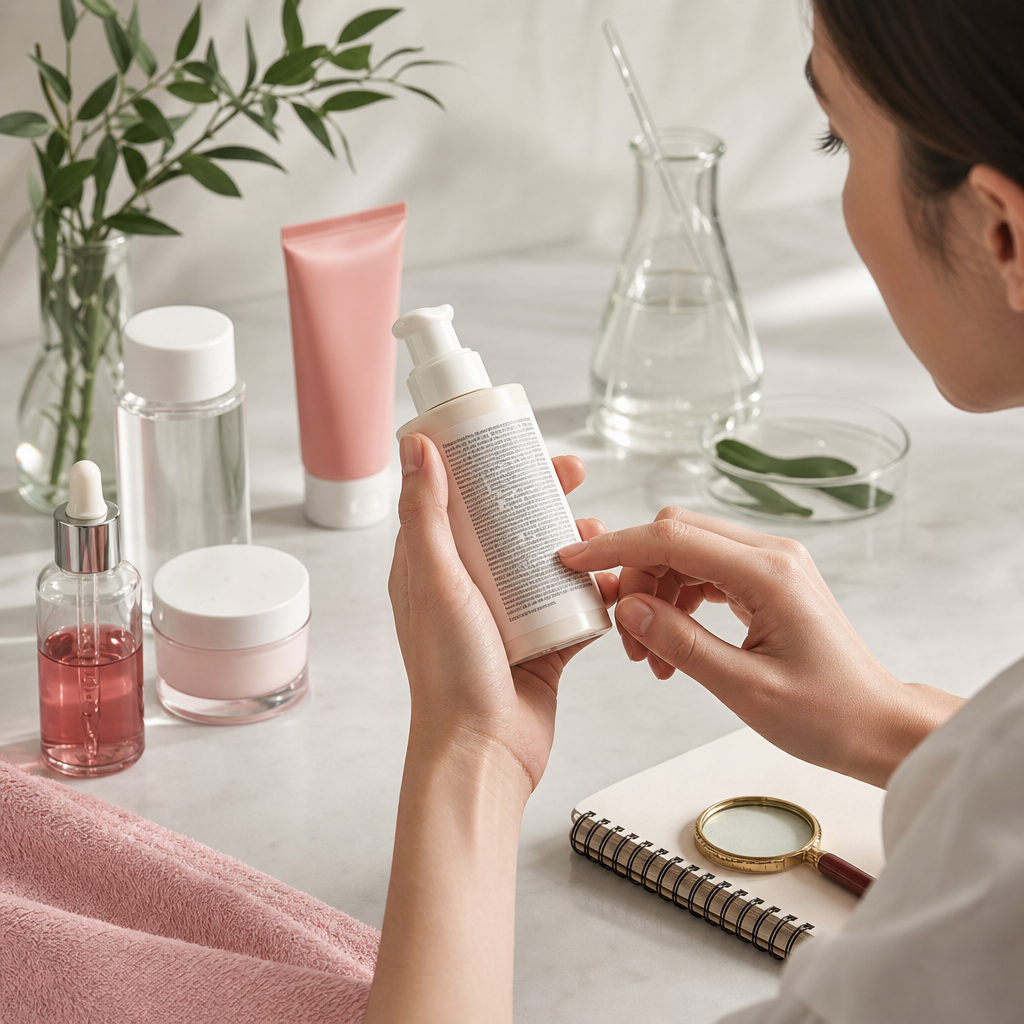
What Is a Skincare Ingredient Checker and Why Every Routine Needs One
A skincare ingredient checker is a tool that reads a cosmetic ingredient list and translates each item into plain-language meaning: what it does, who it suits, and when it might cause trouble. Match that reading against your own skin profile and you get a fast, personalised verdict on whether a product actually fits you, instead of a wall of chemical names you can't parse. That is exactly what we built Macherre to do, and why we think a skincare ingredient checker belongs in every routine.
The reason this matters is structural. Ingredient disclosure is mandatory almost everywhere cosmetics are sold, but interpretation is not provided. You are handed the raw data and left to make sense of it alone. A checker closes that gap.
Table of contents
- What a skincare ingredient checker actually is
- The main variants and what separates them
- Why it changes decisions for sensitive and acne-prone skin
- How to judge whether a checker is worth trusting
- Where to start with your own products
- Frequently asked questions
What a skincare ingredient checker actually is
Every cosmetic label carries an ingredient declaration. In the United States, ingredients appear in descending order of predominance under FDA cosmetic labeling rules. In the European Union and many other markets, the list is headed by "INGREDIENTS" and written using standardized INCI names that stay consistent across borders. So the information is already there, mandated by law, sitting on the back of the bottle.
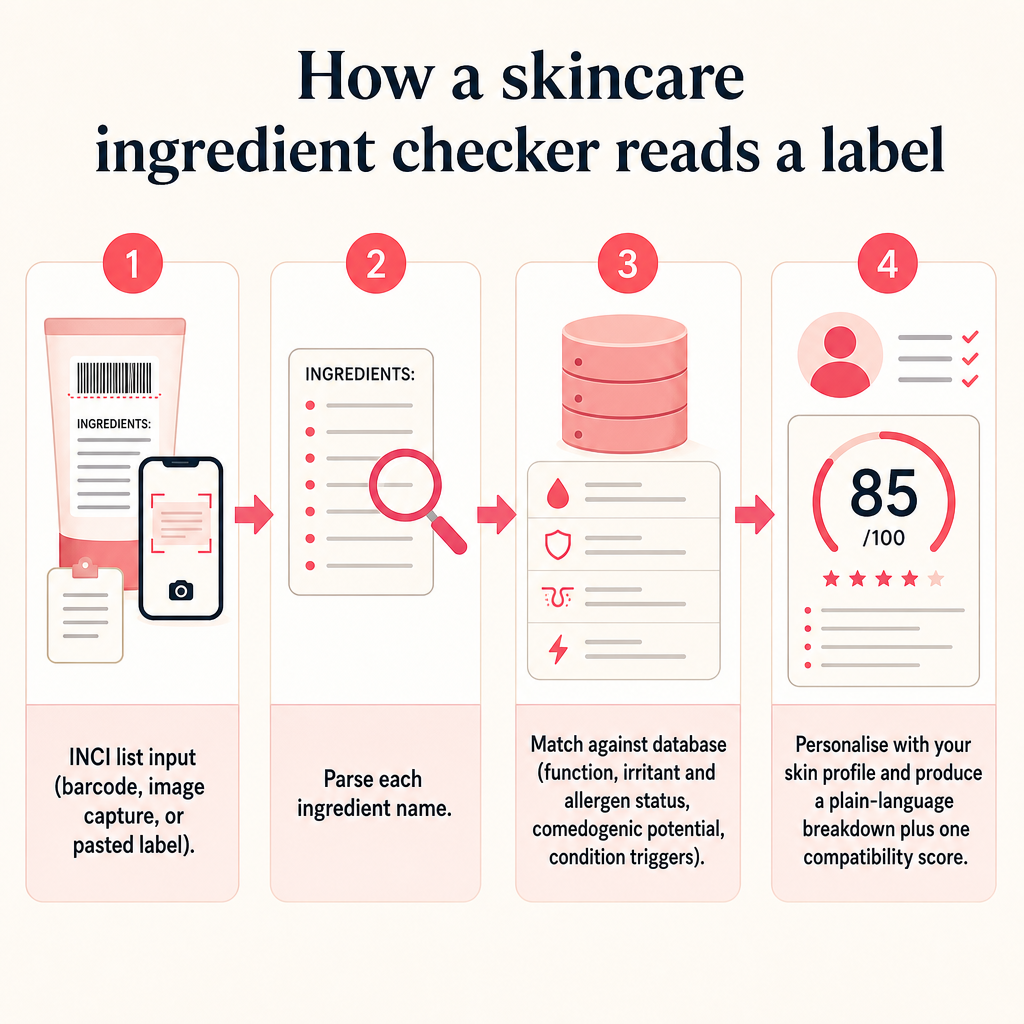
The problem is that INCI is a naming system built for regulators and formulators, not for shoppers. "Tocopherol" tells you nothing until you learn it is vitamin E. "Sodium lauroyl isethionate" reads like a warning when it is just a mild cleansing agent. A skincare ingredient checker does the translation work: it takes the parsed list and matches each name against a database that encodes function, known irritant or allergen status, comedogenic potential, and condition-specific risk.
At Macherre, that engine sits underneath everything. You paste a label, scan a barcode, or use image capture, and we return a per-ingredient breakdown plus a single compatibility score for the product as a whole. The breakdown explains what each component does and flags when it might irritate or clash, filtered through the skin type, sensitivities, goals, and avoid-list you set up in your profile. The score is a summary; the ingredient-by-ingredient view is where the reasoning lives.
The key distinction: a checker does not certify a product as universally "safe." Regulatory labelling confirms what is in the bottle, but it does not assess your individual tolerance, your skin condition, or how the formula interacts with the rest of your routine. That interpretive layer is the whole point of the tool.
The main variants and what separates them
"Ingredient checker" is an umbrella term. Underneath it sit several tools that read the same ingredient data but answer different questions. Knowing which variant you need saves you a lot of guessing.
General ingredient checker. The archetype: paste any label and get a full per-ingredient breakdown. This is the right starting point when you simply want to understand a formula or figure out why a product isn't agreeing with you. Our general ingredient checker is the default destination whenever you want the complete picture rather than a single yes-or-no answer.
Barcode scanner. Same engine, frictionless input. Instead of typing, you scan the product in-store or at home and we pull up the matching formula, then show the ingredient-based analysis and compatibility notes, including alerts for anything on your avoid list. Our cosmetic barcode scanner exists for the moment you are standing in an aisle deciding whether to buy.
Condition-specific screens. These narrow the same data down to one concern. Our fungal acne checker flags fatty acids, esters, and polysorbates in the C11–C24 range plus high-risk botanical oils that can feed Malassezia yeast, applying heuristics built from dermatology literature and sorting each flag by risk tier. Our seborrheic dermatitis trigger checker focuses on seb derm triggers, and our pore-clogging checker surfaces comedogenic signals. Same formula, different lens.
Comparison and routine tools. A single-product check answers "should I use this?" A routine-level view answers the harder question: "does this fit with everything else?" Our side-by-side product comparison lays two or three formulas next to each other and shows shared ingredients, unique ingredients, key actives, and where the meaningful differences sit. The routine builder extends the same logic across a full lineup, using clash detection to catch overlapping actives, irritant stacks, or redundant steps.
What separates these is not the underlying database; it is the heuristic layer applied on top and the question each one is built to answer. A fungal acne screen and a comedogenic screen can flag completely different ingredients in the same product, which is why we tell congestion-prone users to run both.
Why it changes decisions for sensitive and acne-prone skin
For a lot of people, skincare is a cycle of buying something that looks gentle, breaking out or flaring, and never knowing which ingredient did it. An ingredient checker breaks that cycle by making the invisible visible before you commit.
Take acne. Dermatology research on comedogenic cosmetics and acne has identified specific ingredients, such as lauric acid and stearic acid in facial cleansers, that show a dose-effect relationship with breakouts. That is exactly the kind of finding a comedogenic checker operationalises: instead of trusting a "non-comedogenic" claim on the front of the pack, you see the flagged ingredients on the back and their risk level.
For fungal acne, the stakes are subtler. Malassezia folliculitis is fed by particular fatty acids and esters, and a product marketed for sensitive skin can be full of them. Screening the label against those substrates tells you in seconds what a marketing claim never will. And because fungal and comedonal acne often coexist, checking one concern in isolation can leave you fixing half the problem.
The sensitivity case is broader than acne. If you're managing seborrheic dermatitis, eczema, rosacea, or you're pregnant or breastfeeding and avoiding certain actives, a personalised checker filters the entire ingredient list against your specific avoid-list and profile. It turns a generic label into a signal that actually applies to your skin, rather than a stranger's.
This is also where the routine-level view earns its place. Two well-tolerated products can still conflict when stacked, whether through overlapping strong actives or a combination that overwhelms the barrier. Seeing that clash mapped out before you layer them is far less painful than discovering it on your face.
How to judge whether a checker is worth trusting
Not every tool that decodes labels is equally useful. These are the criteria worth weighing before you rely on one, whichever tool you land on.
- INCI coverage and accuracy. Because ingredient labelling runs on standardized INCI nomenclature, a checker is only as good as its ability to recognise and correctly classify those names across global products. Thin coverage means missed ingredients and blind spots.
- Condition-specific logic. General flags are helpful, but if you have a specific skin condition, look for screens built around your trigger rather than a one-size verdict. Purpose-built views catch risks a generic score can flatten.
- Routine-level perspective. A checker that only evaluates products in isolation misses how skincare is actually used. The ability to compare formulas and detect clashes across a full routine reflects real behaviour.
- Plain-language explanation. A score with no reasoning behind it is a black box. The breakdown that explains why an ingredient is flagged is what lets you make your own judgement.
- Independence. A tool that quietly steers you toward specific brands is answering a different question than "what fits my skin?" We built Macherre as an independent, privacy-first, ingredient-led app precisely so the analysis serves the reader, not a sales funnel.
One honest caveat: no consumer checker replaces a dermatologist. Our heuristics draw on published dermatology literature, but the tools are for understanding and decision support, not medical diagnosis or treatment. If a skin condition is persistent or severe, professional care comes first, and a checker becomes a companion to it rather than a substitute.
Where to start with your own products
The fastest way to feel the difference is to run something you already own. Pick the product you're least sure about, the one that might be behind a flare or a breakout, and check its ingredient list. If you have a persistent issue, cross-run the same formula through the fungal acne, seborrheic dermatitis, and pore-clogging screens, since those can point at different culprits in one product.
Once you start recognising ingredient patterns, the next move is usually routine-level: compare two products you're deciding between, or map your whole lineup for clashes and redundancy. If a favourite is out of stock or over budget, our dupe finder points you to formulas with similar ingredient profiles instead of relying on marketing resemblance.
For the exact mechanics of scanning, pasting, and building a routine step by step, our dedicated how-to guides walk through the process. Here, the takeaway is simpler: the label already tells you what's in the bottle. A checker tells you what it means for you.
Frequently asked questions
What is a skincare ingredient checker?
It is a tool that reads a cosmetic ingredient list and explains each item in plain language, then matches those ingredients against your skin type, sensitivities, and goals to show whether a product fits you.
Do I need a checker if products already list their ingredients?
Yes, because labels are mandated to disclose ingredients but not to interpret them. INCI names are written for regulators, not shoppers, so a checker translates the required disclosure into meaning you can act on.
Can an ingredient checker diagnose my skin condition?
No. It flags ingredients associated with concerns like comedogenicity or fungal acne triggers using dermatology-informed heuristics, but it is decision support, not a medical diagnosis. Persistent or severe conditions need professional care.
What is the difference between a general checker and a fungal acne checker?
Both read the same ingredient list, but a general checker gives a full breakdown of every component, while a fungal acne checker narrows the analysis to ingredients that can feed Malassezia yeast and sorts them by risk tier.
Can I check a whole routine instead of one product at a time?
Yes. Beyond single-product checks, comparison and routine tools evaluate multiple products together, flagging overlapping actives, irritant stacks, and redundant steps so you can see how a formula behaves alongside the rest of your routine.