skin care products for sensitive skin: The Best Skincare Products for Sensitive Skin (And How to Spot Them)
If you have sensitive skin, you have probably bought something stamped "gentle," "for sensitive skin," or "hypoallergenic" and still ended up with stinging cheeks or a rash by day three. That gap between the front-of-pack promise and what your skin actually feels is the real problem, and it is why finding good skin care products for sensitive skin starts with the ingredient list, not the marketing copy. Terms like "hypoallergenic" and "sensitive-skin-friendly" have no universal regulatory definition, so two products with identical claims can behave completely differently on your face. Macherre was built to close that gap: scan a product, get a plain-language breakdown of every ingredient, and see a single compatibility score tuned to your skin type and sensitivities. This article explains what actually makes a formula kind to reactive skin, and how to use Macherre to spot those products in seconds instead of squinting at an INCI list you can't decode.
Table of contents
- What "sensitive skin" really means, and why labels aren't enough
- What makes a product genuinely sensitive-skin-friendly
- How Macherre helps you spot sensitive-skin-safe products fast
- Building a calm, barrier-friendly routine with Macherre
- Smart swaps: dupes and comparisons to protect skin and budget
- Frequently asked questions
What "sensitive skin" really means, and why labels aren't enough
Sensitive skin isn't one single thing. For some people it shows up as tightness and stinging after cleansing. For others it's flushing and redness, or flaking around the nose and brows, or breakouts triggered by richer creams. Beauty guidance often distinguishes sensitive skin from truly reactive skin, where the barrier is compromised and reacts to a wider range of triggers, and a pharmacist-led overview in Elle describes exactly this spectrum of redness, stinging, and inflammation that reactive skin tends to produce.
That variety matters because it changes what "best" means for you specifically. A cream that soothes one person's dry, tight cheeks might clog someone else's acne-prone but still-sensitive skin. A calming oil-based balm could be perfect for eczema-prone dryness yet feed the microbes involved in fungal acne or seborrheic dermatitis. So there is no universal shopping list of products that works for everyone who identifies as sensitive.
The harder truth is that the labels meant to guide you don't carry a fixed guarantee. "Hypoallergenic" and "formulated for sensitive skin" are marketing descriptors, not standardized certifications, so they don't promise the absence of a specific irritant that bothers your skin. A product can be fragrance-forward and still call itself gentle, or leave out fragrance but include a high level of drying alcohol. The only reliable way to know whether a formula suits you is to read what's actually in it and match that against your own triggers.
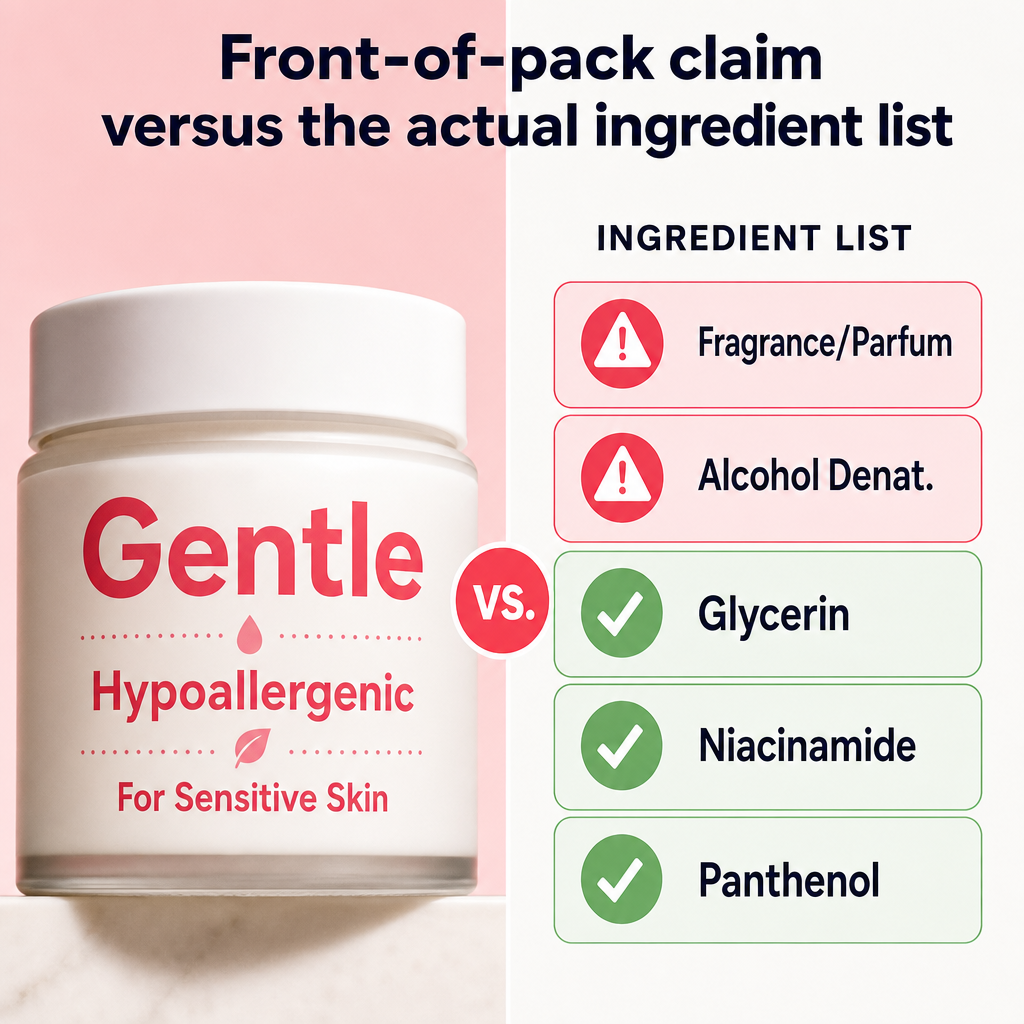
This is where an ingredient-first approach beats brand loyalty. Once you know what to look for and what to avoid, the claim on the box becomes secondary. You can verify a product yourself in the time it takes to read one shelf tag.
What makes a product genuinely sensitive-skin-friendly
Across dermocosmetic and pharmacy guidance, the same formulation traits keep appearing for sensitive skin, and they fall into two simple buckets: what to avoid and what to welcome.
On the avoid side, the recurring advice is to steer clear of added fragrance, drying alcohol, and aggressive actives. Druni's guidance on creams for sensitive skin recommends choosing products free of fragrances, alcohol, and irritants such as retinoids or strong acids, describing the ideal sensitive-skin cream as a soft, calming formula. Cleansing gets the same treatment. La Roche-Posay emphasizes gentleness for sensitive skin, favoring pH-appropriate products made for sensitive skin and options like micellar water that lift impurities without harsh rubbing, while Babor recommends perfume-free, mild cream cleansers over aggressive ones. The through-line is low irritation: fewer surfactants, no fragrance, no unnecessary stimulants. In practice this means reading past the first two or three ingredients, because a fragrance or a drying alcohol can sit lower on the list and still be enough to provoke a reaction on a barrier that is already compromised.
On the welcome side, several soothing and barrier-supporting ingredients come up again and again. The pharmacist overview in Elle points to niacinamide for reducing inflammation, strengthening the barrier, and calming redness; hyaluronic acid for hydration without irritation; centella asiatica, aloe vera, and calendula as calming botanicals; colloidal oatmeal for its anti-inflammatory and antioxidant properties; allantoin for soothing and regeneration; panthenol (provitamin B5) for barrier function and reduced redness; and glycerin as a dependable humectant. Marvimundo's sensitive-skin routine guide echoes this, highlighting ceramides, niacinamide, and colloidal oatmeal for barrier restoration and soothing toners built around aloe vera, panthenol, and oat water. These are not exotic or trend-driven actives; they are the workhorse ingredients that support the skin barrier rather than challenge it, which is exactly what reactive skin needs day to day.
The best sensitive-skin products respect your barrier, skip common irritants, and lean on proven calming ingredients, whatever the label says.
Two more formulation ideas round this out. First, simplicity: shorter, minimal ingredient lists tend to reduce the number of things that could trigger a reaction, which is why guidance repeatedly favors simple compositions for reactive skin. A shorter list also makes your own review faster, because there are fewer entries to recognize and fewer places for a hidden irritant to hide. Second, tolerance-focused labeling used carefully. Primor notes that hypoallergenic and non-comedogenic cosmetics can help lower the risk of intolerance, but because those terms aren't standardized, they are a starting filter, not proof. You still confirm at the ingredient level before you trust the claim.
Finally, daytime protection matters and shouldn't be skipped for fear of irritation. Marvimundo recommends finishing the morning routine with SPF 30 or higher, ideally with mineral filters that are often better tolerated by sensitive skin, and Elle similarly points toward sunscreens formulated for sensitive or reactive skin with mineral filters preferred. The catch is that some sunscreens still carry fragrance or alcohol, so a "sensitive" sunscreen still deserves an ingredient check before it earns a spot in your routine. Skipping sun protection tends to backfire on reactive skin anyway, since unprotected exposure can worsen the very redness and inflammation you are trying to calm.
How Macherre helps you spot sensitive-skin-safe products fast
Everything above is only useful if you can apply it in the aisle or on a product page without a chemistry background. That's exactly what Macherre turns into a few taps. Instead of memorizing avoid-lists and hero ingredients, you let the app read the formula and translate it for your skin.
Start by setting your profile. Macherre lets you specify your skin type and your sensitivities or conditions, and that profile feeds the compatibility score so products are rated in your context rather than in the abstract. Setting sensitivity as a priority changes how the score reacts to fragrance, harsh actives, and other common triggers, which is the difference between a generic rating and one that reflects your skin. The more accurately your profile describes your triggers, the more useful every subsequent score becomes, so it is worth taking a minute to get it right before you start scanning.
From there, the core loop is scan, read, decide. Point the cosmetic barcode scanner at a product and you get its ingredient list plus a compatibility score for your profile, so you can accept or reject something before it ever reaches the checkout. When a product isn't scannable, or you're shopping online, paste the ingredient list into the ingredient checker and it decodes every entry in plain language, flagging things like fragrance, drying alcohol, or strong acids and explaining what each ingredient does and when it might cause issues. That converts "how do I spot them" into a repeatable habit: scan or paste, read the breakdown, keep or skip. Because the breakdown names the specific flagged ingredient rather than just returning a verdict, you also learn what to watch for over time, which makes each future shopping trip a little faster.

Sensitive skin also comes with specific conditions that need targeted checks, and Macherre includes dedicated tools for them. If your sensitivity involves flaking, itching, or diagnosed seborrheic dermatitis, the seborrheic dermatitis trigger checker scans a product for ingredients commonly linked to seb derm flare-ups, such as certain oils, fatty acids, and esters, so you can screen out likely irritants before you buy. If your sensitive skin also breaks out easily, the pore-clogging ingredient checker flags comedogenic ingredients that can quietly trigger inflammatory breakouts even in an otherwise mild formula. These specialized checkers matter because a product can be fragrance-free and still be wrong for your particular condition, and the general compatibility score alone may not surface a condition-specific trigger the way a dedicated screen does.
A fair note on limits: Macherre reads and interprets ingredient lists, but no database covers every product in every market, and the compatibility score is decision support, not a medical verdict. It tells you how well a formula matches your stated profile and highlights likely trouble spots. It doesn't replace a patch test on your inner arm or a dermatologist's advice for a severe or persistent condition. Used that way, it does the tedious decoding so your judgment can focus on the decision.
Building a calm, barrier-friendly routine with Macherre
Spotting one good product is a start, but sensitive skin usually reacts to the routine as a whole. Over-layering is one of the most common self-inflicted triggers: two exfoliants running at once, a retinoid stacked on a strong acid, or three active serums competing for the same skin. That's why the goal for reactive skin is a short, deliberate routine that supports the barrier rather than testing it. A calmer routine is also easier to troubleshoot, because when something does flare, you have fewer variables to isolate.
The structure that external guidance keeps returning to is straightforward. A gentle, fragrance-free cleanser that removes the day without stripping. A soothing hydrator or toner built on calming humectants. A barrier-supporting moisturizer carrying ingredients like ceramides, niacinamide, panthenol, colloidal oatmeal, or glycerin. And in the morning, a well-tolerated sunscreen, with mineral filters often preferred for sensitive skin. Everything else is optional and should be introduced one product at a time, ideally with a few days between additions so you can attribute any reaction to the right product.
The routine creator with clash detection is built for exactly this restraint. As you add products, it flags conflicts, like too many exfoliating steps or an irritating actives combination, so your sensitive skin isn't asked to tolerate a pile-up you didn't notice. It also lets you organize a routine around low-irritant cleansers and barrier-supportive moisturizers rather than around whatever is trending. If you want to understand why a specific soothing ingredient earns its place, Macherre's explainer on finding niacinamide products that actually deliver walks through how to evaluate it in context instead of chasing a buzzword, which matters because concentration and formulation determine whether a niacinamide product genuinely calms your skin.
Moisturizer choice deserves its own attention because it's the step sensitive, breakout-prone skin most often gets wrong. "Non-comedogenic" on the front of a jar isn't a standardized guarantee, so it helps to understand what the term does and doesn't mean before trusting it. Macherre's guide to non-comedogenic moisturizers explains why ingredient-level analysis beats front-of-pack labeling, which is the same principle running through this entire approach: verify, then commit. When the moisturizer is right, the rest of a sensitive-skin routine has a much easier job.
As you settle on products that pass both the compatibility check and the clash check, save them to your shelves so your working routine lives in one place. That makes it easy to revisit later, swap a single step, and see whether a new addition quietly conflicts with something you already rely on. Over time your shelves become a record of what your skin actually tolerates, which is far more reliable than memory when you are standing in a store deciding whether to try something new.
Smart swaps: dupes and comparisons to protect skin and budget
Sensitive skin gets expensive fast when every purchase is a gamble. Two Macherre tools turn that gamble into a comparison you can reason about, which protects both your barrier and your budget.
When you're torn between a product you suspect is irritating and one marketed for sensitive skin, put them head to head with the side-by-side product comparison. It lines up the ingredient lists so you can see, concretely, whether one has fragrance and the other doesn't, whether one leans on a strong active while the other stays gentle, or whether the "sensitive" version simply has a shorter, simpler formula. That's a far better basis for a decision than a claim on the packaging, and it often reveals that the pricier or heavily marketed option isn't actually the gentler one. Seeing the two lists next to each other also makes it obvious when two products are nearly identical, which can stop you from paying a premium for a difference that won't matter to your skin.
The dupe finder solves the other common problem: a product that suits your skin but costs too much or isn't available where you shop. Macherre's dupe tool surfaces alternatives with similar formulations, and because you can then run each candidate through the ingredient checker and your compatibility score, you're not blindly trusting that a cheaper look-alike is equally kind to your skin. You confirm the dupe is as gentle, or gentler, before switching. If breakouts are part of your sensitivity picture, Macherre's article on the pore-clogging ingredient checker shows how to fold that screen into the comparison so a budget swap doesn't quietly reintroduce a trigger you had already learned to avoid.
Used together, comparison and dupe-finding change how you shop. Instead of rebuying the same expensive product out of fear, or risking an unknown one to save money, you make swaps you can defend ingredient by ingredient. Over a full routine, that's where sensitive-skin shoppers save the most without gambling on tolerance, because every substitution is checked against the same evidence that guided the original choice.
Frequently asked questions
Can I trust a product just because it says "for sensitive skin"?
Not on its own. "For sensitive skin" and "hypoallergenic" are marketing descriptions without a universal regulatory definition, so they don't guarantee the absence of an ingredient that specifically bothers you. Treat the claim as a hint, then confirm by reading the actual ingredient list. Scanning or pasting the formula into Macherre lets you see whether it contains fragrance, drying alcohol, or strong actives before you commit, and the compatibility score reframes that formula in the context of your own skin type and sensitivities rather than a generic average.
Which ingredients should sensitive skin usually avoid?
Guidance for sensitive skin consistently points to avoiding added fragrance, drying alcohol, and aggressive actives such as retinoids or strong acids, especially in leave-on products. Harsh, high-surfactant cleansers are also worth steering away from. Because these can hide in products that still call themselves gentle, and because they may sit lower on the ingredient list where they are easy to miss, Macherre's ingredient checker flags them in plain language so you don't have to recognize every INCI name yourself.
Which ingredients are good signs for sensitive skin?
Soothing and barrier-supporting ingredients that recur in dermocosmetic guidance include niacinamide, hyaluronic acid, glycerin, panthenol, ceramides, colloidal oatmeal, allantoin, and calming botanicals like centella asiatica, aloe vera, and calendula. Shorter, simpler formulas also tend to lower the odds of a reaction. Macherre highlights these as positives in a product's breakdown so you can weigh them against any flags and see, at a glance, whether the calming ingredients outnumber the potential irritants.
How do I use Macherre to check a product while I'm shopping?
Set your skin type and sensitivities in your profile first so the compatibility score reflects your skin. In store, use the barcode scanner to pull up the ingredients and score on the spot. Online or for an unscannable product, paste the ingredient list into the ingredient checker. If you have seb derm or breakout-prone skin, also run it through the seborrheic dermatitis or pore-clogging checker, then keep or skip based on what you see. The whole loop takes seconds once your profile is set, which is what makes it practical to do for every product rather than only the ones you already doubt.
Do the specialized checkers replace a dermatologist?
No. Macherre is decision support and ingredient transparency, not a medical device or a diagnosis. The compatibility score and condition checkers help you screen products and understand what's in them, but they don't replace a patch test for a new product or professional care for a severe or persistent skin condition. Use them to shop more confidently, and see a dermatologist when symptoms are significant or ongoing, especially if a reaction persists after you remove the suspected trigger.
Can Macherre help me find a cheaper version of a product that works for me?
Yes. The dupe finder surfaces products with similar formulations to one you already like, and the side-by-side comparison lets you check whether an alternative is genuinely as gentle. Because you can run each candidate through the ingredient checker and your compatibility score, you can confirm a budget swap is as tolerable as the original rather than guessing from the price or packaging, which is exactly how sensitive-skin shoppers save money without gambling on a new reaction.