skin care products for sensitive skin: The Best Skin Care Products for Sensitive Skin (And How to Vet Them Yourself)
Buying skin care products for sensitive skin can feel like paying to be disappointed. A cream promises to be "gentle," you bring it home, and within a day your cheeks are tight, flushed, or stinging. The advice online rarely helps either: it's either chemistry-heavy ingredient breakdowns you'd need a lab coat to parse, or vague reassurance that doesn't tell you whether this bottle will work for your face. The result is expensive trial and error, played out on the most reactive skin possible.
There's a better way to shop, and it doesn't require becoming a cosmetic chemist. The idea behind Macherre is simple: translate an ingredient list into plain language, tie it to what your skin actually reacts to, and give you one clear signal about whether a product is worth trying. This piece walks through what sensitive skin genuinely needs, why marketing labels fall short, and exactly how to vet a cleanser, moisturizer, or sunscreen yourself before you spend a cent on it.
Table of contents
- What sensitive skin actually needs
- Why "gentle" and "hypoallergenic" labels aren't enough
- How Macherre scores and breaks down a product for your skin
- Step by step: vetting any cleanser, moisturizer, or SPF
- Special cases: fungal acne, seborrheic dermatitis, and acne-prone sensitive skin
- Building a low-irritation routine and finding budget dupes
- Frequently asked questions
What sensitive skin actually needs
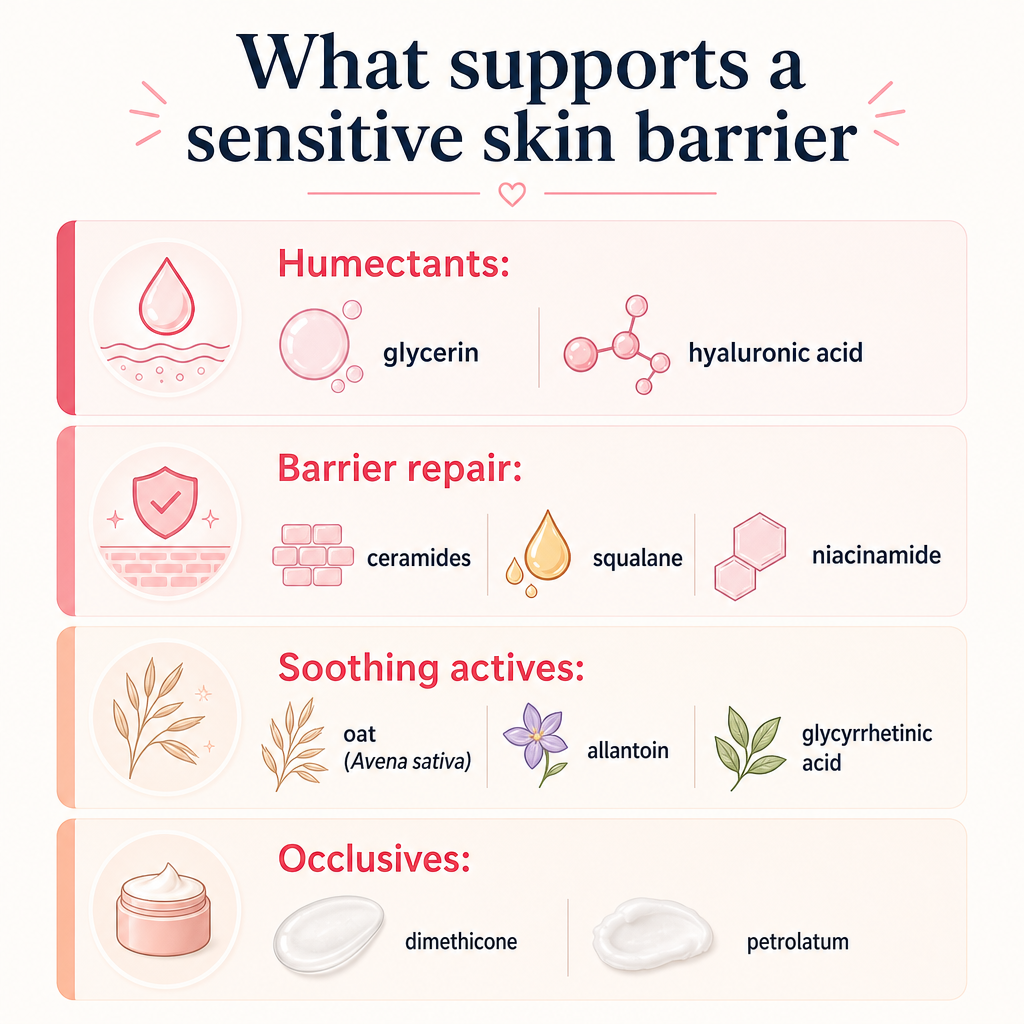
Sensitive skin is less about a single trait and more about a barrier that's easily provoked. When the outer layer of skin loses too much water and its protective structure weakens, ordinary products start to sting, and redness or reactivity follows. So the goal of a good sensitive-skin product isn't to do something dramatic; it's to support that barrier while avoiding the things that tear it down.
The ingredients that consistently help fall into a few groups. Humectants like glycerin and hyaluronic acid draw water into the skin. Emollients and barrier-repair ingredients such as ceramides and squalane help rebuild the structure that holds moisture in. Occlusives like dimethicone and petrolatum reduce water loss from the surface. On top of that sit soothing and reparative actives: a PubMed review on sensitive skin highlights niacinamide, oat (Avena sativa), allantoin, and glycyrrhetinic acid among the ingredients used to calm reactive skin.
Niacinamide deserves a special mention because it works for both sensitive and blemish-prone skin. It strengthens the barrier by reducing trans-epidermal water loss and supporting ceramide production, and it's generally well tolerated. Macherre's own explainer on skincare products with niacinamide and who should use them notes that moisturizers with roughly 2–5% niacinamide help skin feel less tight and less reactive over several weeks, while also helping balance oil. That combination is why it turns up in so many products aimed at people who react to almost everything else.
Just as important is what a sensitive-skin formula should keep to a minimum. Dermatology-oriented guides commonly point to fragrance, drying alcohols, and harsh exfoliating acids as the usual culprits behind flare-ups, because they can weaken the barrier and increase sensitivity over time. None of these are universally banned for every person, but they're the first things worth questioning when your skin keeps reacting.
Why "gentle" and "hypoallergenic" labels aren't enough
The words on the front of a bottle are marketing terms, not guarantees. "Gentle," "soothing," and "for sensitive skin" have no fixed, enforceable definition that tells you what's inside. A product can carry every reassuring phrase and still contain a fragrance blend or a high-strength acid that your particular skin can't handle.
"Hypoallergenic" is similarly slippery. It implies fewer allergens, but there's no single global standard behind the claim, so it can't tell you whether it accounts for your triggers. If essential oils set you off, a hypoallergenic label won't help unless you check the actual ingredient list.
Even "non-comedogenic" — a genuinely useful concept — has limits. Healthline defines non-comedogenic as designed not to block pores, and stresses that it lessens the likelihood of breakouts rather than guaranteeing none. In practice, a non-comedogenic formula tends to avoid ingredients with a high comedogenicity rating and lean on lower-rated ones, but the label doesn't cure acne; it only means the product is unlikely to make things worse. Garnier's scientific team describes non-comedogenic testing as a dermatologist-monitored lab process, often using oily or combination-skin panelists to check whether comedones increase. That's a manufacturer practice, not a universal legal requirement, and it varies by brand and region.
The practical takeaway is that the only reliable information lives in the ingredient list — the INCI list on the back. Two Macherre explainers dig into this specifically: one on what makes a moisturizer non-comedogenic and how to spot one, and a companion piece on what actually won't clog your pores. The point of both is the same: stop trusting the front of the box and start reading the back — which is exactly the part most people find impenetrable.
How Macherre scores and breaks down a product for your skin
This is where the vetting becomes practical instead of theoretical. Macherre is a skincare and cosmetics scanner that turns an ingredient list and product details into personalized guidance based on your skin type, sensitivities, and goals. Rather than leaving you to memorize which ingredients matter, it combines your profile into a single compatibility score per product, meant as a clear signal of whether something is worth trying for you specifically.
The score sits on top of a plain-language breakdown of every ingredient: what each component does, who it tends to help, and when it might cause problems. No chemistry background required. For sensitive skin, the checks that matter most are the irritancy and sensitivity flags, and — for those who also break out — pore-clogging signals. Because the analysis is tied to your profile, the same product can read differently for two people: fine for one, flagged for another whose profile lists fragrance as an avoid.
One honest caveat: Macherre doesn't publicly detail exactly how the score is weighted or where the cut-offs sit between "good fit" and "high risk." So treat the number the way it's intended — as a simple, at-a-glance signal that points you toward the ingredient breakdown, not as a mathematical promise. The real value is that it directs your attention to the ingredients that deserve a second look, and explains why.
Macherre is also independent from any brand, which matters for a decision like this. The scoring isn't steering you toward a retailer's inventory or a brand's own line; it's designed to help you make an unbiased choice for your skin. And to be clear about scope: the app is built for cosmetic ingredient education and personal product discovery, and it does not diagnose, treat, cure, or prevent any condition.
Step by step: vetting any cleanser, moisturizer, or SPF
Here's the actual workflow, using the tools rather than a generic checklist. It works the same whether you're evaluating a cleanser, a moisturizer, or a sunscreen.
Step 1 — Build your sensitive-skin profile. Before scanning anything, set up your profile inside the app. Mark your traits (dry, reactive, redness-prone, acne-prone), add known triggers such as fragrance, essential oils, particular acids, or sulfates, and set goals like barrier repair, calming redness, or reducing breakouts. You can also note pregnancy or breastfeeding status and product standards you care about, so the analysis is filtered through your skin from the start.
Step 2 — Capture the label. With a product in hand, there are three ways in. You can scan the barcode with the cosmetic barcode scanner to pull up the full ingredient and score breakdown, photograph the ingredient label so OCR reads it, or paste an INCI list manually. Manual pasting is handy when you're shopping online and only have a product page in front of you.
Step 3 — Read the score, then the flags. Look at the compatibility score first as a quick orientation, then scroll into the ingredient breakdown. This is the part that answers the real question: not just is this good, but what specifically might bother me. For sensitive skin you're watching for irritancy and sensitivity flags; if you're also breakout-prone, check the pore-clogging signals too. If you want to understand a single ingredient in depth, the ingredient checker decodes any list and links out to the ingredient dictionary.
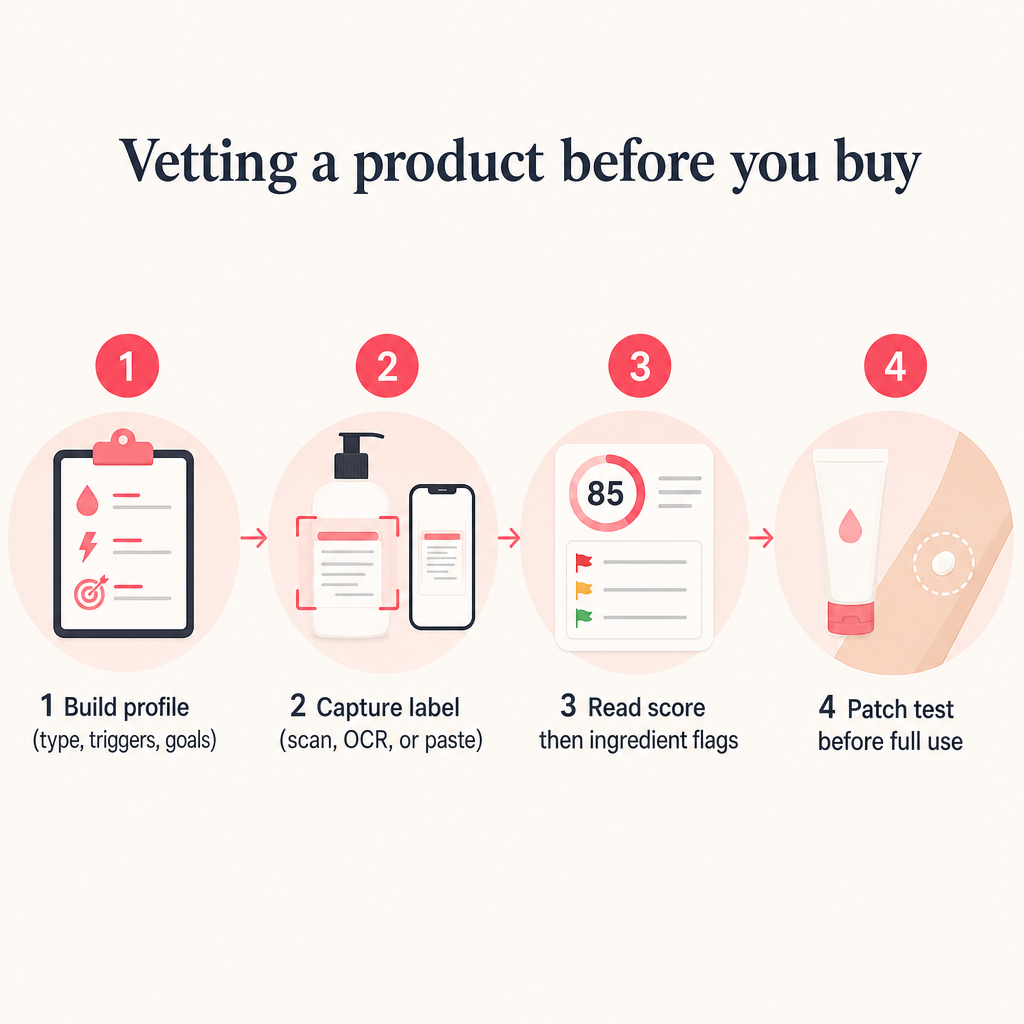
Step 4 — Patch test anyway. A favorable score is a green light to try, not a license to skip caution. This matters most for products with long ingredient lists or potent actives like retinoids, exfoliating acids, or high-percentage vitamin C. Guidance on patch testing recommends applying a small amount to a discreet spot — behind the ear or the side of the neck — for several days and watching for redness, burning, itching, or bumps before you commit it to your whole face. Healthline echoes this for acne-prone and sensitive skin specifically. Macherre's flags narrow the field; your own skin confirms the final call.
That's the entire loop. Profile, capture, read, patch test. Once it's habit, evaluating a new product takes a couple of minutes instead of a couple of weeks of guessing.
Special cases: fungal acne, seborrheic dermatitis, and acne-prone sensitive skin
Sensitive skin rarely arrives alone. Plenty of people juggle it alongside conditions that need more targeted screening, and a single general "safe/unsafe" label doesn't cut it. This is where Macherre's specialized checkers come in.
Fungal acne (Malassezia-driven bumps). If you get small, uniform, itchy bumps that don't respond to normal acne treatment, some of your products may be feeding Malassezia yeast. The fungal acne checker lets you paste any INCI list and flags the fatty acids, esters, polysorbates with C11–C24 chain lengths, and high-risk botanical oils most consistently linked to feeding that yeast. The flow is straightforward: copy the full ingredient list, run the screen, and cross-check with related tools. Crucially, the page labels this a fast first filter, not a diagnosis — fungal acne is a clinical diagnosis, and persistent or severe cases warrant a dermatologist.
Seborrheic dermatitis. For flaking, redness, or irritation around the nose, brows, or scalp, the seborrheic dermatitis trigger checker helps you screen leave-on products and cleansers for common triggers instead of guessing. Treat it as complementary to clinical care, never a replacement: seborrheic dermatitis is an inflammatory condition that's typically managed with medicated treatments under a doctor's guidance.
Acne-prone sensitive skin. When your barrier is reactive and you break out, comedogenicity becomes a second axis to check alongside irritation. The pore-clogging (comedogenic) checker surfaces ingredients with higher comedogenicity so you can see whether a rich moisturizer or sunscreen is likely to worsen congestion. Because fungal acne and ordinary comedonal acne can coexist, running a product through both the fungal acne checker and the pore-clogging checker is a reasonable move for anyone whose congestion has never fully cleared.
Across all of these, the same boundary applies: these checkers are screening aids that point you toward products worth avoiding or examining more closely. They don't diagnose anything, and they don't replace a professional assessment for conditions that persist.
Building a low-irritation routine and finding budget dupes
Vetting individual products is half the job. The other half is making sure they work together — and that you're not overpaying for a formula you could get more gently or more cheaply.
Sensitive skin does best with a short, minimalist routine built around barrier support: a humectant to pull in water, an emollient to rebuild structure, and an occlusive to seal it. The mistake that quietly wrecks reactive skin is stacking too many actives — two exfoliating acids plus a retinoid plus a strong vitamin C — until the barrier gives out. The routine creator is built to catch exactly this: you add your products, and it highlights clashes and gaps so you can confirm you're not doubling up on irritants and that barrier-supportive ingredients like ceramides, hyaluronic acid, and niacinamide actually appear across the routine.
The money side is where two more tools earn their place. Say you've fallen for an expensive "sensitive skin" cream but want a gentler or cheaper equivalent. The dupe finder locates alternatives that match a target's base structure and actives. Then the side-by-side product comparison tool lines up two or three products and shows you precisely what overlaps and what differs: which ingredients appear in all of them, which are unique to product A, and which are unique to product B, along with key actives, ratings, and sensitivities. Instead of deciding by bottle design or an influencer's enthusiasm, you're choosing by formula.
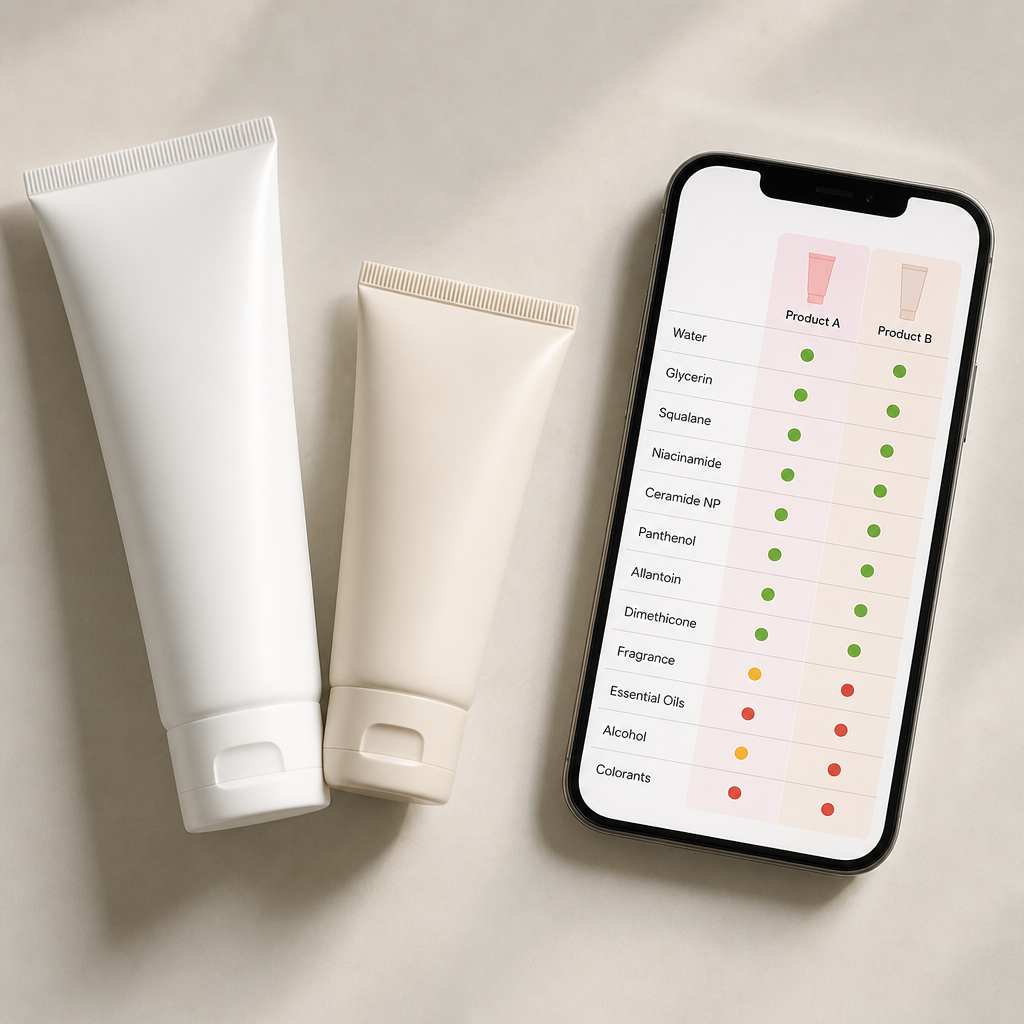
That comparison is genuinely useful for budget shoppers. A drugstore moisturizer and a premium one aimed at the same concern often share most of their meaningful ingredients; seeing that overlap in black and white makes it easy to walk away from the markup without walking away from the result. And because everything runs through your profile, a cheaper dupe that happens to contain one of your triggers gets flagged before it reaches your cart.
One last reminder that keeps the whole system honest: non-comedogenic products and gentle ingredients reduce, but never fully eliminate, the chance of irritation or a breakout. The score, the flags, and the checkers stack the odds in your favor. Patch testing and — when something won't settle — a dermatologist keep you safe.
Frequently asked questions
Does a high compatibility score mean a product is guaranteed safe for me?
No. The score is a simple signal that a product broadly fits your profile and is worth trying; it's not a mathematical promise. Macherre doesn't publish exact thresholds for "good fit" versus "high risk," so use the number to orient yourself, then read the ingredient breakdown and patch test before committing. Sensitivity is individual, and even a favorable score can't predict every reaction.
What does "non-comedogenic" actually guarantee?
Less than the label suggests. Non-comedogenic means a product is designed not to block pores, typically by favoring lower-comedogenicity ingredients, and it lessens the likelihood of pore-related breakouts. It does not cure acne or guarantee zero breakouts, and testing practices vary by manufacturer and region. Running the ingredient list through the pore-clogging checker gives you a clearer, personalized read than the front-of-box claim.
Which ingredients should sensitive skin usually look for and avoid?
Helpful ones include humectants like glycerin and hyaluronic acid, barrier-repair ingredients such as ceramides and niacinamide, and soothing actives like oat, allantoin, and glycyrrhetinic acid. Common irritants worth questioning are fragrance, drying alcohols, and strong exfoliating acids. "Usually" is the key word — set your own known triggers in your profile so the app flags what specifically matters to you.
How do I patch test a new product?
Apply a small amount to a discreet area, such as behind the ear or the side of the neck, for several days and watch for redness, burning, itching, or bumps. This matters most for products with long ingredient lists or potent actives like retinoids, acids, or high-percentage vitamin C. Only once it stays calm should you add it to your full routine, even if the score looks great.
Can Macherre tell me if I have fungal acne or seborrheic dermatitis?
No. The fungal acne and seborrheic dermatitis checkers are screening tools that flag ingredients associated with those conditions in your products — a fast first filter, not a diagnosis. Both conditions are clinical diagnoses. If bumps, flaking, or irritation persist or worsen, see a dermatologist for proper assessment and treatment.
Do I have to buy a product to vet it?
No, and that's the point. You can paste an ingredient list from any online product page or use the barcode scanner in a store aisle before you decide. Vetting before purchase is exactly how you avoid the expensive trial-and-error cycle that sensitive skin usually forces.