Non-Comedogenic Moisturizers Explained: What Actually Won't Clog Your Pores
You're standing in the drugstore aisle, or maybe you've got the add-to-cart screen open on your phone, and there it is on the front of the bottle: non-comedogenic. You've trusted that word before. You bought the "safe" moisturizer, did everything right, and still woke up three days later to a fresh crop of clogged pores along your jaw. It feels like a betrayal, because you read the label and the label told you it was fine. Here's what almost nobody mentions on the shelf: a non comedogenic moisturizer claim is not regulated by the FDA, and there is no standardized legal definition for the term. According to MedicalNewsToday, any brand can print "non-comedogenic" on any bottle without submitting a single piece of testing data. The word on the front isn't the truth. The ingredient list on the back is. By the end of this piece, you'll be able to verify the claim yourself in under a minute — no chemistry degree required.
Table of Contents
- Why "Non-Comedogenic" on a Label Doesn't Guarantee Anything
- The Comedogenic Ingredients Hiding in "Safe" Moisturizers
- How to Read a Moisturizer Ingredient List in Under 60 Seconds
- Ingredients That Are Actually Safe for Acne-Prone and Sensitive Skin
- Matching a Non-Comedogenic Moisturizer to Your Specific Skin Concern
- Verifying Any Moisturizer in Seconds Instead of Memorizing Ingredient Lists
- Your Non-Comedogenic Moisturizer Buying Checklist
- Common Questions About Non-Comedogenic Moisturizers
Why "Non-Comedogenic" on a Label Doesn't Guarantee Anything
Let's start with the uncomfortable mechanics of how this claim works, because once you understand it, you'll never read a label the same way again. In the United States, there is no regulatory standard for "noncomedogenic." The FDA does not require companies to prove noncomedogenicity or submit any testing data before printing the term on a moisturizer, a serum, or a foundation, according to MedicalNewsToday. The word costs the brand nothing. It carries no obligation. It's printed because it sells.
Healthline reinforces the same point: there are no federal rules around the use of the word, and the 0–5 comedogenic scale itself isn't standardized across sources. Two companies can apply two different interpretations and both end up with "non-comedogenic" on the front. So a non-comedogenic moisturizer meaning anything specific is, frankly, an illusion. The phrase describes a marketing intention, not a verified formulation outcome.
Sit with the consequence for a second. Two products on the same shelf, both labeled "non-comedogenic," can have completely different ingredient lists. One might be built on glycerin and squalane. The other might list coconut oil — rated a 4 out of 5 for pore-clogging — as its second ingredient. Both wear the same badge. Only one of them is telling your pores the truth, and the label gives you no way to tell which.
Dermatologists have been saying this for years. Dr. Shari Marchbein, a board-certified dermatologist and clinical assistant professor of dermatology at NYU, emphasizes that "non-comedogenic" is a marketing term rather than a regulated standard. Her advice is consistent and practical: focus on the actual ingredient list and patch test new products, rather than trusting front-of-pack claims. The label is the cover of the book. The ingredients are the story.
Dr. Leslie Baumann, the Miami-based dermatologist who wrote Cosmetic Dermatology, adds a layer that matters even when a brand did test. Many "non-comedogenic" claims stem from limited or outdated testing. So she frames the label as a starting point, not a guarantee — something to be confirmed against your own tolerance and your own awareness of which ingredients tend to break you out. Treat it as a hypothesis, not a verdict.
This is one of several unregulated marketing terms you'll meet on a skincare shelf, and it's worth knowing they travel in a pack. "Fragrance-free" suffers from the exact same verification gap — the claim sounds reassuring but isn't backed by a consistent standard, which is exactly why learning to read the back of the package matters across the board. If you want the full picture on that parallel claim, here's how to spot a genuine fragrance-free moisturizer for sensitive skin.
MedicalNewsToday puts it bluntly: noncomedogenic products may still cause breakouts, because no governing body verifies these claims and individual response varies from person to person. The publication's explicit recommendation is to scrutinize the ingredient list rather than relying on the label alone.
A non-comedogenic label is a marketing promise, not a formulation standard — the ingredient list is the only contract that counts.
Which is exactly where we're headed. The label is unreliable, so verification has to happen somewhere else: in the ingredient list. The rest of this article teaches you that skill, starting with the specific ingredients that tend to clog pores while hiding inside products that swear they won't.
The Comedogenic Ingredients Hiding in "Safe" Moisturizers
Before the reference table makes sense, you need the comedogenic scale in your head. The commonly used system rates ingredients from 0 to 5. According to the widely circulated PlatinumSkincare comedogenic ratings chart (a vendor source, so weigh it accordingly), 0 means "Will Not Clog Pores," 1 is "Low probability," 2 is "Moderately Low," 3 is "Moderate," 4 is "Fairly High," and 5 is "High probability it will clog pores." That's one of the more explicit numeric-to-risk translations in common use.
In practice, the screening rule most people apply is simple: 0–2 gets treated as "non-comedogenic" and 3 and above as a red flag for acne-prone skin, a threshold reinforced by Healthline's overview of the scale. That's the lens to bring to the comedogenic ingredients list below, which pulls from OnSkin's "considered comedogenic" and "probably comedogenic" classifications alongside PlatinumSkincare's ratings.
| Ingredient (common name) | INCI / also known as | Comedogenic rating | Commonly found in |
|---|---|---|---|
| Coconut oil | Cocos Nucifera Oil | 4 | Cream moisturizers, balms |
| Isopropyl myristate | Isopropyl Myristate | 5 | Lotions, lightweight creams |
| Isopropyl palmitate | Isopropyl Palmitate | 4 | Moisturizers, emollient lotions |
| Lauric acid | Lauric Acid | 4 | Cleansing balms, oils |
| Laureth-4 | Laureth-4 | 5 | Emulsified lotions |
| Ethylhexyl palmitate | Ethylhexyl Palmitate | 4 | Silky-finish moisturizers |
| Avocado oil | Persea Gratissima Oil | 2–3 | Nourishing creams |
| Olive oil | Olea Europaea Oil | 2 | Rich balms |
| Stearic acid | Stearic Acid | 2 | Cream emulsifiers |
(Ratings sourced from PlatinumSkincare and OnSkin classifications.)
Now the critical caveat, because reading these numbers as absolute verdicts is exactly the mistake to avoid. Dr. Joshua Zeichner, director of cosmetic and clinical research in dermatology at Mount Sinai Hospital, explains that comedogenicity is highly context-dependent. A high-rated ingredient used at a very low concentration behaves differently than the same ingredient used as a primary emollient. The rating has to be read alongside concentration and vehicle — where it sits in the formula, and what it's blended with.
The methodology behind these numbers deserves scrutiny too. Naturium notes that the scale is rooted in older studies, frequently rabbit-ear assays, where isolated ingredients were applied at fixed concentrations directly to rabbit ears. That setup cannot be mapped cleanly onto a modern finished moisturizer used on human skin. Different lists also disagree with each other, because the scale was never standardized in the first place.
So treat this table as a screening tool, not a final ruling on pore clogging ingredients. An ingredient rated 4 sitting near the bottom of an ingredient list — present in trace amounts — is far less concerning than the same ingredient rated 4 sitting at position two. Which is precisely why the position of a flagged ingredient is the next thing you learn to read.
How to Read a Moisturizer Ingredient List in Under 60 Seconds
Here's the manual scan method, and it's faster than you think once you've done it a few times. The foundation is INCI ordering: ingredients are listed by descending concentration for everything present above roughly 1%. Position is information. Something at the top is doing real work; something at the bottom is often a rounding error. That single rule is the backbone of how to read moisturizer ingredients quickly and accurately.
- Check the top 5 ingredients first. These are the highest-concentration components and they dictate how the product actually behaves on your face. A comedogenic oil sitting here matters enormously. The same oil in the last three positions usually doesn't.
- Flag known comedogenics from your reference list. Run your eye down the list looking for the rating-3-and-above offenders from the table above — coconut oil, isopropyl myristate, isopropyl palmitate, laureth-4, lauric acid, ethylhexyl palmitate. You're pattern-matching, not memorizing chemistry.
- Note the position of any flagged ingredient. Position 2 is a serious red flag because the formula is built around it. Position 20 is usually negligible, since it's present in a trace amount. This is the concentration principle in action — a high comedogenic rating at low concentration is a different animal than the same rating at high concentration.
- Account for your own skin type. Oily and combination skin reacts more readily to the "probably comedogenic" middle tier — avocado oil, olive oil, sweet almond oil, stearic acid — than dry skin does, according to OnSkin. Dry skin can often tolerate ingredients that would trigger oilier skin types. Your tolerance threshold is personal.
- Cross-check for a redeeming humectant. Confirm there's a safe hydrator in the mix — glycerin or hyaluronic acid being the two benchmarks. Their presence signals a formula built around water-based hydration rather than heavy oils. The next section breaks down exactly which ingredients earn the "safe" label.
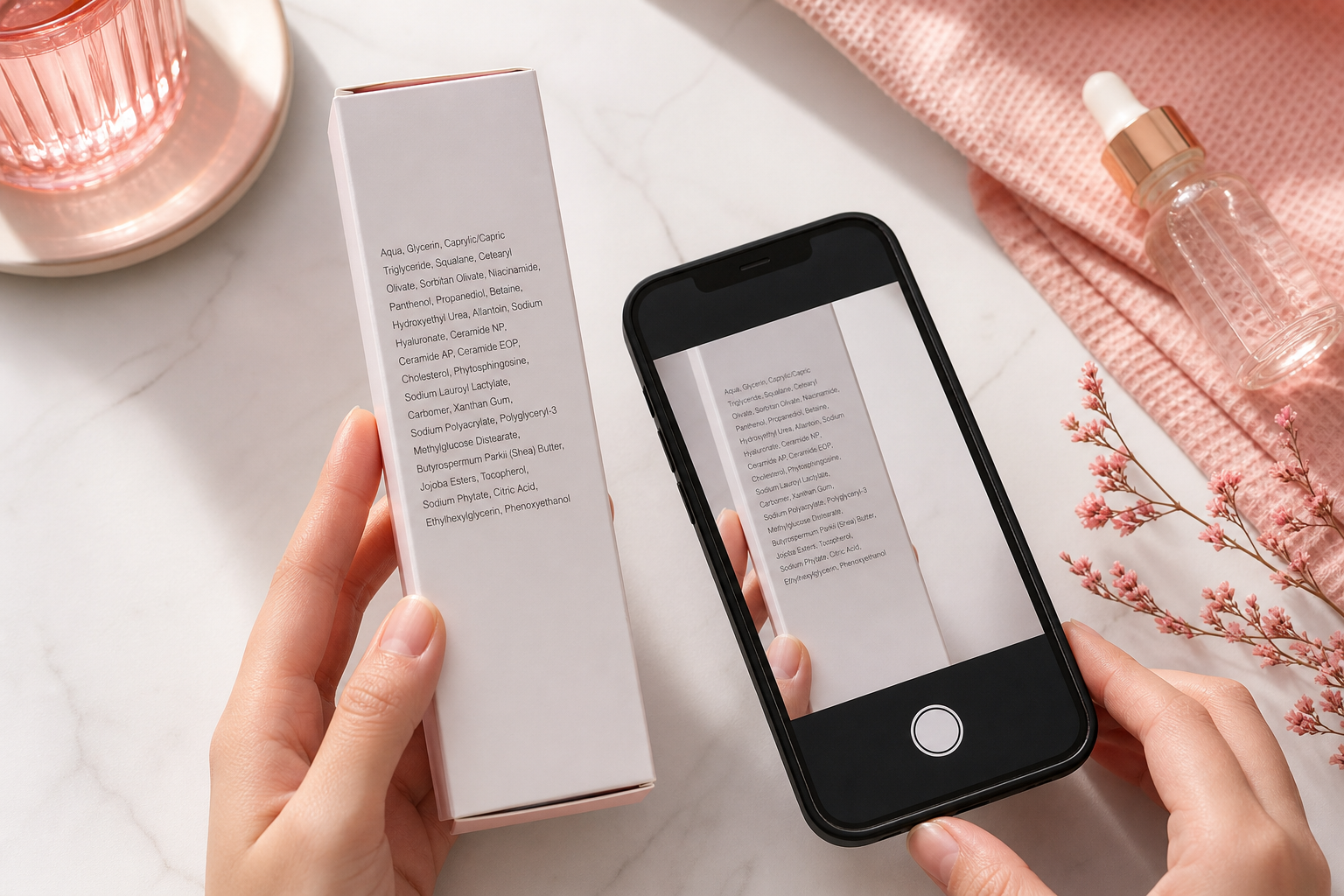
Ingredients near the top of the list do the heavy lifting — a comedogenic oil in position two matters far more than one buried in position twenty.
Ingredients That Are Actually Safe for Acne-Prone and Sensitive Skin
Enough about what to avoid. The flip side is the more useful list — the hydrators and soothers that moisturize without loading up your pores. These are the best non comedogenic ingredients to actively look for, and the ones that make a non comedogenic moisturizer for acne prone skin genuinely work rather than just claim to.
Hyaluronic acid — A humectant that pulls water into the skin without any oil or occlusive load whatsoever. That mechanism is what makes it one of the safest hydrators for acne-prone skin: it adds moisture without adding anything that could block a pore. Dr. Whitney Bowe stresses that barrier-supporting humectants like this are preferable for acne-prone and sensitive skin precisely because they hydrate without the risk. If you're deciding between this and other actives, the difference between hyaluronic acid and niacinamide comes down to whether you need pure hydration or barrier-and-oil support.
Glycerin — A lightweight, water-binding humectant that hydrates without clogging. It's the benchmark "safe" ingredient and shows up in most fungal-acne-safe formulations, according to TheSkinimalist. Dr. Bowe groups it right alongside hyaluronic acid as a top pick. If you see glycerin high on an ingredient list, that's a good sign the formula prioritizes hydration.
Squalane — A lightweight emollient that mimics your skin's own natural oils but stays non-comedogenic and, importantly, Malassezia-safe. Skynbio recommends it specifically for fungal-acne-prone skin, which makes it a rare emollient that works for people who normally can't tolerate oils at all.
Niacinamide — A multitasker that supports the skin barrier and helps regulate oil production without adding any pore-clogging load. It's one of the few actives that earns a place in nearly any routine, oily or sensitive. If you want the full breakdown of what it does and who benefits most, here's a deeper look at skincare products with niacinamide.
Dimethicone (with nuance) — A silicone that forms a breathable, non-greasy film over the skin. It's non-comedogenic for most people and gives that smooth, soft-focus finish. The honest caveat: some acne-prone users prefer to limit heavy silicone layering, especially if they're stacking several silicone-rich products. For most skin, it's fine; for a few, it's worth watching.
Ceramides plus soothing actives — Ceramides rebuild the barrier, and the calming actives that often accompany them are reliably gentle. MedicalNewsToday lists aloe vera, witch hazel, rose water, and allantoin as low-comedogenic benchmarks for "safe" moisturizers. Panthenol and allantoin are also fungal-acne-safe, per Skynbio and TheSkinimalist, making this cluster a strong choice for reactive, easily irritated skin.
One honest warning to close on. Even with these safe bases, Dr. Bowe cautions that heavy occlusive balms and fragrant essential oils can still trigger breakouts despite a non-comedogenic label. A good ingredient list can be undone by a heavy texture or a fragrance load, so the whole formula matters, not just the presence of one safe humectant.
Matching a Non-Comedogenic Moisturizer to Your Specific Skin Concern
Here's the insight that reframes everything: "non-comedogenic" is not one-size-fits-all. A moisturizer can score perfectly clean on the 0–5 scale and still wreck the skin of someone with fungal acne. That's because fungal acne isn't a pore-clogging problem at all — it's driven by Malassezia yeast feeding on fatty acids and esters. It's a different mechanism, so it needs a different screen. A standard comedogenic chart will happily wave through ingredients that feed fungal acne. This is the core reason a non comedogenic moisturizer for sensitive skin has to be chosen against your specific concern, not a generic rating.
| Skin concern | Additionally screen out | Prioritize | Common mistake |
|---|---|---|---|
| Fungal acne | Fatty acids, esters, most oils | Squalane, panthenol, allantoin, urea | Trusting "non-comedogenic" alone |
| Seborrheic dermatitis | Oils & fatty acids feeding yeast | Zinc pyrithione, ketoconazole, sulfur | Using rich occlusive creams |
| Rosacea | Fragrance, essential oils, harsh actives | Glycerin, ceramides, soothing humectants | Over-focusing on pore rating only |
| Oily / acne-prone | Rating 3+ comedogenics (coconut, IPM) | Lightweight gels, niacinamide | Heavy creams marketed "non-comedogenic" |
| Sensitive | Fragrance, essential oils | Aloe, allantoin, panthenol, ceramides | Assuming "non-comedogenic" = gentle |
(Sourced from Skynbio, COSRX, TheSkinimalist, and MedicalNewsToday.)
The fungal-acne distinction is the one that trips people up most, so it's worth spelling out. Skynbio identifies fatty acids and esters as the major food sources for Malassezia and recommends building a fungal acne safe moisturizer around squalane, panthenol, allantoin, or urea — ingredients the yeast can't metabolize. That's a fundamentally different shopping list from a generic acne-prone one.
On the active side, COSRX's fungal acne guide (a vendor source) specifies treatment ingredients to reach for — ketoconazole, zinc pyrithione, and sulfur — while advising you avoid the oils and fatty acids that feed the fungi. Those same actives anchor the seborrheic dermatitis row, since seb derm and fungal acne share that yeast-driven root.
The market itself now reflects this split. SkinSort maintains a curated "10 best fungal acne safe moisturizers" list with full ingredient breakdowns — concrete proof that "non-comedogenic" and "fungal-acne-safe" are treated as two separate categories, not synonyms. For sensitive and fungal-prone skin, TheSkinimalist points to gentle bases featuring oat seed water, glycerin, squalane, and centella asiatica.
Tie it all together and the lesson is clear. A single comedogenic score can't capture concern-specific needs. Someone with rosacea is worried about fragrance and essential oils, not oleic acid. Someone with fungal acne is worried about esters that a standard comedogenic chart cheerfully marks as "safe." The right moisturizer depends on which problem you're actually solving.
Verifying Any Moisturizer in Seconds Instead of Memorizing Ingredient Lists
By now you can see the catch. The manual method works — genuinely works — but it's slow and it leans hard on memory. To do it properly at the shelf, you'd need to hold a 40-ingredient cross-reference list in your head, plus a concern-specific screening matrix, plus the concentration-and-position logic, plus your own skin-type adjustments. That's a lot to run through while someone's reaching past you for their toner. The manual scan from the earlier sections is the right method; it just doesn't scale to a busy shopping trip.
Scanning solves the scale problem. Instead of decoding the label yourself, you let a tool run the same screen instantly. This is where Macherre fits — built specifically to do the lookup you'd otherwise do by hand.
- Scan a product by its ingredient list and get an automatic readout. No INCI decoding, no flipping back to a reference chart.
- A pore-clogging checker flags comedogenic ingredients automatically against the same 0–5 scale logic covered earlier — and accounts for position in the list.
- A fungal acne checker screens specifically for the fatty acids and esters that feed Malassezia, the exact category a standard comedogenic chart waves through. That's the gap from the previous section, closed automatically.
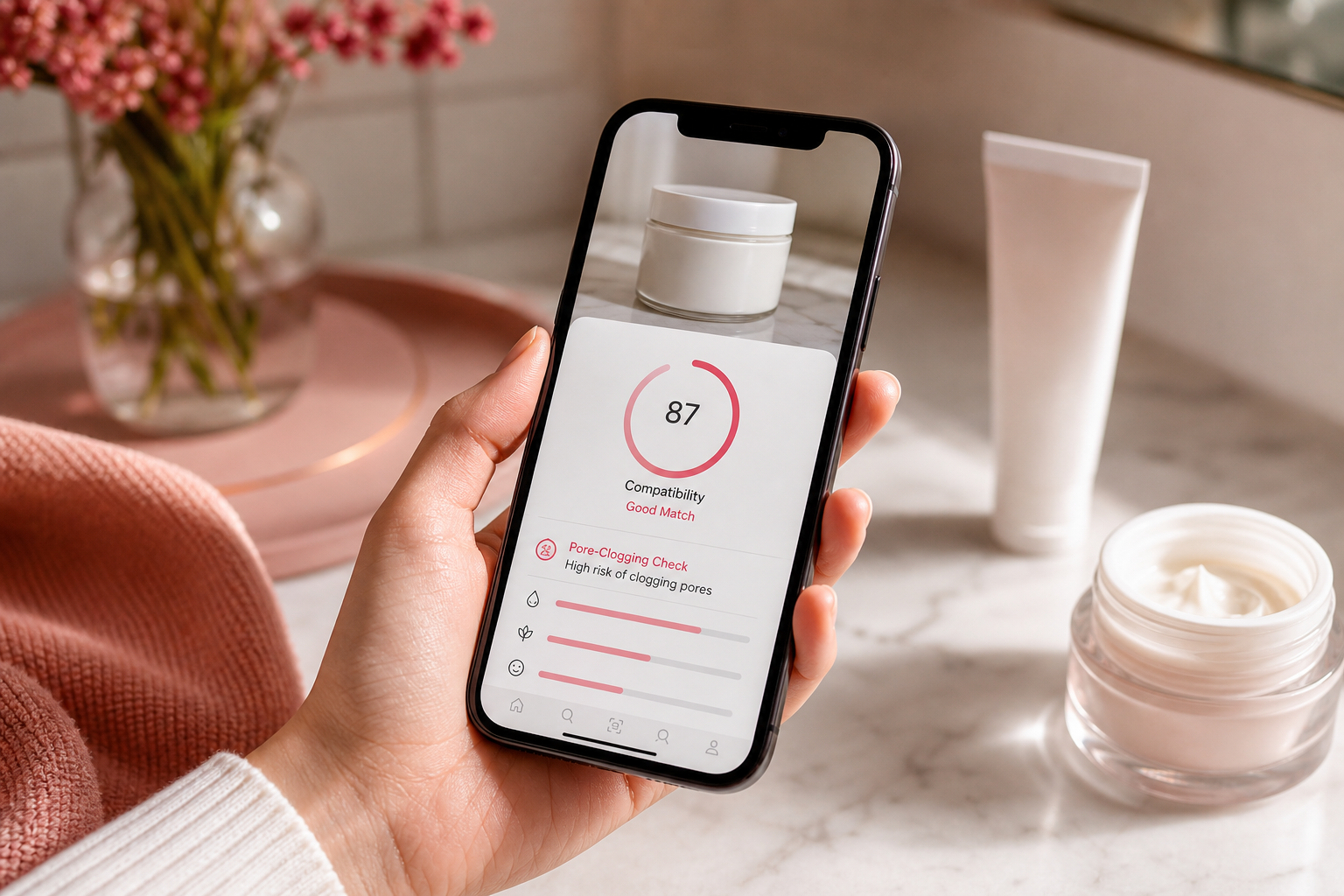
- A compatibility score distills everything into one personalized number based on your skin type, sensitivities, and goals — so the verdict reflects your skin, not a generic rating built for someone else.
- An ingredient dictionary gives a plain-language breakdown of every ingredient, which removes the memorization burden entirely.
- A dupe finder locates cheaper non-comedogenic alternatives that match a product you already like — directly useful if a clean formula you found is priced higher than you'd want.
The fastest way to know if a moisturizer will clog your pores isn't memorizing a list of forty ingredients — it's letting a scan do the screening you'd otherwise do by hand.
A note on honesty, because it matters. This doesn't replace a dermatologist or a patch test — Dr. Marchbein's patch-testing advice from earlier still stands, and there's no substitute for seeing how a product behaves on your own skin over a couple of weeks. What scanning replaces is the tedious manual lookup, the part that's mechanical and error-prone. As an independent, privacy-first alternative to tools like CosDNA, SkinCarisma, and SkinSort, the goal is straightforward: when you're standing at the shelf or hovering over the checkout button, a scan runs the screening you'd otherwise do by hand — faster, and without the memory gaps.
Your Non-Comedogenic Moisturizer Buying Checklist
Take this to the store or pull it up at checkout. Six steps, in order, and you'll have screened a product properly before it ever touches your face.
- Ignore the "non-comedogenic" claim on the front. It's unregulated and unverified, so treat it as zero evidence either way. Don't let it reassure you and don't let its absence scare you off — just flip the package over and go straight to the ingredient list.
- Read the top 5 ingredients. These are the highest-concentration components and they decide how the product behaves on your skin. This is your single fastest signal. If the top five are clean humectants and lightweight emollients, you're already in good shape.
- Flag anything rated 3 or above on the comedogenic scale. Use the reference table — coconut oil, isopropyl myristate, isopropyl palmitate, laureth-4, lauric acid, ethylhexyl palmitate. Then note where it sits. High up the list is a real concern; near the bottom is usually negligible. Per Healthline, scores of 3 and above are the threshold worth pausing on for acne-prone skin.
- Cross-check against your specific concern. This is the step most people skip. If you have fungal acne or seborrheic dermatitis, you must additionally screen out fatty acids and esters — the Malassezia food sources Skynbio flags — even on a product that's genuinely non-comedogenic by the pore-clogging scale. Your concern dictates your second screen.
- Confirm a safe humectant is present. Look for glycerin or hyaluronic acid. Their presence is a strong signal the formula is built around water-based hydration rather than heavy occlusive oils. A formula leading with humectants is usually a safer bet for reactive skin.
- Compare against a known-clean alternative or dupe before buying. Don't buy in a vacuum. Run the product through a scan, check its compatibility score, and use a dupe finder to confirm your choice — and to surface a cheaper non-comedogenic match if the one in your hand is pricey.
Before you tap "buy," scan the moisturizer to get a personalized compatibility score and an automatic pore-clogging check — so the only non comedogenic moisturizer that reaches your face is one you've actually verified, not one you took on faith from the front of the bottle.
Common Questions About Non-Comedogenic Moisturizers
Does non-comedogenic mean oil-free?
No — these are two separate claims that get conflated constantly. A moisturizer can contain oils, like squalane or certain low-rated plant oils, and still be non-comedogenic, because not all oils clog pores. Meanwhile, an oil-free product can absolutely still contain pore-clogging non-oil ingredients. Look at OnSkin's "considered comedogenic" list and you'll see esters like isopropyl myristate — a 5 on the scale — that aren't oils at all. "Oil-free" tells you about one category of ingredient; it says nothing about the esters and fatty acids that may be doing the actual clogging.
Can a moisturizer be non-comedogenic but still cause breakouts?
Yes, and it happens more than the marketing would suggest. MedicalNewsToday cautions that noncomedogenic products may still cause breakouts because no governing body verifies the claim and individual response varies from person to person. On top of that, Dr. Bowe points out that occlusive balms and fragrant essential oils can trigger breakouts despite a non-comedogenic label — the texture and the fragrance can undo an otherwise clean ingredient list. The label being accurate and your skin being happy are not the same thing.
Are comedogenic ratings reliable, and where do they come from?
Treat them as rough guidance, not gospel. Naturium and OnSkin both trace the ratings back to older rabbit-ear assays, where researchers applied isolated ingredients at fixed concentrations directly to rabbit ears — a setup materially different from how anyone actually uses a finished moisturizer. Because the scale was never standardized, different lists openly disagree with one another about the same ingredient. Useful as a screening filter, unreliable as a final verdict.
Is non-comedogenic the same as fungal-acne-safe?
No, and this is the most consequential mix-up of the whole article. Fungal acne is driven by Malassezia yeast feeding on fatty acids and esters — ingredients a standard comedogenic chart frequently marks as "safe." So a product can be genuinely non-comedogenic by the pore-clogging scale and still feed fungal acne. If that's your concern, you have to screen separately for esters and fatty acids using Skynbio's avoid-list, and lean on a fungal acne safe moisturizer built around squalane, panthenol, allantoin, or urea. Two different problems, two different screens — never assume one label covers both.