Fragrance-Free Moisturizers for Sensitive Skin: How to Spot the Real Deal
Why Your "Fragrance-Free" Moisturizer Still Made Your Skin Burn
You bought the fragrance-free moisturizer. You read the front of the box twice. You trusted the label — and 48 hours later your cheeks were stinging, your jaw was flushed, and you were back at the bathroom mirror wondering what you did wrong. You didn't do anything wrong. The problem is that a fragrance-free moisturizer for sensitive skin isn't a regulated formula category. It's a marketing claim. According to the US FDA's guidance on fragrances in cosmetics, there is no binding legal definition of "fragrance-free" — which means brands can ship products under that label while the formula still contains botanical extracts that biologically behave exactly like perfume. By the end of this guide you'll be able to scan any moisturizer in under two minutes and predict whether it will trigger you, without trusting a single word on the front of the package.
Table of Contents
- What "Fragrance-Free" Legally Means (and the Three Loopholes Brands Exploit)
- The Three Hidden Irritant Categories Sabotaging "Safe" Moisturizers
- Reading a Moisturizer Ingredient List in Under Two Minutes
- Fragrance-Free Moisturizer Choices by Skin Condition
- The Routine Clashes That Make Fragrance-Free Moisturizers Fail Anyway
- Your Fragrance-Free Verification Workflow
What "Fragrance-Free" Legally Means (and the Three Loopholes Brands Exploit)
The label is doing less work than you think. Before you can shop intelligently, you have to know exactly what regulators require — and what they don't.
The US gap. The FDA does not codify "fragrance-free." It treats the phrase as a marketing claim, not a formula standard. The agency's cosmetic labeling guidance distinguishes "fragrance-free" (no fragrance added for the purpose of scent) from "unscented" (a product that may legally contain added fragrance, used specifically to mask the base odor of raw materials so the formula reads as smelling like nothing). Read that twice. A moisturizer labeled "unscented" can contain added fragrance. The fragrance is there to produce the absence of smell. If you've been buying "unscented" thinking it was the safer of the two terms, the labeling system has been working against you the entire time.
The EU 26-allergen rule. The European Union goes further than the US, but not as far as most consumers assume. Under EU Regulation (EC) No 1223/2009, Annex III, 26 named fragrance allergens — including limonene, linalool, citral, geraniol, eugenol, and citronellol — must be individually disclosed on the label only when they exceed 0.001% in leave-on products or 0.01% in rinse-off products. Below those thresholds they are legally hidden inside the umbrella term "parfum" or "aroma." That means a fragrance-free EU product can still contain trace fragrance allergens, and trace levels are precisely enough to react in someone who's already sensitized. The threshold protects the average shopper. It does not protect you if your skin has been flaring for years.
The botanical loophole. This is the one almost nobody catches. Plant extracts like citrus peel oil, lavender, peppermint, eucalyptus, rose, ylang-ylang, and tea tree contain the exact sensitizing terpenes — limonene, linalool, eugenol — that show up in synthetic fragrance mixes. The contact dermatitis literature (de Groot & Frosch; SCCS opinions on fragrance allergens) is unambiguous on this. But because these molecules arrive inside a botanical, they get listed by their botanical INCI name, not as "fragrance." A formula full of essential oils can be labeled fragrance-free and pass every regulatory check. In contact dermatitis clinics, standardized Fragrance Mix I and II patch tests come back positive in roughly 8–12% of tested patients (Zug et al., NACDG data, Dermatitis) — a population already enriched for skin reactivity, but a useful upper-bound for what your reaction profile might look like if you've been flaring repeatedly.
A moisturizer can be legally fragrance-free in two regulatory zones and still contain a dozen botanical ingredients that trigger the exact same reaction as synthetic perfume.
The "hypoallergenic" red herring. The European Commission's "Guidelines for the Assessment of Cosmetic Claims" restrict the use of "hypoallergenic" unless the brand can substantiate it. The FDA has publicly called the term essentially meaningless without standardized criteria. "Dermatologist tested" sounds clinical but only confirms the product was applied to some panel of people under dermatological supervision — it tells you nothing about whether the formula is safe for your skin profile, your sensitivities, or your barrier state. None of these claims survive contact with a real ingredient list.
This is why label-trust fails. The label is a starting point, not a verdict. The next section moves you from label-trust to ingredient-trust — the only level of detail that actually predicts what your face will do.
The Three Hidden Irritant Categories Sabotaging "Safe" Moisturizers
Sensitive skin isn't rare. Multinational surveys published by Misery et al. in JEADV report that roughly 50–70% of women and 30–60% of men describe their skin as at least somewhat sensitive. General-population fragrance contact allergy sits at a smaller 1–4% (Thyssen et al., Contact Dermatitis) but climbs sharply to 8–12% in eczema-prone and patch-test populations (Zug et al., NACDG). The takeaway: if you've repeatedly reacted to products labeled fragrance-free, you are statistically more likely to be reacting to something the label doesn't flag at all. Three ingredient categories cause the bulk of these "but it said fragrance-free!" reactions.
1. Fragrant botanicals masquerading as actives. Citrus peel oils (bergamot, lemon, orange), lavender, peppermint, eucalyptus, ylang-ylang, rose, cinnamon bark, tea tree, geranium, oakmoss — these are the heavy hitters. Every one of them carries limonene, linalool, eugenol, or citral, the same molecules on the EU 26-allergen list. Rosacea patients are especially vulnerable to peppermint, menthol, and eucalyptus because these compounds activate the TRPM8 cold receptor, which provokes flushing and stinging in reactive vasculature (Lazar et al., JEADV). Practical rule: if a plant extract appears anywhere in the top 10 ingredients of a fragrance-free moisturizer, treat the formula as a fragranced product regardless of what the label claims. The position matters as much as the presence.
2. Preservative systems with high allergy histories. Methylisothiazolinone (MI) and methylchloroisothiazolinone (MCI) were the engine of a documented allergy epidemic in the 2010s — bad enough that the EU SCCS banned them from leave-on products. Formaldehyde-releasing preservatives (DMDM hydantoin, quaternium-15, imidazolidinyl urea) carry well-established sensitization rates in the contact dermatitis literature. Phenoxyethanol, capped at 1.0% under EU rules, is not a true allergen for most people but can sting a compromised barrier on contact. Preservative reactions get blamed on "fragrance" constantly, because the symptom is identical: heat, redness, tingling, sometimes peeling 48 hours later. Misdiagnosing the cause means you keep buying the same wrong formulas.
3. Emulsifiers and fatty alcohols that read as fragrance reactions. Polysorbates (20, 60, 80) are well-tolerated for most skin types — but they're metabolizable substrates for Malassezia yeast, the organism behind fungal acne (Gupta et al., JAAD, on Malassezia folliculitis). Cetearyl alcohol and ceteareth-20 are generally safe but can sting when the barrier is already disrupted. Sodium lauroyl lactylate and certain PEG-based emulsifiers produce stinging responses in rosacea patients. The reactions feel identical to fragrance burn — that's why they get mislabeled. If your last three "fragrance-free" failures all contained polysorbate 60 in the top 10, the polysorbate isn't a coincidence.
Reading a Moisturizer Ingredient List in Under Two Minutes
One rule anchors everything: INCI ingredient lists are ordered by descending concentration until 1%, after which order becomes flexible (US FDA cosmetic labeling regulations; European Commission cosmetic labeling guidance). That means an essential oil at position 5 is at meaningfully higher concentration — and meaningfully higher reactive potential — than the same oil at position 22. Position is information. Most shoppers never count.
The decision matrix below is the tool to use. Memorize the categories, not the individual names.
| Ingredient Category | Example INCI Names | Why It's in the Formula | Risk for Sensitive Skin | Red-Flag Position |
|---|---|---|---|---|
| Fragrant botanical oils | Citrus aurantium, Lavandula angustifolia, Mentha piperita, Eucalyptus globulus | Marketing appeal, mild antimicrobial | High — contains limonene, linalool, eugenol | Anywhere in top 15 |
| Listed fragrance allergens | Limonene, Linalool, Citral, Geraniol, Eugenol | Disclosed under EU 26-allergen rule | High in eczema/rosacea; moderate otherwise | Any position |
| Harsh preservatives | Methylisothiazolinone, DMDM hydantoin, Quaternium-15 | Microbial protection | High — major contact allergens | Any position |
| Mid-risk preservatives | Phenoxyethanol, Benzyl alcohol | Microbial protection | Low–moderate; may sting broken barriers | Above 1% concerning |
| Yeast-feeding emulsifiers/esters | Polysorbate 20/60/80, Isopropyl myristate | Texture, oil dispersal | High for fungal acne only | Top 10 = flare risk |
| Generally safe emollients | Glycerin, Squalane, Petrolatum, Caprylic/Capric Triglyceride | Hydration, occlusion | Very low | Safe at any position |
| Barrier-repair actives | Ceramides (NP, AP, EOP), Niacinamide, Panthenol | Barrier restoration | Very low; net beneficial | Want these in top 10 |
INCI lists are concentration-ordered, not alphabetical. An essential oil at position five hits your skin harder than the same oil at position twenty-two — learn to count.
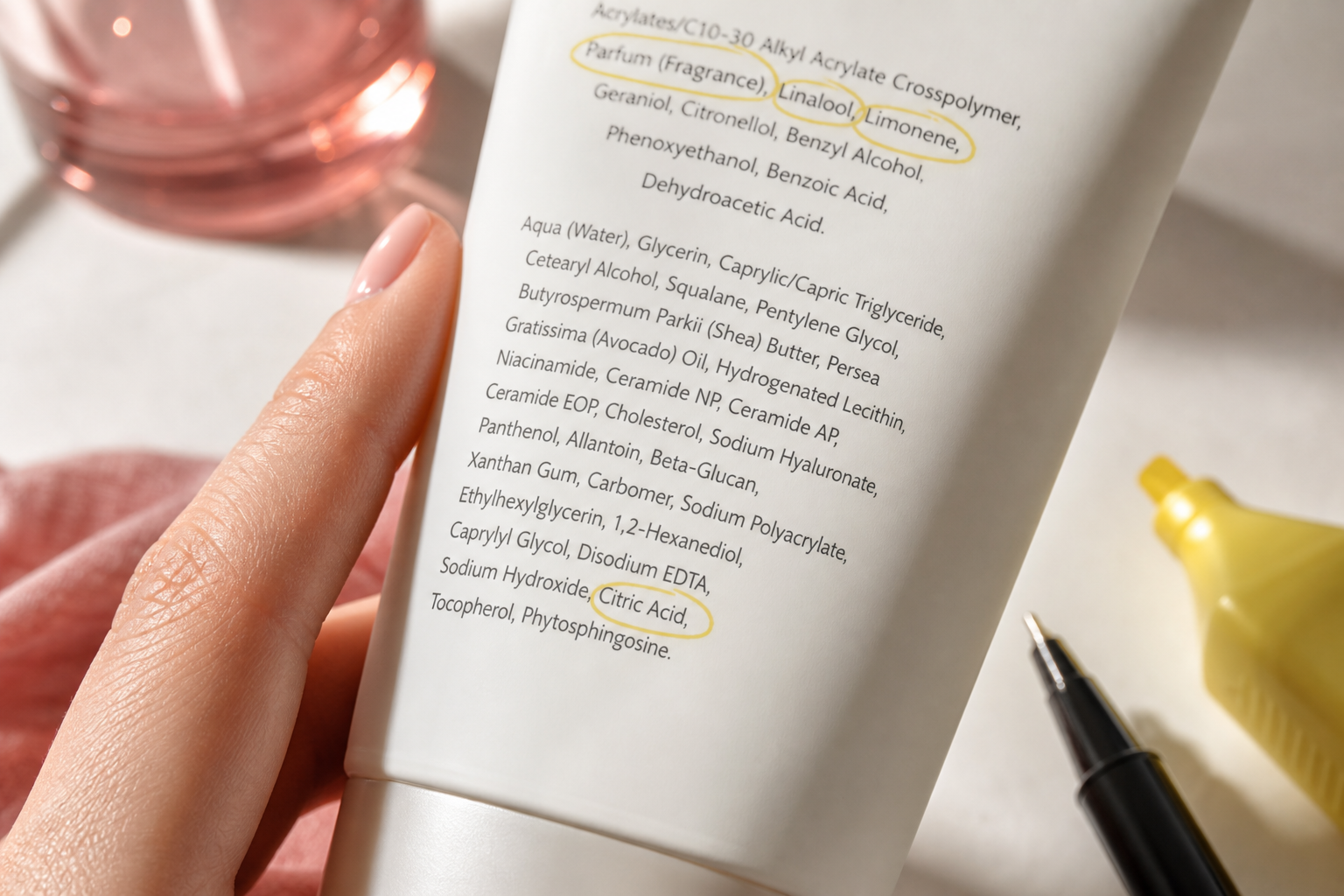
In a real shopping scenario, run the matrix as a four-step process. Step one: open the product page or pull the box and find the full ingredient list. Step two: scan only the first 10 ingredients — that's where roughly 90% of the formula by weight lives. Step three: flag anything that lands in the "fragrant botanical oils," "harsh preservatives," or "yeast-feeding emulsifiers" rows. Even one hit in the top 10 is usually disqualifying for repeatedly reactive skin. Step four: confirm that at least one ingredient from "generally safe emollients" or "barrier-repair actives" appears in the top 10. If nothing from those rows is in the top 10, the formula isn't actively doing barrier work — it's just neutral filler, and if you're layering actives like retinol that already strain your barrier, neutral isn't enough. (For more on sequencing retinol against a fragile barrier, see our retinol for sensitive skin guide.)
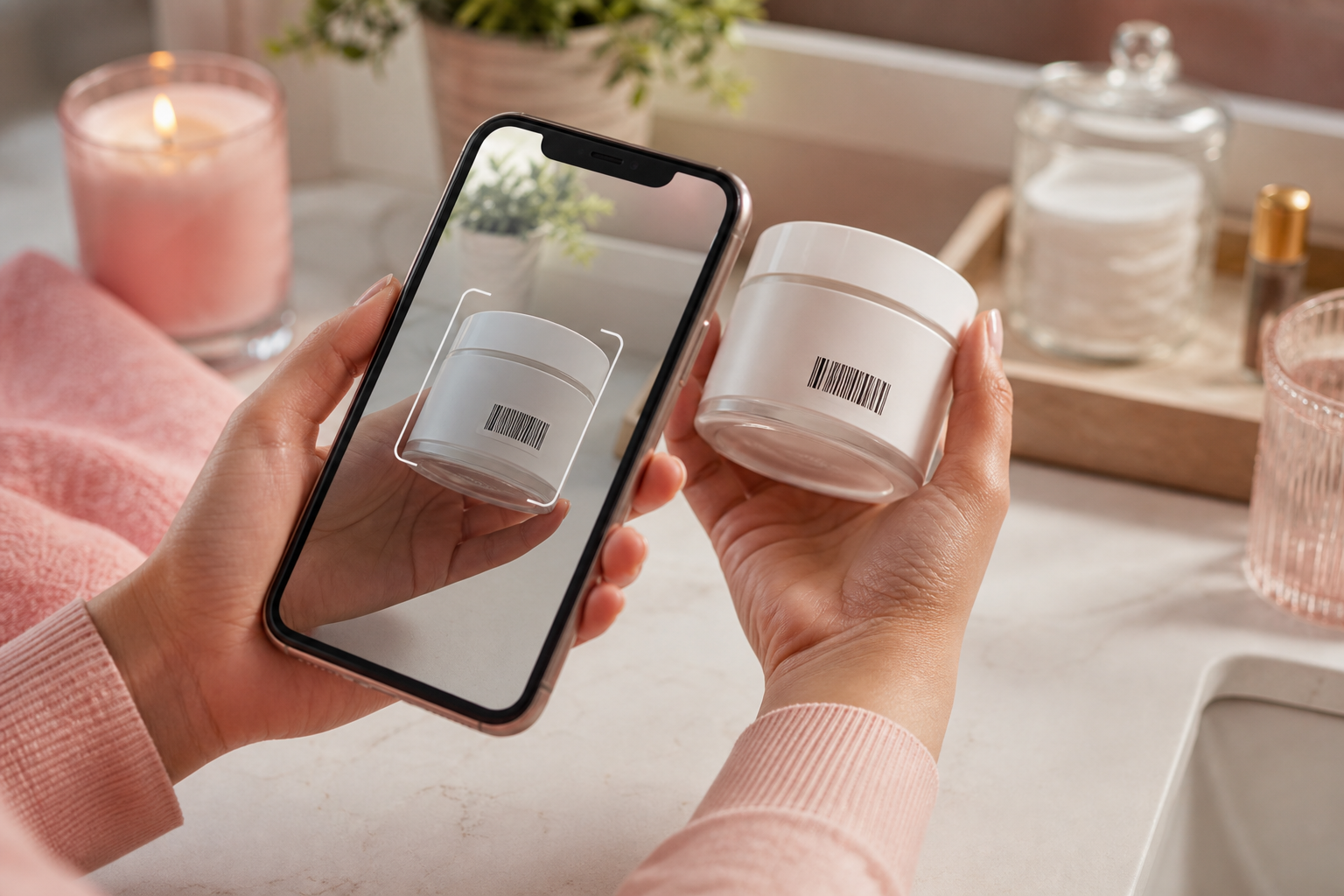
The manual process works, but it's slow and easy to fumble in a Sephora aisle with your phone at 8% battery. The Macherre app handles the same workflow in roughly 15 seconds: scan the barcode, get a single compatibility score against your declared skin type and sensitivities, see every ingredient flagged by function and risk, and pull authentic reviews filtered specifically by your skin condition. The specialized checkers carry the heavy lifting for harder-to-spot triggers — the fungal acne checker auto-flags polysorbates and esters, the pore-clogging checker handles comedogenicity as a separate question, and the seborrheic dermatitis checker overlaps with the Malassezia logic. A single "is this safe for me?" answer beats scrolling through CosDNA-style raw data every time.
Fragrance-Free Moisturizer Choices by Skin Condition
Segmenting by condition matters because the "right" fragrance-free moisturizer for eczema (heavy occlusion, ceramide-anchored) is the wrong moisturizer for fungal acne (no esters, no polysorbates, no fatty acids in the C11–C24 range). Eichenfield et al.'s atopic dermatitis guidelines in JAAD position fragrance-free emollients as first-line therapy for eczema — but those same guidelines say nothing about Malassezia compatibility, because Malassezia isn't an eczema mechanism. Gupta et al. in JAAD document the inverse: the ingredient logic that controls fungal acne is incompatible with the ingredient logic that comforts eczema. There is no universal "sensitive skin" moisturizer. There is a right answer per condition.
| Skin Condition | What the Formula Must Avoid | What the Formula Must Include | Common Vehicle | Verification Step |
|---|---|---|---|---|
| Fungal acne (Malassezia folliculitis) | Polysorbates, esters (isopropyl myristate), most plant oils, fatty acids C11–C24 | Squalane, glycerin, niacinamide, urea | Light gel or gel-cream | Run through fungal acne checker |
| Rosacea | All essential oils, menthol, peppermint, eucalyptus, alcohol denat., high phenoxyethanol | Centella asiatica (non-fragrant), niacinamide, ceramides, glycerin | Light cream | Filter by rosacea reviews |
| Eczema / atopic dermatitis | All fragrance, all botanical extracts, MI/MCI, formaldehyde-releasers, dyes | Ceramides (NP, AP, EOP), cholesterol, petrolatum, colloidal oatmeal | Thick cream or ointment | Check for "parfum" and botanicals |
| Non-eczema sensitive skin | Top-10 botanicals, harsh preservatives, high-fragrance allergens | Glycerin, panthenol, ceramides, low preservative load | Lotion or light cream | Compare compatibility scores |

For fungal acne, the mechanism is biological, not allergic. Malassezia yeast metabolizes mid-chain fatty acids and esters as food. An otherwise clean fragrance-free moisturizer with isopropyl myristate at position 4 will still flare it, because position 4 means there's enough substrate to feed a yeast bloom. This is why a generic "fragrance-free" filter on a retailer site doesn't solve fungal acne — the retailer is filtering for the wrong variable. The Macherre fungal acne checker filters for the variable that actually matters.
For rosacea, the trap is the "cooling" feeling. Many soothing-looking fragrance-free formulas include peppermint or eucalyptus specifically for the fresh sensation on application. That sensation is TRPM8 cold-receptor activation (Lazar et al., JEADV) — the same mechanism that triggers rosacea flushing. The cooling feeling is the warning sign, not the feature. Niacinamide appears in nearly every safe recommendation for rosacea — here's why it works for sensitive skin and how it compares against hyaluronic acid as a barrier-supporting active: see our breakdown of niacinamide vs hyaluronic acid.
For eczema, the National Eczema Association's patient guidance has been consistent for years: fragrance-free, dye-free, short ingredient lists, ceramide- or petrolatum-anchored. Dr. Peter Lio, an NEA contributor and Northwestern dermatology faculty member, has warned repeatedly that many "baby" and "sensitive baby" lines still include fragrance or botanicals that quietly undermine their positioning. Read the back, not the front, regardless of the implied audience.
For non-eczema sensitive skin, the goal is reducing total ingredient load. Fewer ingredients means fewer failure points. Major retailers now maintain dedicated category pages — Target's No Fragrance Added moisturizers and Bluemercury's fragrance-free moisturizers are two examples — but these categories are populated by brand self-attestation. Retailers don't audit the INCI lists. A product can sit in the "no fragrance added" category and still carry lavender oil at position 8. Product search filters that combine skin condition with explicit ingredient exclusions, then sort by compatibility score for your declared profile, are the only reliable way to bridge that gap. That's the difference between "fragrance-free per the label" and "actually safe for your skin."
The Routine Clashes That Make Fragrance-Free Moisturizers Fail Anyway
Even the right fragrance-free moisturizer fails when the rest of the routine is wrong. People with sensitive skin often arrive at fragrance-free moisturizers in the first place because something else in the routine already broke the barrier — usually actives applied too aggressively, in the wrong order, or stacked without recovery time. The margin for routine error is smaller for sensitive skin, not larger. The barrier-compromise effect Eichenfield et al. describe in atopic skin — broken barriers letting more allergen through to the immune system — applies even when the formal diagnosis is just "reactive." The checklist below catches the six routine errors that produce "the moisturizer doesn't work" complaints when the moisturizer itself is fine.
- Audit your actives for overlap. If you're using vitamin C in the morning, retinol at night, and an exfoliating acid two nights a week, your barrier is already running on a deficit before the moisturizer ever touches your face. A fragrance-free moisturizer cannot restore a barrier you're actively dismantling. Cut one active for two weeks and watch what happens before blaming the cream.
- Check for duplicate preservatives. If your toner, serum, and moisturizer all use phenoxyethanol near the 1.0% EU cap (per SCCS opinions), you're delivering cumulatively more preservative than any single product implies — and the sting you're attributing to the new moisturizer may actually be a stacked dose from three layers. Macherre's clash detection runs your full routine in one pass and flags this exact pattern.
- Move the fragrance-free moisturizer to the end of your routine. Apply it last, after serums and actives have had time to absorb. Layering active treatments on top of a moisturizer can push reactive ingredients deeper into a barrier that's supposed to be sealed.
Sensitive skin doesn't get more forgiving when you find a good moisturizer — the margin for routine error gets smaller, not larger.
- Hold new actives for two weeks after introducing a sensitive-skin moisturizer. Let the barrier stabilize before you add anything else. If azelaic acid is one of your actives, sequence it carefully against your moisturizer — see our azelaic acid skincare routine guide for how to phase it in without overlap. Adding a new active on day 3 of a new moisturizer means you cannot isolate which product is causing what when the inevitable reaction shows up.
- Watch for cumulative essential oils across products. Your fragrance-free moisturizer may pass — but if your sunscreen contains lavender and your cleanser contains tea tree, the daily exposure stacks on the same skin. Sensitization is dose-dependent (Thyssen et al., Contact Dermatitis); a small dose three times a day for six weeks adds up to a real cumulative exposure, even if no single product looks alarming on its own.
- Use a routine builder with clash detection. Add every product in your routine — cleanser, toner, serums, moisturizer, sunscreen, treatments — and let the app flag preservative duplication, active stacking, comedogenic conflicts, and fungal-acne triggers in one combined view. Catching clashes before you build the routine is faster and cheaper than diagnosing a flare two weeks in.
Your Fragrance-Free Verification Workflow
This is the workflow to run before you buy any moisturizer labeled fragrance-free, sensitive-skin, hypoallergenic, or dermatologist-tested. It takes about four minutes per product and replaces every part of the broken process you were probably using before — trusting the front label, Googling random ingredients out of context, scrolling reviews from strangers with different skin types. Each step maps to a specific feature in the app, but the workflow runs manually too if you're patient and have the ingredient matrix from Section 3 open on another tab. Save it. Run it on the next product you're considering — including any product you currently use and have never properly audited.
- Scan the product and check the compatibility score against your declared profile. A single number reflects your skin type, your sensitivities, your goals, and the formula's ingredient profile against all three. This is the fastest filter for a fragrance-free moisturizer for sensitive skin — a low score ends the conversation before you spend $40 finding out the hard way.
- Open the ingredient breakdown and check the top 10 for fragrant botanicals. Run the Section 3 decision matrix in your head. Citrus, lavender, mint, eucalyptus, rose, ylang-ylang — anywhere in the top 10 means the formula is fragranced in everything except the legal sense. Put it back.
- Run the condition-specific checker that matches your concern. Fungal acne checker for Malassezia folliculitis. Pore-clogging checker for comedogenicity. Seborrheic dermatitis checker for the overlap zone. Each isolates risks that a general compatibility score doesn't always foreground, because the score balances dozens of factors and a single high-risk ingredient can get diluted in the math.
- Compare side-by-side with two alternatives. Two near-identical fragrance-free moisturizers can carry meaningfully different preservative loads, ester content, or emulsifier choices. Product comparison surfaces this in seconds. The "good enough" option you were about to settle for usually has a cleaner alternative within $5.
- Run the dupe finder if cost matters. A $48 fragrance-free cream may have a $14 dupe with a near-identical INCI top 10. The dupe finder identifies it in seconds; doing the same research manually takes hours and rarely produces a confident match. For budget-conscious shoppers with reactive skin, this single step routinely saves more in a year than the app costs over a lifetime.
- Filter reviews by your skin condition. Don't read random reviews — read reviews from users with rosacea, eczema, fungal acne, or your specific concern. A generic five-star review from a "normal skin" user tells you nothing about what the product will do to a compromised barrier. A two-star review from someone with your exact condition is worth more than fifty enthusiastic generic ones.
- Patch test and log the result on your shelf. Apply to the inner forearm or behind the ear for 48 hours before applying to the face. Note the reaction — or non-reaction — on your shelf so future-you remembers what happened and when. Memory is unreliable. A logged result six months from now is the only honest record of how a product actually performed on your skin.
The reason this workflow holds up is structural. You're not trusting the word "fragrance-free." You're not trusting marketing departments, retailer category curation, or your own pattern-matching memory of products from two years ago. You're checking a real ingredient list against your actual skin profile, with the clash and condition logic running in the background. That's a process. Processes are repeatable. Reactions get rarer.