
How a Skincare Ingredient Analyzer App Works
A skincare ingredient analyzer app reads a product's full ingredient list, translates each ingredient into plain language, and turns that analysis into a single compatibility score so you can see, at a glance, how well a product is likely to fit your skin. That single number, backed by reasoning, is the difference between squinting at an INCI list in a store aisle and knowing whether a formula suits your skin type, concerns, and sensitivities. In Macherre, this analysis engine sits underneath tools like the ingredient checker and the cosmetic barcode scanner, so scanning or pasting a label instantly gives you both a per-ingredient breakdown and a personalized compatibility score instead of raw chemistry you have to decode yourself.
Table of contents
The decision you are actually making
Choosing a skincare ingredient analyzer app is less about convenient label-reading and more about picking a decision engine for your routine. For beginners, that engine answers one question in language that needs no chemistry background: is this safe for me to try? For people with sensitive skin, fungal acne, rosacea, eczema, or seborrheic dermatitis, the question sharpens to something more specific: will this exact formula trigger my issues, or is it likely to behave well? And for budget-minded and ingredient-conscious shoppers, the same analysis surfaces dupes, alternatives, and transparent formulations without hours of manual cross-referencing.
Our core decision layer is the compatibility score: a single, personal score per product that reflects your skin type, conditions like fungal acne or seborrheic dermatitis, and your stated sensitivities and goals, rather than one universal grade applied to everyone. We present that score as an interpretation of current evidence and risk patterns, not a blunt safe-versus-toxic verdict, and we pair it with explanations that show which ingredients counted for or against the product on your skin. That pairing of a personal score with visible reasoning is what turns the app from a static lookup table into something you can actually build a routine on. If you want the mechanics of the number itself, we walk through it in how a skincare compatibility score works.
How the analysis works under the hood
Every ingredient analyzer starts with the same raw input: the product's INCI list, the International Nomenclature of Cosmetic Ingredients that manufacturers print on packaging. In Macherre, you can get that list into the system four ways: paste it from a website, type it manually, scan a barcode, or capture the label with your camera. Once the list is in, the app matches each ingredient name against an internal dictionary and database of functions, benefits, and risks.
Reading and translating the label
Our ingredient checker accepts a full list from any cosmetic or skincare product and cross-references every ingredient against the in-app ingredient dictionary. That dictionary is where roles like emollient, humectant, surfactant, preservative, or fragrance component are defined, and it also stores evidence about irritation potential, comedogenicity, fungal acne triggers, and links to conditions like seborrheic dermatitis.
Raw ingredient names help almost no one, so the next job is translation. For every component, the breakdown explains what it is doing in the formula, whether that is hydrating, exfoliating, thickening, or cleansing, and flags when it might irritate, clog pores, feed fungal acne, or trigger allergies. These notes are written for non-chemists and attached directly to the ingredient list, so the reason something matters sits right next to the term instead of in a separate technical reference.
Matching the analysis to your skin
Here is where analyzers genuinely diverge. A universal rating system gives every user the same grade for a product regardless of skin type or condition. Our engine is deliberately personal: it weighs your skin type, whether oily, dry, combination, normal, or sensitive, specific conditions such as fungal acne or seborrheic dermatitis, and your own sensitivities and goals to generate a tailored read on each product.
When you set up a profile, you provide details about skin type, breakout history, tolerance level, and concerns like redness, congestion, dehydration, or fine lines, plus any ingredients or categories you prefer to avoid. The app applies that profile to every check. So the same mildly comedogenic emollient might be treated as neutral for a dry, resilient skin type but flagged more strongly for someone who breaks out easily. Same ingredient, different verdict, because the reader is different.
Rolling it into one score
The compatibility score consolidates dozens of individual signals, including beneficial functions, potential irritants, pore-clogging risk, fungal acne triggers, seborrheic dermatitis links, and your personal avoid-list, into a single number per product. Under the hood, the app evaluates each ingredient against rating data and behavioral traits such as occlusiveness for pore-clogging or known Malassezia triggers for fungal acne, then applies your personal weightings so the ingredients relevant to your concerns carry more influence than those that are not.
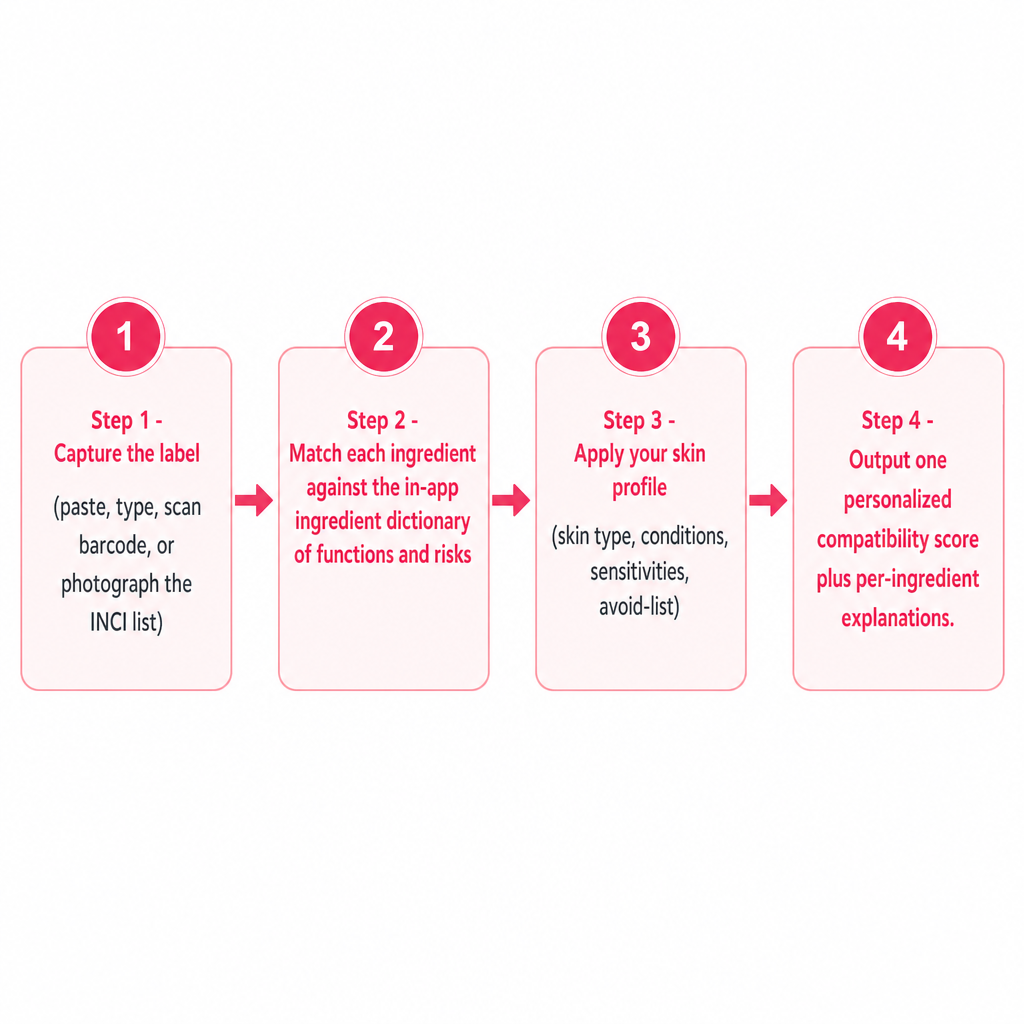
The final number gives a quick overall read on how likely a product is to sit well on your skin, with supporting detail underneath as flags and explanations. We treat that score as an interpretation of current evidence and risk patterns, not a medical diagnosis or a safety guarantee, and we surface the reasoning beside it so you can see exactly which ingredients pushed the number up or down and decide how much weight to give each factor. If you want a deeper read on what a checker can and cannot tell you, see what a skincare ingredient checker actually tells you.
Specialized analyzers built on one engine
A modern analyzer is rarely one checker; it is several specialized engines sharing a single data foundation. We build multiple tools on top of the same ingredient dictionary and compatibility logic, which lets you examine a product from different angles without leaving the ecosystem.
Pore-clogging and acne risk
Comedogenic ingredients are a top concern for acne-prone users. Our pore-clogging checker identifies ingredients associated with higher comedogenic potential and occlusive behavior, mapping them to familiar scales such as the 0-to-5 comedogenic rating style. Instead of a bare list of red flags, it surfaces each flagged ingredient with a short explanation of its role, its comedogenic profile, and why it may matter for breakout-prone skin.
Those signals do not live in isolation. They feed the product's overall compatibility score, so a serum with a few moderate comedogens may still score well for a resilient, non-acne-prone user but rank more cautiously for someone with frequent congestion. That is more useful than a flat "this product is bad because it contains X," because congestion is rarely caused by one ingredient acting alone.
Fungal acne and seborrheic dermatitis triggers
People managing fungal acne and seborrheic dermatitis often need to avoid specific ingredient families, especially certain lipids and esters that can feed Malassezia yeast. We fold these trigger patterns into the analysis, flagging components associated with higher risk for these conditions. Because the same ingredient can be neutral for one person and problematic for another, the findings are weighted through your profile rather than applied as a universal rule. Our seborrheic dermatitis trigger checker reads the full formula, highlights potential triggers, and explains in plain language how they relate to routine design, which for chronic scalp or facial cases is the difference between guessing at labels and screening cleansers, moisturizers, and sunscreens systematically.
Scanning in the aisle
An analyzer is most useful when it is fast. Our cosmetic barcode scanner collapses the copy-and-paste step into a single scan: point your camera at a product's barcode, and the app fetches the matching product record, reads the INCI list, and shows the ingredient-based analysis and compatibility score in seconds, with the same plain-language breakdown underneath so you can decide whether to buy before you leave the store. Because it runs on the same engine as the web checker, you get consistent results whether you scan on your phone or paste a list at home.
Routine-level tools
One product's score is useful, but real routines are combinations. We extend the same analysis to routine-level tools: a routine builder with clash detection, a side-by-side comparison tool, and a dupe finder that surfaces alternatives with similar ingredient profiles. The routine builder uses the same risk and benefit signals to show how products behave together, for example when multiple strong exfoliants or irritant-prone actives stack in one routine. The comparison and dupe tools lean on ingredient similarity plus compatibility scoring, so a swap is not just similar on paper; because everything runs through your personal profile, a dupe is similar for your skin specifically.
How to choose and use an ingredient analyzer app
For a global audience with varied concerns and budgets, the choice comes down to a handful of practical criteria rather than raw database size.
| Criterion | What to look for | Why it matters |
|---|---|---|
| Personalized scoring | Scores tuned to your skin type, conditions, and sensitivities | A universal grade ignores the fact that the same ingredient behaves differently on different skin |
| Plain-language explanations | A short note on what each ingredient does and when it causes issues | Numbers and flags only help if you understand what drives them |
| Depth of ingredient data | Coverage of comedogenicity, trigger patterns, and irritation risk | Complex conditions need nuance, not oversimplified red flags |
| Cross-tool integration | One engine behind scanning, routines, comparison, and dupes | Consistent decisions whether you scan in store or plan at home |
| Independence | Scoring driven by evidence and profiles, not brand marketing | Contextual guidance beats ad-driven or alarmist verdicts |
Measured against these, the real question is not which app has the biggest database but which one gives clear, evidence-based reasoning aligned to your skin, routine, and budget without asking you to become a chemist. In practice, the fastest way to start is to run one product you already own through the checker, read the per-ingredient notes, then set up your profile and watch how the score shifts once it knows your skin.
Limits worth keeping in mind
Ingredient analysis is powerful, but it is not clinical care, and treating it that way leads to bad decisions.
First, the analysis can only see what is on the label. If a product has incomplete, outdated, or region-specific ingredient disclosures, even a strong app works with imperfect information. Second, compatibility scores are probabilistic. They reflect how ingredients typically behave, not guaranteed outcomes on every face, and individual reactions, allergies, and environmental factors can still override what the data suggests. That is why we frame the score as an interpretation of current evidence paired with visible reasoning, so you can make your own call rather than reading it as an absolute safe-or-unsafe stamp.
A third trap is over-focusing on one "bad" ingredient while ignoring the whole formula and routine. Because pore-clogging and condition-specific triggers roll into an overall score, the app nudges you toward looking at how everything adds up instead of fixating on a single flag. And finally, no app replaces specialist medical advice for chronic conditions. Ingredient analysis is best used as a support tool that makes avoiding known triggers and designing gentler routines easier, alongside patch-testing, paying attention to your own skin, and consulting a professional for persistent or severe issues.
Frequently asked questions
What exactly is a skincare ingredient analyzer app?
It is a tool that reads a cosmetic ingredient list and explains each item in plain language, what it does, who it suits, and when it might cause trouble, usually combined with a risk or compatibility score. Macherre adds a personalized compatibility score tuned to your skin profile plus a clear explanation for each ingredient, so you are not left decoding raw chemistry on your own.
How does Macherre's compatibility score differ from other ratings?
Many systems hand out one universal grade per product and treat all users the same. Our compatibility score is personal: it weighs your skin type, conditions like fungal acne or seborrheic dermatitis, and your sensitivities and goals to generate a tailored result. The score arrives with its reasoning and is framed as an evidence-based interpretation, not a blunt safe-or-toxic label.
Can Macherre help with acne, fungal acne, or seborrheic dermatitis?
Yes. The pore-clogging checker evaluates ingredients for comedogenic potential and occlusive behavior and folds those findings into the overall score. Fungal acne and seborrheic dermatitis trigger patterns are also reflected in the analysis, helping you quickly spot formulas more likely to behave well with those conditions.
How do barcode scans and manual checks compare?
They run on the same engine. When you paste a label or run a manual check, the ingredient checker reads the list, explains each ingredient, and generates a score for your profile. When you use the barcode scanner, the app fetches the product record from the barcode, applies the same analysis, and shows results instantly on your phone.
Does using an analyzer app replace professional advice?
No. Our compatibility scores are interpretations of current evidence meant to support smarter product choices, not medical diagnoses. Use the app alongside patch-testing, listening to your skin, and seeking professional care for persistent or severe issues.