
Is a Skincare Scanner App Free? What to Know
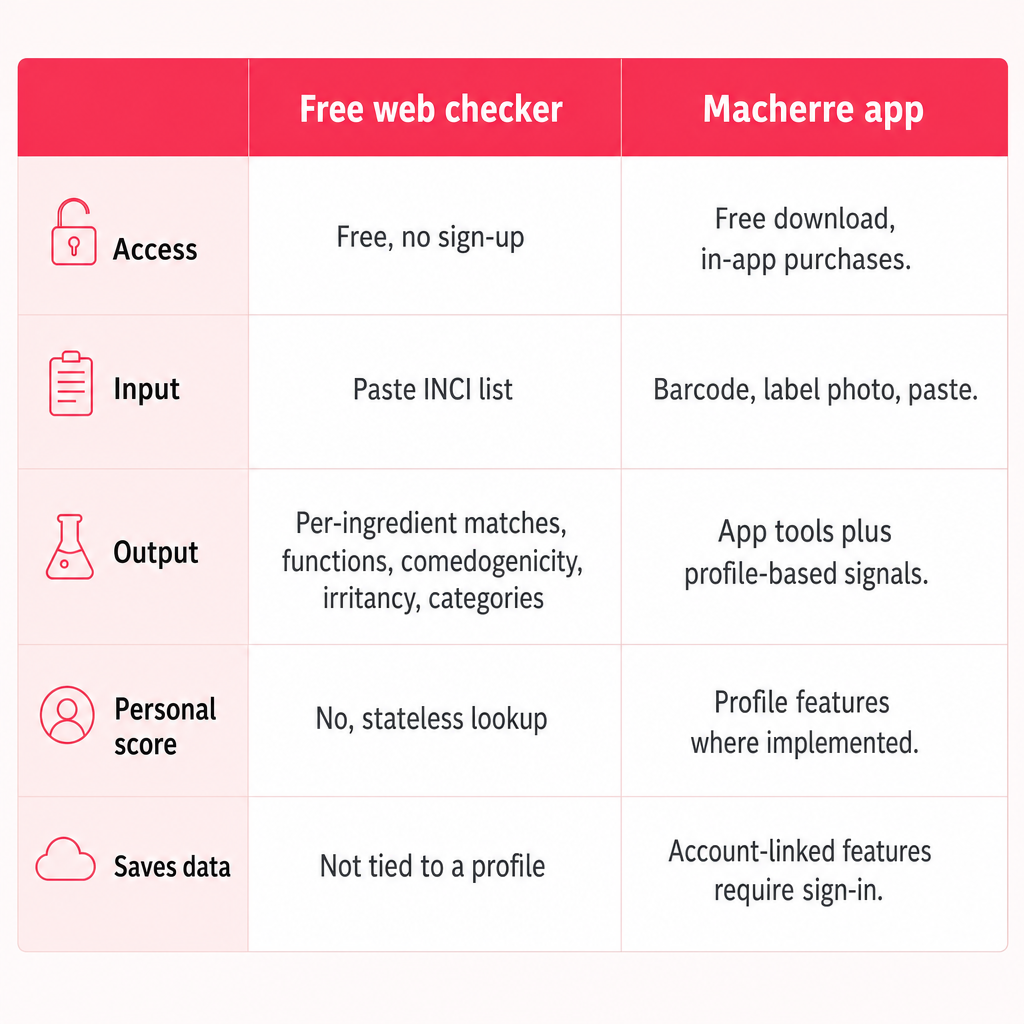
Short answer: yes, a skincare scanner app can be free, but "free" covers two different things. Our web ingredient checker is free to use with no sign-up, and the Macherre app is a free download with in-app purchases. So when you ask is a skincare scanner app free, the honest reply is that you can paste an ingredient list and get results at no cost, while some app-only features may sit behind a sign-in or purchase. This guide walks through what each free option actually does, where the limits are, and how to pick the version that fits what you're trying to learn.
Table of contents
What a free skincare scanner actually checks
A skincare scanner works from a product's cosmetic ingredient list, usually printed on the box as the INCI list. A web tool typically lets you paste that list; an app may also identify a product from a barcode or read a label photo. What you get back depends on whether the ingredients are recognized and on the database behind the tool.
With our free web checker, you paste a comma-separated INCI list and we show each matched ingredient's function, its category, and reference scores for comedogenicity and irritancy. Categories group ingredients into things like humectants, emollients, and preservatives, so you can see the shape of a formula at a glance. One thing worth setting straight early: that web check is stateless. It isn't tied to a skin profile and it doesn't produce a personal compatibility score. It's a fast, account-free lookup, not an individualized verdict.
The tool also has blind spots you should expect. It may not match typos, brand-new INCI names, vague trade names, or proprietary blends. If an ingredient doesn't appear, the usual cause is a spelling difference or a name the database hasn't catalogued yet, so it's worth checking the label again rather than assuming the ingredient is harmless or absent.
An ingredient list is useful, but it can't tell the whole story of how a finished product behaves on your skin. Ingredient order has limits: under U.S. FDA labeling rules, ingredients present at 1% or less, along with color additives, may be listed without regard to how much is in the formula. So a scanner's flags are clues to investigate, not a full account of concentration, the complete formula, or your individual response. If you want the mechanics of how a checker reads a label, we cover that in what a skincare ingredient checker is.
Free web checker or the app: which fits your question?
The right free option depends on what you already have in hand and what you want to walk away knowing.
Reach for the free web checker when you have an ingredient list and want a quick, per-ingredient explanation without creating an account. Pasted lists aren't tied to a profile or kept around long-term, which suits a one-off question like "what is this ingredient and what does it do?" You can decode a cosmetic INCI list directly, or look up a single ingredient in our cosmetic ingredient dictionary when you only need context for one name.
Reach for the app when you want tools that depend on identity and memory: barcode or label scanning, profile-based checks, saved products, or routines. The App Store listing labels the download "Free · In-App Purchases" and describes profile features and product tools. Purchase options can vary by storefront and region, so check the listing available to you before buying anything. Account-linked features require signing in, which is the trade-off for scans that persist and signals that reflect your stated skin profile.
If you're weighing specific products rather than loose ingredient names, browse the Macherre product catalog to inspect actual formulas side by side. A product page or an app feature can give you more context than a single pasted list, but no scanner can promise that a formula will suit your skin.
How to judge whether a free scanner is worth trusting
Before you lean on any skincare scanner, free or paid, run it through five quick questions:
- What it accepts: cosmetic INCI lists, product searches, barcodes, or label photos. If it only handles one input, make sure that matches how you shop.
- What it returns: ingredient matches and plain-language explanations, reference flags, or genuinely personalized guidance. Don't assume a paste-in checker uses a skin profile.
- What it saves: whether scans are linked to an account, a profile, or a history, or whether each lookup is one-and-done.
- What costs extra: whether the app listing or feature page clearly discloses in-app purchases, so "free" doesn't surprise you later.
- What its results cannot establish: a score or an ingredient flag is not proof that a product will break you out, and it's not proof that a product is safe for you.
Our free web checker is built for cosmetics and skincare INCI lists, and its output is an educational ingredient breakdown rather than an individualized medical assessment. The App Store listing similarly states the app does not diagnose or treat conditions. That boundary matters: a checker is a research assistant, and keeping it in that role is what makes it reliable. If you want to understand what the single number in the app represents and why the web tool doesn't produce one, our explainer on what a compatibility score for skincare is breaks it down.
Checking a moisturizer before you buy: a worked example
Say a moisturizer lists glycerin, an emollient, and a preservative. A free check can explain each of those, show you that glycerin is a humectant, and surface any irritancy or comedogenicity references attached to the other two. From there, the useful move is to turn that information into questions rather than a snap verdict: have I reacted to this preservative before? Does this emollient show up on a comedogenicity reference, and does that match my own history with similar products?
That's the difference between using a scanner well and misusing it. A single flag is a prompt to look closer, not an automatic buy-or-skip ruling. For a product-specific read, pair the ingredient check with the full label and, where available, the product's listing so you're reasoning about the whole formula.
There's a firm limit here too. If you have a known allergy, persistent irritation, eczema, or another diagnosed skin concern, a scanner cannot confirm whether a formula is safe for you. Ingredient flags are screening information, not a diagnosis and not a guarantee of individual safety or pregnancy clearance. For medical or allergy questions, that's a conversation for a qualified clinician, and the checker is best used to prepare for it, not replace it.
When you're ready to move from "what does this ingredient do" to "does this specific product fit," that's where the app's profile-based tools earn their place, while the free web checker stays the fastest way to answer a one-off ingredient question at no cost.
Frequently asked questions
Is Macherre's skincare ingredient checker free?
Yes. Our web ingredient checker is free with no sign-up required. It accepts a comma-separated INCI list and returns per-ingredient matches, functions, comedogenicity and irritancy ratings, and ingredient categories.
Is the Macherre app free too?
The App Store listing describes the app as a free download with in-app purchases. Check your local listing for the current purchase options. The web checker and the app are two separate ways to use Macherre.
Does the free web checker give me a personal compatibility score?
No. The web checker is a stateless lookup that isn't tied to a skin profile. Treat its ingredient-level matches and flags as educational information, not as a personal compatibility score.
Can a skincare scanner tell me whether a product is safe?
No scanner can guarantee an individual outcome. Ingredient lists and checker results support product research, but they don't establish that a cosmetic is safe for everyone or diagnose a skin condition. For allergies or medical concerns, consult a qualified professional.
What does a free scanner miss about a formula?
Plenty. Ingredient order has limits, ingredients at 1% or less and color additives can be listed out of order, and a list never reveals exact concentrations, the full formula, or how your skin specifically will respond.