
Is a Skincare Scanner App Worth It?
You can settle the core question quickly: a skincare scanner app is worth it when you treat it as an ingredient-research tool, not a medical authority or a promise that a product will work on your face. So is a skincare scanner app worth it for you specifically? That depends on whether decoding a cosmetic INCI list before you buy would lead to a better decision than reading the front of the box alone. For most beginners, sensitive-skin shoppers, and anyone juggling a multi-step routine, it usually does.
What a scanner cannot do is just as important. It can't predict whether you'll break out, confirm an allergy, or tell you a formula will treat a condition. An ingredient list is a starting point for investigation, not a verdict on your skin. The rest of this guide explains exactly where that line sits, what our tools show, and how to judge whether any scanner earns a spot in your routine.
Table of contents
What a skincare scanner app actually does
A scanner's real job is to interpret the INCI list, the standardized ingredient declaration printed on packaging and product pages. Cosmetic ingredients are generally listed in descending order of predominance, though ingredients at 1% or less can appear in any order, according to the FDA cosmetics labeling guide. That ordering gives you useful context, but it is not a full formula specification, which is why a plain-language breakdown helps.
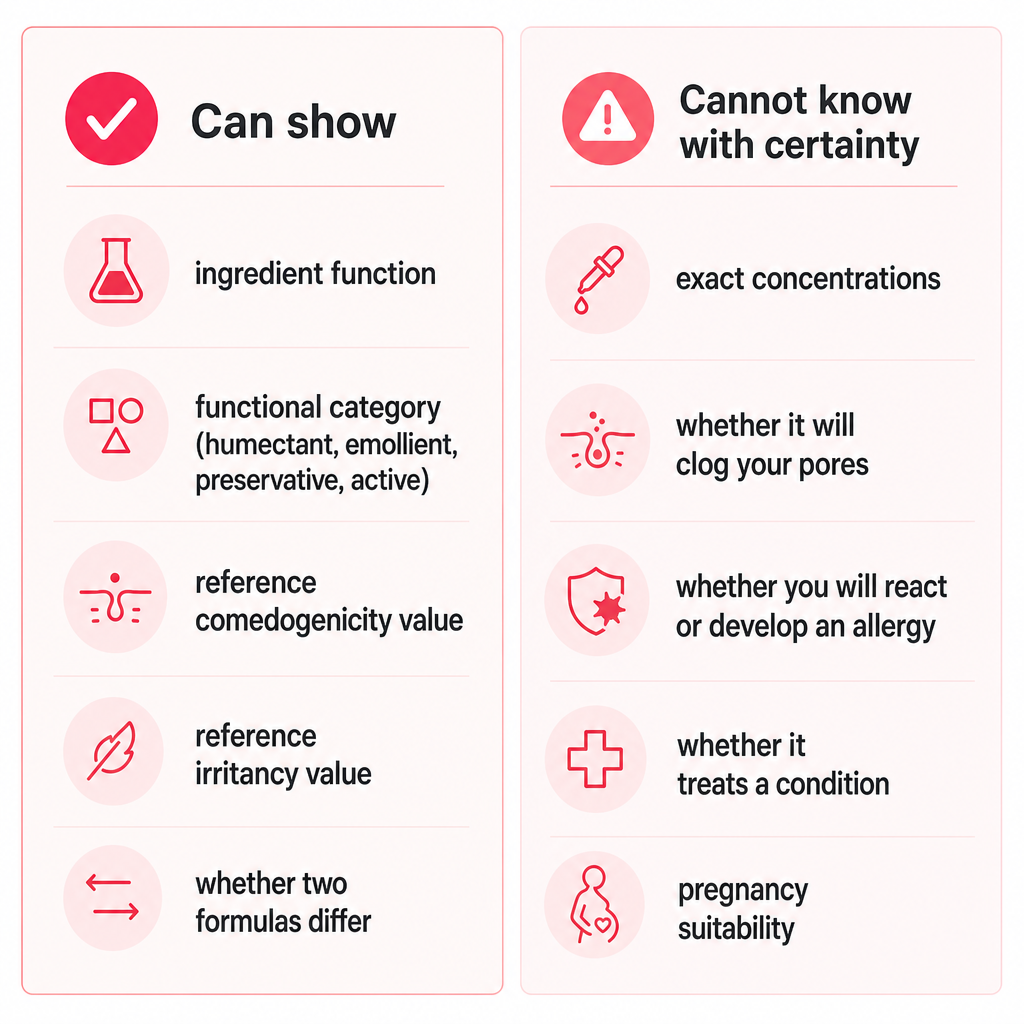
Depending on the tool, a scanner may identify ingredients by their cosmetic names, explain what each one does, group them by function such as humectant, emollient, preservative, or active, show reference values for comedogenicity or irritancy, flag ingredients relevant to a specific screening goal, compare two formulas, or suggest alternatives. Some apps read a product barcode; others let you paste the list by hand. A barcode lookup is faster, but the result should still be checked against the current packaging, because formulas and regional labels change.
What our free web checker tells you
Our free skincare ingredient checker accepts a pasted, comma-separated INCI list and returns a line-by-line breakdown: matched ingredients, their functions, functional categories, and comedogenicity and irritancy reference values. It is handy when you have a label you can't interpret, when you're comparing several ingredient lists, or when you want to identify ingredients that deserve a closer look before patch testing. You can also look up anything unfamiliar in our cosmetic ingredient dictionary.
One detail shapes how you should read those results: the web checker is stateless. Pasted lists are used for a lookup and are not tied to a skin profile or stored as persistent shelves. That means it does not generate a personal compatibility score from the web tool alone. The profile-aware scoring, barcode scans, saved shelves, and routine tools live in the Macherre app where those features are implemented. If you want to understand the interpretation mechanics in depth, our explainer on how a skincare ingredient analyzer app works walks through the steps, and what a compatibility score means covers the personalized side.
What a scanner can and cannot know from a label
The honest value of any scanner comes from respecting both sides of this boundary. On the useful side, it can clarify the likely role of each ingredient, whether something is commonly used as a humectant, emollient, surfactant, preservative, fragrance component, or active, whether an ingredient carries a reference comedogenicity or irritancy rating, and whether two products share a similar ingredient structure. That matters because cosmetic labels are written for regulatory and technical clarity, not for a first-time buyer.
What it usually cannot determine is just as concrete: the exact concentration of most ingredients, whether a finished formula will clog your pores, whether you will develop an allergic reaction, whether a product will treat acne, rosacea, eczema, or seborrheic dermatitis, whether an ingredient is appropriate during pregnancy, or whether a product is contaminated, counterfeit, or poorly stored. An ingredient name is a prompt to investigate, not proof of personal safety. Keeping those two lists separate is the difference between using a scanner well and misreading it.
Are comedogenicity and irritancy scores reliable
They work as screening signals, not judgments. A comedogenicity rating is a reference indicator tied to an ingredient or ingredient class, and it does not automatically predict what happens in a finished product. The real outcome can hinge on concentration, the rest of the formula, whether the product is rinsed off or left on, how often you use it, and your own skin.
Irritancy references behave the same way. An ingredient that bothers reactive skin in one product may sit comfortably at a lower concentration in another. Fragrance, exfoliating acids, retinoids, and some preservatives are often worth closer attention for sensitive skin, but no scanner can diagnose the cause of an individual reaction. We present these ratings as a place to start investigating, not a reason to reject every product with a non-zero value. Use them to decide what deserves a second look before you patch test. You can screen a specific label with our pore-clogging ingredient checker when congestion is your concern, remembering that a flag does not prove breakouts and a clean result does not guarantee suitability.
When a scanner is worth it, and when it is not
A scanner earns its place when it solves a specific shopping or routine problem rather than serving as a vague reassurance.
It tends to be worth it when you:
- are new to skincare and want ingredient names translated into plain functions so marketing terms like "clean" or "for sensitive skin" become checkable;
- have reactive skin and want to spot fragrance or exfoliating components to investigate before buying;
- are congestion-prone and need to compare leave-on moisturizers, sunscreens, or makeup;
- are checking a focused question, using our fungal-acne ingredient checker for potential Malassezia triggers or the separate seborrheic dermatitis trigger checker, since those are distinct screens, not one generic "safe" result;
- are building a multi-step routine and want to see how products fit together, which you can plan with our routine creator;
- want to compare formulas side by side or find alternatives instead of judging by packaging and price.
It adds little value when you:
- already read INCI lists fluently;
- expect an app to diagnose a skin condition or guarantee no reaction;
- want pregnancy clearance or medical treatment advice;
- trust a score over your own documented experience;
- won't check the current label;
- have severe irritation, facial swelling, blistering, a persistent rash, rapidly worsening acne, or a suspected allergic reaction, which call for professional care rather than an app.
Those fungal-acne and seborrheic-dermatitis screens are worth treating as separate questions. Both are screening aids, not diagnostic tests, and neither can confirm that a condition is present or that a product suits everyone with it.
How to evaluate any skincare scanner before you trust it
Not every tool deserves the same confidence, so a few criteria help you judge one quickly.
First, it should explain individual ingredients, not just stamp a product "good" or "bad." A per-ingredient breakdown with functions, categories, and reference flags is far more useful than a single opaque verdict. Second, it should separate data from conclusions; be cautious when an app presents a single flag as proof you'll break out, and look for language that acknowledges concentration, the whole formula, rinse-off versus leave-on use, and individual variation.
Third, it should support manual label checking. Product databases can be incomplete, outdated, or region-specific, so the ability to paste a cosmetic INCI list directly matters, which is exactly what our web checker does. Fourth, it should handle unknown ingredients honestly: no database matches every typo, trade name, or proprietary blend, and a responsible tool makes unmatched items visible rather than silently treating them as safe. When a match fails, checking the canonical spelling or searching our ingredient dictionary is the sensible next move.
Fifth, privacy should be understandable. Before you create a profile or upload anything, the Federal Trade Commission advises looking for a privacy notice that clearly explains what health-related information an app collects, how it uses it, and whom it shares it with. Our web ingredient checker is deliberately different from a persistent profile: pasted lists drive a stateless lookup rather than feeding a stored account. Sixth, a trustworthy tool does not overpromise. Steer clear of anything claiming to guarantee clear skin, predict every breakout, diagnose a condition, or certify a product as pregnancy-safe without proper medical and regulatory support.
Patch testing still decides the outcome
A scanner helps you decide what to investigate, but your skin's response is the evidence that counts. The American Academy of Dermatology recommends applying a product to a small test spot twice daily for seven to ten days, using it as directed, and for rinse-off products reflecting the normal contact time.
Stop if you notice a concerning reaction, and seek medical advice for severe symptoms such as swelling, breathing difficulty, a widespread rash, or persistent irritation. Home patch testing has limits too; it cannot guarantee a product will stay comfortable on your whole face, and some reactions appear only later. That is the realistic sequence a good scanner supports: paste the label, read the ingredient-level information, use the focused screens only for their intended purpose with our side-by-side comparison tool when you're deciding between two formulas, then confirm with the current packaging and a cautious patch test.
Frequently asked questions
Is a skincare scanner app worth it for beginners?
Yes. It translates unfamiliar cosmetic ingredient names into plain-language functions and helps you compare products. Treat the result as educational guidance, not a guarantee.
Can a skincare scanner tell me if a product is safe?
Not with certainty. It can identify ingredients and show screening references, but it cannot predict your individual reaction, verify manufacturing factors, or provide medical clearance.
Can the free web checker give me a personal compatibility score?
No. The free web checker accepts pasted INCI lists and returns per-ingredient functions, categories, comedogenicity, and irritancy information. It is stateless and not tied to a skin profile.
Can a scanner diagnose fungal acne or seborrheic dermatitis?
No. Our specialized checkers screen for potential ingredient matches or trigger flags. They are not diagnostic tools and cannot confirm that a condition is present.
Should I still patch-test after scanning a product?
Yes. A scanner helps you investigate a formula, while patch testing shows how your skin actually responds. The AAD recommends testing on a small area twice daily for seven to ten days.