Niacinamide 101: How to Find Skincare Products That Actually Deliver Results
You bought the serum because everyone said it would shrink your pores, mop up the shine by lunchtime, and fade those old breakout marks. Three months on, the bottle is half-empty and your skin looks exactly the same. If that stings a little, you're in good company — it happens constantly, and the blame almost never belongs where people put it. The problem usually isn't niacinamide the molecule, which has genuine peer-reviewed evidence behind it. The problem is the product it's riding in: too little of it, buried near the bottom of the ingredient list, sometimes parked in a fragranced base that irritates more than it soothes, or sold as "extra strength" at a concentration that mostly makes skin flush. The good news is that skincare products with niacinamide are easy to evaluate once you know what to look at. By the end of this, you'll be able to pick up any product — or scan it — and tell whether the niacinamide inside is actually working or just decorating the label. Here's the teaser that reframes everything: clinical studies show benefits at just 2–5%, not the 15–20% formulas marketed as superior, according to cosmetic chemists Chemist Confessions.
Table of Contents
- What Niacinamide Actually Does for Your Skin
- The Concentration Question: How Much Is Actually Effective
- Reading the Whole Ingredient List, Not Just the Hero Name
- What Cancels Out (or Boosts) Niacinamide
- Matching Niacinamide Products to Your Skin Type
- Marketing Tricks vs. Real Formulation Quality
- Your Niacinamide Product Check: 5 Steps Before You Buy
- Niacinamide Questions People Actually Ask
What Niacinamide Actually Does for Your Skin
Niacinamide is a documented multitasker, not a miracle. The trick to not being disappointed is knowing what each benefit realistically looks like, the concentration the evidence actually used, and roughly how long it takes. Read these five and figure out which ones map to your skin.
- Oil and pore control — Preparations with 2–5% niacinamide measurably reduce facial sebum production and visible pore size over 4–8 weeks; some brand clinical summaries cite up to roughly 30% sebum reduction at 10%, per a mechanistic niacinamide review and 2% sebum trial. Set your expectation at less shine in about a month, not overnight.
- Brightening and dark spots — A double-blind randomized trial found 4% niacinamide cream twice daily for 8 weeks reduced melasma severity comparably to 4% hydroquinone, with fewer side effects, according to an International Journal of Dermatology melasma trial. The mechanism: niacinamide inhibits melanosome transfer from melanocytes to keratinocytes — the same basis behind Japan's regulated skin-lightening quasi-drug status (Ando & Matsui review). Expect visible fading over 8 weeks or more at about 4–5%.
- Barrier repair — Topical niacinamide reduces transepidermal water loss (TEWL) and improves hydration and skin pliability — measurable, not just "moisturizing," per work published in Scientific Reports. This is the quiet benefit that makes everything else tolerable.
- Redness and sensitivity — A niacinamide-containing moisturizer improved barrier function and significantly reduced erythema and dryness scores in rosacea patients over several weeks, according to a study in Cutis.
- Fine lines and texture — A 5% niacinamide moisturizer over 12 weeks improved fine lines, hyperpigmentation, red blotchiness, and sallowness versus vehicle, per an aging-skin study in Dermatologic Surgery.
That spread of outcomes is exactly why dermatologist and clinical researcher Dr. Zoe Diana Draelos describes niacinamide as a "multi-functional cosmeceutical ingredient," noting its benefits are well documented at relatively low concentrations in leave-on products (Practical Dermatology). If you want a clearer sense of who niacinamide is really for, the pattern is simple: almost everyone tolerates it, but the payoff depends on dose and base.

The Concentration Question
The single most useful number on a niacinamide label is the percentage — when it's actually printed. Here's how the ranges map to use case, expected payoff, and the risk of your skin pushing back.
| Concentration | Typical use case | Expected benefit | Irritation risk |
|---|---|---|---|
| ~2% | Beginners, sensitive skin | Sebum reduction, hydration | Very low |
| 4–5% | Brightening, tone, barrier | Dark-spot fading, fine lines, redness | Low |
| 10% | "Strong" oil/pore products | Marginally stronger sebum control | Moderate (flushing possible) |
| >10% (15–20%) | "Extra strength" marketing | No proven extra benefit | Highest — burning, redness |
The instinct that a higher percentage means a better product is where most people go wrong. The evidence points the other way. Benefits plateau around 2–5%, and very high concentrations of 15–20% mainly raise the risk of burning and redness without proven superiority, according to cosmetic chemists Victoria Fu and Gloria Lu, who put it plainly: "niacinamide's skin benefits are proven with just 2% to 5%." Push past that and you're buying risk, not results.
The roughly 10% mark is where the trouble clusters. Flushing, burning, and pseudo-breakouts tend to show up at 10% and above, especially on a barrier that's already compromised from over-exfoliation or harsh actives, per Clinikally's review of niacinamide side effects. That's not the ingredient being mean — it's a dose mismatch.
Regulators draw a similar line. EU scientific guidance (SCCS) cites a 10% maximum for leave-on cosmetics, which frames anything above 10% as outside the standard comfort zone (European Commission COSING / SCCS guidance). The Cosmetic Ingredient Review safety assessment reaches a compatible conclusion, supporting niacinamide at "current low concentrations of use" — industry shorthand for keeping most leave-on formulas in the low-single-digit percent range.
A higher percentage on the label doesn't mean a better product — it often just means a higher chance your skin pushes back.
One practical wrinkle: most products never disclose the percentage at all. When that happens, you're not stuck — you judge by where niacinamide sits in the ingredient list instead, which is exactly the skill the next section builds. And treat "extra strength" claims as a red flag rather than a selling point, because the evidence simply doesn't reward them.
Reading the Whole Ingredient List
When the percentage is hidden, the ingredient list becomes your dosing chart. Under FDA cosmetic labeling rules, ingredients are listed in descending order of predominance by weight, using standardized INCI names (FDA Cosmetics Labeling Guide). That ordering rule is the whole game. Once you internalize it, a label stops being a wall of chemistry and starts telling you roughly how much of each thing is in the bottle.
The practical consequence: actives present above about 1% usually appear in the top or middle of the list, while ingredients near the very end are typically present in trace amounts, according to label-reading guidance from esthetician Renee Rouleau and AEDIT's label guides. So a product proudly branded as a "niacinamide serum" — with niacinamide sitting near the bottom of the INCI list, somewhere after the preservatives — is most likely under 1%. At that level it's a marketing claim, not an active. It's on the label so the front of the box can say the word.
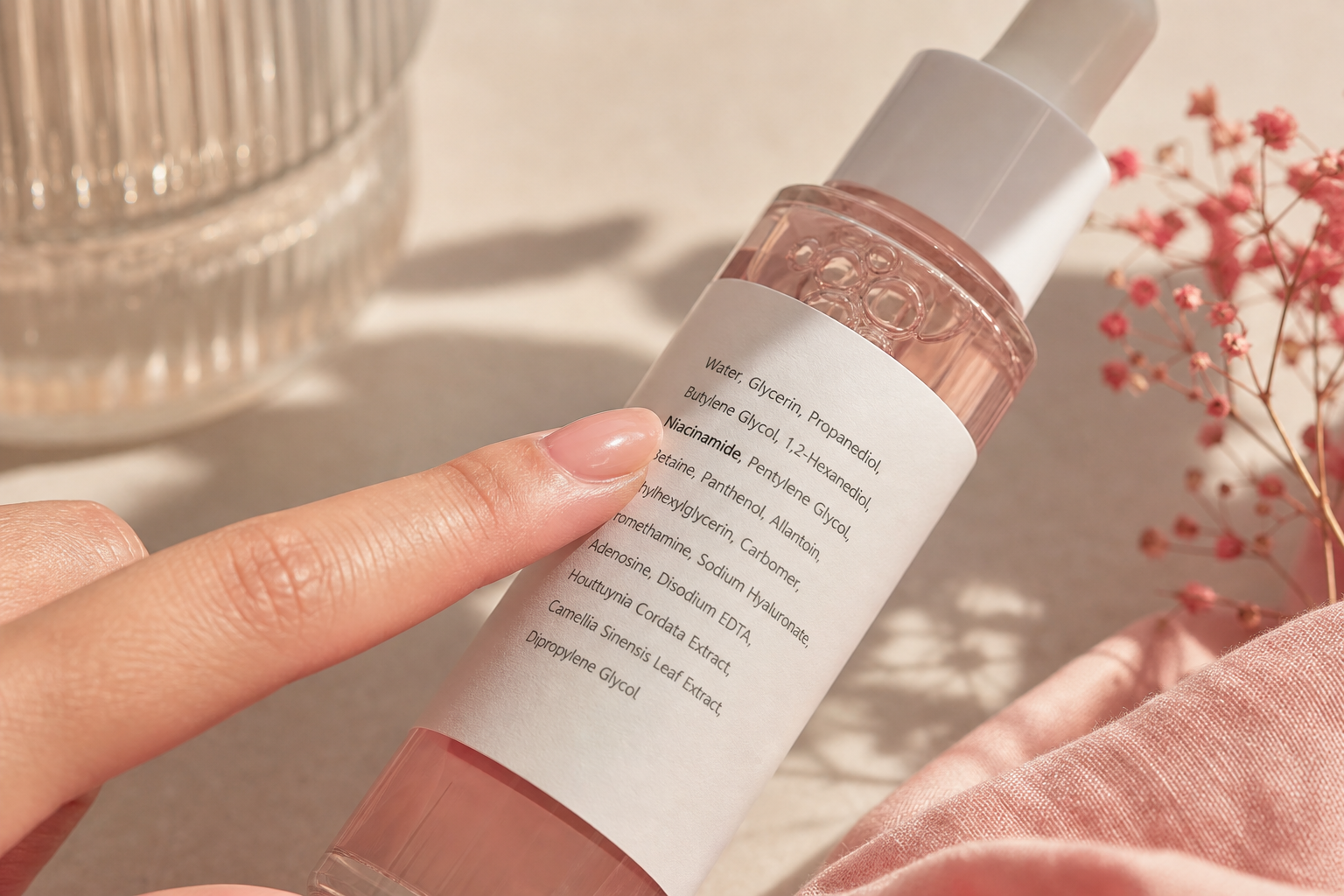
There's a naming catch worth knowing. Niacinamide has to appear under exactly that INCI name — not "vitamin B3," not "niacin," and not folded into a vague "brightening complex." INCIDecoder's ingredient entry makes the point that shorter, simpler lists make it far easier to spot true actives versus filler. If a brand tucks niacinamide inside a proprietary "brightening complex," you've lost the ability to judge the dose entirely, because that blend gets listed as a single line item and the individual amounts vanish. A vague blend is a choice, and it's rarely made in your favor.
Position tells you how much. The supporting cast tells you whether the formula was built with care. A few ingredients genuinely make a niacinamide product better:
- Hyaluronic acid for hydration — purely complementary, no downside.
- Ceramides for barrier support, which pairs naturally with niacinamide's documented TEWL reduction. The two reinforce each other.
- Zinc, frequently co-formulated with niacinamide for oil control.
The base formula matters as much as the hero ingredient, and people consistently underweight this. A hydrating, fragrance-free base serves sensitive and barrier-compromised skin and lets the niacinamide do its job. A drying, alcohol-heavy, or heavily fragranced base can quietly undo the benefit you paid for. Fragrance is the one to watch most closely — it's among the most common cosmetic allergens, and clinical reviews report that around three-quarters of fragrance-allergic patients in one series didn't know they were sensitized until patch testing, per the fragrance allergy literature summarized by Clinikally, with parallel findings in the EU "Perfume Allergies" briefing and the FDA's "Allergens in Cosmetics" work. A fragranced "soothing" serum is a contradiction more often than people realize.
So a thorough check looks like this: find niacinamide's position in the list, confirm it's under its real name and not hidden in a blend, scan for supportive ingredients like ceramides and hyaluronic acid, and flag fragrance if your skin is reactive. Doing that across the dozen products you're comparing on a given afternoon is genuinely tedious. This is where the fun stops and the homework starts — which is precisely the moment most people give up and just buy the prettiest bottle. If you'd rather skip the manual cross-referencing, scanning a label and letting the analysis run is the obvious shortcut to pick the right niacinamide product.
What Cancels Out (or Boosts) Niacinamide
No conversation about niacinamide stays civil for long without someone insisting you can't mix it with vitamin C. Let's settle the pairing questions with a clear matrix, then deal with the myths.

The vitamin C scare is the big one, and it's outdated. Modern dermatology and formulation sources agree that niacinamide and vitamin C can be safely combined in the same product or layered, according to GoodRx and guidance from skincare brand CeraVe (a vendor source, flagged as such). The old "never mix" rule traces back to 1960s experiments using unbuffered forms at extreme pH and heat — conditions that have nothing to do with the stabilized cosmetic products on shelves now. Facial plastic surgeon Dr. Paul Nassif goes further, calling the pairing "highly recommended" for brightening and anti-aging when it's correctly formulated (Nassif MD, a vendor source).
The rest of the pairings are mostly about timing, not avoidance:
- AHA/BHA acids — Niacinamide is fine alongside exfoliating acids, but stacking strong exfoliants in the same step can shift pH and dull the acid's efficacy. Space them to a different step or time of day, per GoodRx and Skincare.com.
- Retinol — A widely endorsed combination. Niacinamide actually helps reduce retinol-induced irritation, according to Healthline, which is why so many retinol formulas include it.
- Zinc — Commonly co-formulated for oil control; no conflict.
- Hyaluronic acid — Purely complementary. Layer it freely.
Most "ingredient conflict" rules online are leftovers from outdated lab studies — the real test is sequencing, not separation.
The deeper lesson is that stinging rarely means two ingredients are fighting. Dermatologist Dr. Andrea Suarez (Dr Dray) explains that burning and redness usually reflect an impaired barrier, over-exfoliation, or a high concentration — not niacinamide being inherently harsh. Her practical advice: space acids away from niacinamide, start at lower strengths, and avoid fragranced formulas, as she lays out in her video on why niacinamide burns. Sequencing, not separation.
Memorizing a pairing matrix is one more bit of homework, which is why the Macherre routine builder includes clash detection — it flags the sequencing issues automatically as you add products, so you don't have to keep the chart in your head.
Matching Niacinamide Products to Your Skin Type
The same molecule belongs in very different products depending on your skin. Find your profile, then match the format, the supporting ingredients, and the things to steer around.
- The oily / acne-prone shopper — Reach for a lightweight serum or gel with about 2–5% niacinamide, ideally with zinc, in an oil-free base. Skip heavy occlusive creams that sit on already-congested skin. The sebum-control evidence lands squarely in that 2–5% range, per the mechanistic review and sebum trial.
- The sensitive / rosacea shopper — Choose a niacinamide moisturizer in a fragrance-free, hydrating base at around 2–5%. Avoid fragranced "soothing" serums, since fragrance is a leading cosmetic allergen that undermines the very barrier claims these products lean on, per the Cutis rosacea study and the fragrance allergy review. Stay below 10% — your skin doesn't need the extra flush risk.
- The dry / barrier-compromised shopper — Look for niacinamide paired with ceramides and hyaluronic acid in a cream, using niacinamide's documented TEWL reduction to your advantage, per Scientific Reports. Avoid alcohol-heavy, fast-drying serums that work against the barrier you're trying to rebuild. If redness and texture are part of your picture too, a complementary ingredient is worth a look in this azelaic acid routine for redness, acne, and texture.
- The fungal-acne-prone shopper — Niacinamide itself is non-problematic, but Malassezia yeast feeds on certain lipids, so the base is what trips people up. Avoid esters and many oils, and choose "Malassezia-safe" formulas, per the NIH Malassezia folliculitis review, Folliculitis Scout, and SkinSort's fungal-acne-safe lists. The Macherre fungal acne checker exists to catch exactly those base-oil landmines.
- The hyperpigmentation shopper — Target about 4–5% niacinamide in a hydrating, fragrance-free base. Skin-of-colour specialist Dr. Vanita Rattan (Doctor V) calls roughly 5% in a gentle vehicle the "sweet spot" for brown and Black skin — enough to fade pigment without provoking post-inflammatory hyperpigmentation, as she explains in her niacinamide product-selection guide, which lines up with the 4% melasma trial. Many shelf serums sit below that 4–5% range, so concentration matters more here than anywhere else.
Marketing Tricks vs. Real Formulation Quality
Most niacinamide marketing leans on words the formula doesn't back up. Run any product past these five red flags before it earns your money.
- Niacinamide buried low in the INCI list. If it shows up near the bottom, it's likely under 1% and mostly a label claim, given that FDA rules list ingredients by descending weight and label-reading guides (Renee Rouleau) tie position directly to dose. The front of the box says "niacinamide"; the back of the box says "barely."
- No percentage disclosed plus a vague "brightening complex." When the active is folded into a proprietary blend, you can't judge the dose at all, and the trace amount often hides inside that single line item, per INCIDecoder. Opacity is rarely an accident.
- Fragranced "soothing" or "barrier" formulas. Fragrance is among the most common cosmetic allergens, so a fragranced niacinamide serum isn't universally gentle no matter what the front label promises, per the fragrance allergy review. A soothing claim and a fragrance high on the list are working against each other.
- "Extra strength" 15–20% formulas. There's no proven benefit over 2–5%, only a higher risk of irritation and flushing, per Chemist Confessions. The big number on the front is selling the number, not the result.
- Premium pricing for a commodity ingredient. Niacinamide is cheap to formulate well, so an inflated price usually buys packaging and brand story rather than performance. That gap is exactly where a dupe earns its keep.
Niacinamide is cheap to formulate well — when a product charges a premium for it, you're usually paying for the bottle, not the benefit.
That last point is the practical one. Before committing to a $40 serum, it's worth checking whether a $9 version has effectively the same working formula — which is the job the Macherre dupe finder and its single compatibility score handle in a couple of taps.
Your Niacinamide Product Check
Here's the whole article compressed into something you can run standing in an aisle or while scanning a label. Five steps, each with a quick reason.
- Confirm the concentration range fits your skin. Aim for 2–5% if you're sensitive, barrier-compromised, or chasing brightening, and treat 10% or higher as a flush risk rather than an upgrade — because the evidence rewards the lower range and punishes the higher one.
- Check niacinamide's position in the ingredient list. Top-to-middle means it's probably doing real work; bottom means it's probably a claim — since labels run in descending order by weight.
- Scan the base for fragrance and your conflicts. Go fragrance-free for sensitive or rosacea-prone skin, and confirm your routine sequencing so acids land in a separate step — because the base can undo the active and timing prevents irritation.
- Run a fungal-acne or pore-clog check if relevant. Niacinamide is safe, but the base oils and esters may not be — so the formula around the active deserves its own look.
- Compare against a dupe before paying a premium. Niacinamide is a commodity ingredient, so price rarely tracks performance, and a cheaper twin often delivers the same thing.

All five of those checks — concentration cues, INCI position, fragrance flags, fungal-acne and pore-clog screening, and the dupe comparison — collapse into a single compatibility score when you scan a product. That's the one-tap version of everything above, for the days you don't feel like doing the homework by hand.
Niacinamide Questions People Actually Ask
Can I use niacinamide every day, morning and night?
Yes. At 2–5% in a well-buffered formula, most skin tolerates it daily — the barrier, oil-control, and brightening studies dosed it twice daily for 8 to 12 weeks, including the 12-week aging-skin study and the 8-week melasma trial. If your barrier is currently compromised, start once daily and build up rather than going straight to twice.
Why does my niacinamide product make my skin flush or tingle?
Stinging usually points to an impaired barrier, over-exfoliation, a high concentration of 10% or more, or a fragranced base — not niacinamide being harsh. The fix is to drop to a lower strength, switch to fragrance-free, and space your acids into a separate step, advice that lines up with both Dr Dray's guidance and Clinikally's side-effects review.
Is "niacinamide" the same as nicotinic acid or niacin on my label?
Look specifically for the INCI name "Niacinamide." It's distinct from nicotinic acid, which is more associated with flushing. Niacinamide is the form used in Japan's regulated skin-lightening quasi-drugs and in most cosmetic formulas, per INCIDecoder and the CIR safety assessment. If a label says "niacin" or hides it in a blend, you can't be sure what you're getting.
How long before I see results?
It depends on the goal. Sebum and shine tend to ease over roughly 4–8 weeks; brightening and dark spots take 8 weeks or more at 4–5%; fine lines and overall tone need about 12 weeks. Those windows come straight from the sebum review, the melasma trial, and the aging-skin study respectively — so if you quit at week three, you stopped before the data says results show up.