pore clogging ingredient checker: Pore-Clogging Ingredient Checker: Instantly Spot Breakout Triggers in Any Product
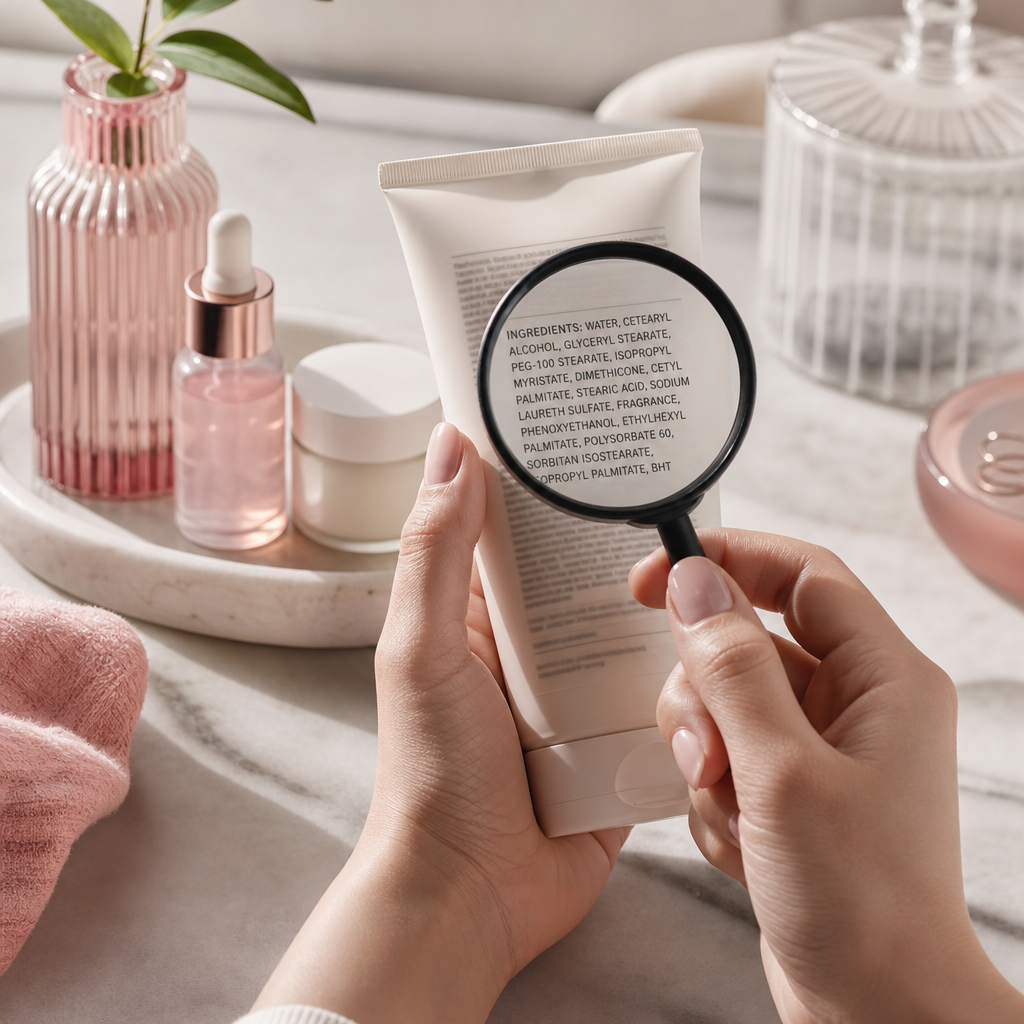
If your skin breaks out in blackheads, whiteheads, or those small under-the-skin bumps no matter how gentle your routine looks on paper, the culprit is often hiding in the ingredient list. That is exactly the problem a pore clogging ingredient checker is built to solve: instead of squinting at a wall of Latin-sounding INCI names on the back of a bottle, you get a fast read on which ingredients might be feeding your congestion. Macherre puts that check inside a single scan, pairs it with a plain-language breakdown of every ingredient, and folds the result into one overall compatibility score matched to your skin profile. This piece walks through how that works, what comedogenic ratings actually mean, and how to move from "this product might clog my pores" to "here's something that fits my skin better."
Table of contents
- Why breakout-prone skin needs an ingredient check
- What comedogenic really means and how the 0-5 scale works
- How Macherre's pore-clogging checker turns a label into a decision
- From flagged ingredient to a better product
- Where comedogenic ratings stop being useful
- Frequently asked questions
Why breakout-prone skin needs an ingredient check
Not everyone needs to audit every product they buy. People who rarely develop clogged pores can pick a moisturizer off the shelf and move on, and independent guides make the same point: routine ingredient scrutiny matters far less for skin that doesn't tend to congest. The calculus changes if you regularly deal with blackheads, whiteheads, or comedonal acne. For that skin, a single richly formulated cream can undo weeks of otherwise careful routine-building, and the trigger is often an ingredient sitting high in the list where its concentration is greatest.
The practical obstacle is that ingredient lists are written for regulators, not for shoppers. A cleanser can carry twenty to forty ingredients in descending concentration order, many of them fatty esters, plant oils, or emulsifiers with names that give no hint of how they behave on acne-prone skin. Cross-referencing each one by hand against a comedogenic list is slow, and it's the kind of task most people abandon halfway through. That friction is precisely why a checker earns its place: it does the tedious matching in seconds so you can spend your attention on the decision rather than the lookup.
There's also a compounding problem. A single product with one moderately pore-clogging ingredient may be fine on its own, but layering three or four such products across a full routine stacks the risk. Screening each item before it enters your regimen keeps that quiet accumulation in check, which is one reason a pore-clogging assessment works best as part of a broader routine view rather than a one-off test.
What comedogenic really means and how the 0-5 scale works
Comedogenic ingredients are those with a tendency to clog pores and encourage the formation of comedones, the technical term for blackheads and whiteheads that can progress into acne breakouts. Dermatology-oriented explainers describe this consistently, and they note that ingredients are commonly sorted onto a numerical scale according to how strongly they clogged pores under specific test conditions. You can read a careful breakdown of the method in Lab Muffin Beauty Science's guide to comedogenicity ratings, and a plain-language overview in ScienceInsights on how pore-clogging ratings work.
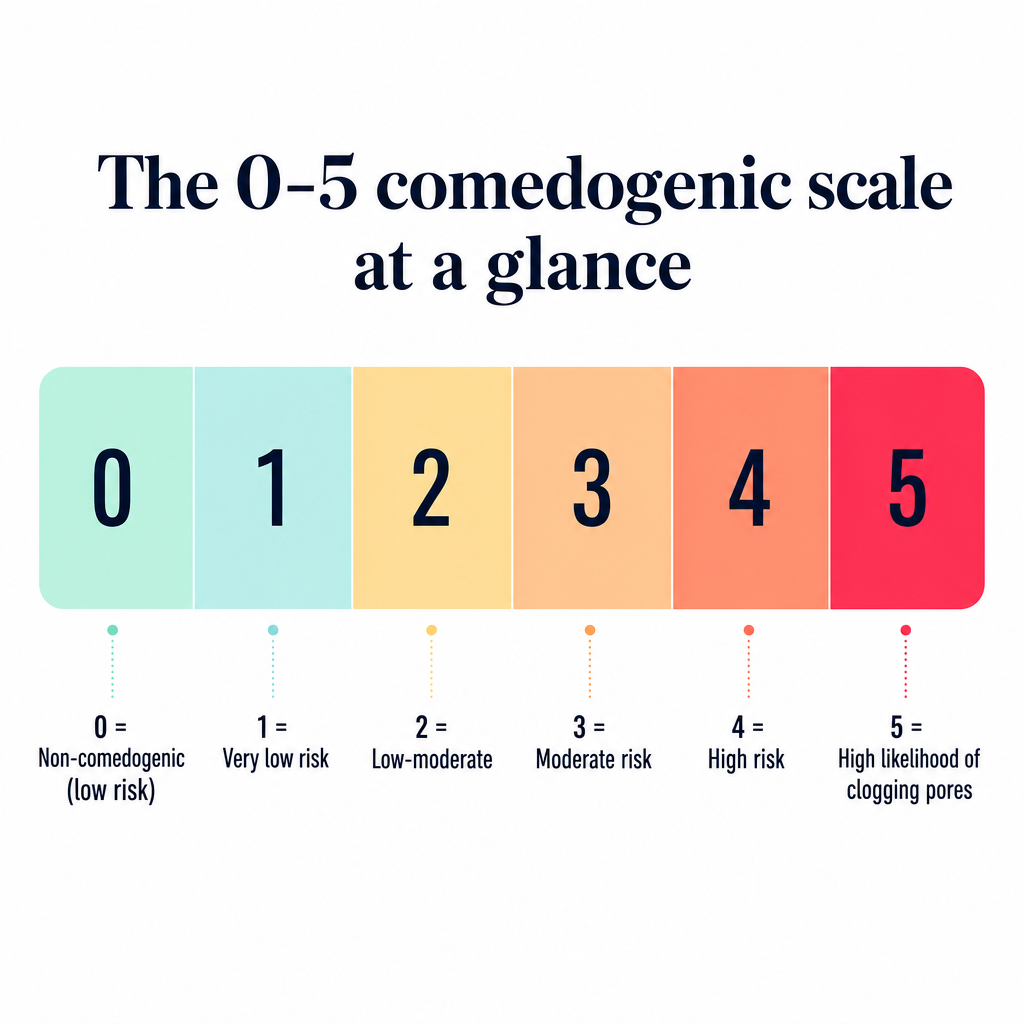
The convention most guides reference runs from 0 to 5. A 0 means non-comedogenic, and a 5 signals a high likelihood of clogging pores. In practice, a rating of 0 to 1 is generally treated as low risk, while ingredients scored 3 to 5 are often flagged as higher risk for oily or acne-prone skin. Commonly cited offenders include certain myristate and palmitate esters, heavy butters, and some high-rating plant oils, though the exact lists differ from one source to another because the underlying data is aggregated expert opinion, not a single fixed registry.
Two things are worth holding onto here. First, these numbers come from patch tests and historical data, not from any regulatory cut-off; no jurisdiction requires a comedogenic warning on cosmetic labels. Second, position in the ingredient list matters. An ingredient with a worrying score sitting near the very end of a list, present at a fraction of a percent, behaves differently from the same ingredient appearing in the first few slots. A useful checker reads both the identity of the ingredient and where it falls, which is far more informative than a raw yes-or-no verdict.
How Macherre's pore-clogging checker turns a label into a decision
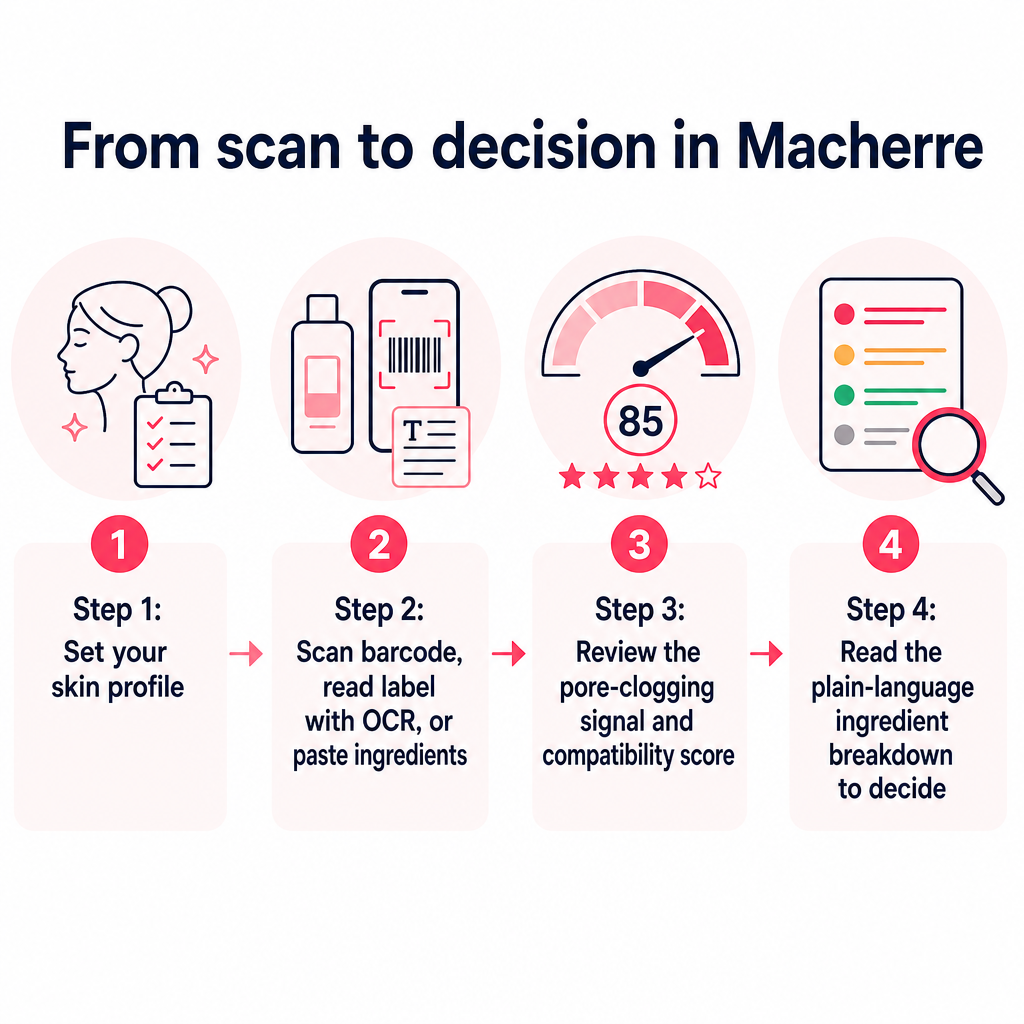
Macherre is an independent skincare and cosmetics app built around a simple loop: scan a product, analyze its ingredient list, and get guidance tuned to your skin. The starting point is a skin profile. In the app you can set your skin type, your goals, ingredients you want to avoid, product standards you care about, and status details such as pregnancy or breastfeeding. That profile is what lets a pore-clogging signal mean something specific to you rather than a generic warning label.
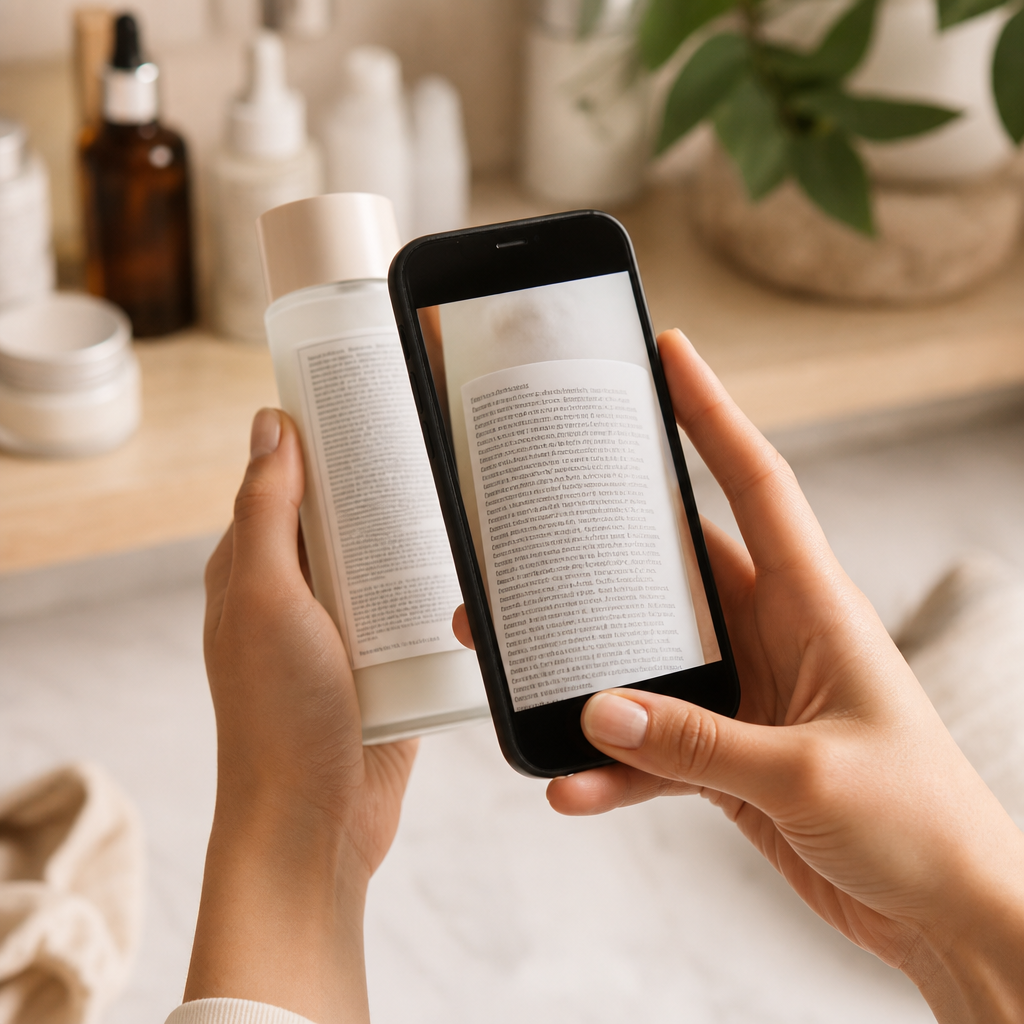
Bringing a product into the app takes one of three routes. You can scan the barcode, read the printed label with the camera using OCR, or paste the ingredient list in manually. This flexibility matters because packaging quality varies wildly, and a checker is only useful if you can actually get the INCI list into it without retyping forty ingredients. Once the list is captured, the pore-clogging (comedogenic) checker assesses the formula for signals that it may clog pores and contribute to comedonal acne, and presents that as part of the scan result.
What you see next is where Macherre's approach differs from a static database. Rather than handing you a spreadsheet of numbers to interpret, the app produces a single compatibility score for the product alongside a plain-language breakdown of each ingredient: what it does, and when it might cause a problem. The pore-clogging signal is one input into that score, sitting next to irritancy and sensitivity flags and any concern-specific checks your profile activates. For someone without a chemistry background, that translation from raw data into a clear read is the entire point.
Reading the result without a chemistry degree
A compatibility score is a summary, not a substitute for the detail underneath it. If a product scores poorly, the ingredient-by-ingredient view shows you which components drove that result, so you can tell the difference between a formula that's a hard no and one that's borderline because of a single ingredient low in the list. That distinction is what turns a checker from a gatekeeper into a decision tool. It also keeps you honest about the limits of the number itself, which we'll return to below.
When to run more than one check
Congestion rarely arrives alone. Macherre's fungal acne checker explicitly advises congestion-prone users to also run their products through the pore-clogging checker, because fungal acne and comedonal acne can coexist and a product can feed both at once. If your breakouts are a mix of small uniform bumps and classic blackheads, screening a product against both concerns before you commit is a sensible safeguard. The same logic extends to the seborrheic dermatitis trigger checker if flaking and redness are part of your picture.
From flagged ingredient to a better product
Finding out a product is likely to clog your pores is only half the job. The more useful question is what to reach for instead, and this is where Macherre's connected tools carry the workflow forward. If a scan surfaces high pore-clogging signals on a moisturizer you already own, the dupe finder helps you look for alternatives that serve a similar purpose without the ingredients driving your congestion, matched against the same skin profile you set up earlier.
When you're weighing two candidates, the compare tool puts them side by side so the difference in pore-clogging signals and overall compatibility is visible at a glance rather than buried in two separate scans. And because stacking matters as much as any single product, the routine creator lets you see how a product fits into your full regimen, with clash detection so you're not unknowingly layering several borderline formulas on top of each other.
A realistic sequence looks like this. You scan your current cleanser, moisturizer, and sunscreen. Two come back clean; the moisturizer flags a couple of higher-rating esters near the top of its list, dragging its compatibility score down. You open the dupe finder, shortlist two alternatives, compare them against the flagged product, and pick the one with the cleaner read for your profile. Then you drop it into your routine to confirm it doesn't clash with anything else you use. Every step happens inside one app, using one profile, which is what keeps the process quick enough that you'll actually do it before buying rather than after the breakout.
Macherre positions itself as a fully independent, privacy-first alternative to ingredient databases like CosDNA, SkinCarisma, and SkinSort, and that independence is part of the value here: the recommendations you get are built around your skin profile and plain-language explanations rather than a static dictionary you have to interpret yourself. If you want to go deeper on a single ingredient at any point, Macherre's ingredient checker decodes a full list on its own, so you can understand a formula outside the context of one product scan.
Where comedogenic ratings stop being useful
Honesty about limits is what separates a helpful tool from a false promise. Comedogenic ratings come from specific test models, and they do not guarantee that an ingredient will break out every person who uses it. Expert commentary is consistent on this: an ingredient with a high rating may still be perfectly tolerated by some skin, and formulation context and concentration can change the outcome entirely. A high-rating oil buried at 0.1 percent behaves nothing like the same oil at the top of the list.
That's the reasoning behind Macherre's compatibility score rather than a bare pass or fail. A single number that only counts comedogenic ingredients would over-warn on plenty of products that would sit fine on your skin, and under-warn on formulas whose problem lies elsewhere. By treating the pore-clogging signal as one factor among several, tuned to your profile, the score aims to reflect fit rather than a decontextualized ingredient census. It's still a starting point, not a verdict.
The practical implication is that you remain the final judge. Guides that discuss comedogenicity in depth recommend patch testing and tracking your own reactions, because your skin is the only test model that counts for you. Use the checker to narrow the field and avoid the obvious triggers, then trust what your skin tells you over a few weeks. None of this is a medical claim: Macherre's pore-clogging checker is a product-decision aid, not a diagnosis or a treatment, and persistent or severe acne is worth discussing with a dermatologist. Treated that way, the checker does the heavy lifting on the labels while leaving the personal verdict where it belongs.
Frequently asked questions
What is a pore clogging ingredient checker?
It's a tool that reads a product's ingredient list and flags the components most associated with clogging pores, so acne-prone and congestion-prone users can spot potential breakout triggers without cross-referencing every INCI name by hand. In Macherre, that check runs as part of a scan and feeds into a single compatibility score alongside a plain-language explanation of each ingredient.
How does the comedogenic scale work?
Most guides describe a 0 to 5 scale, where 0 is non-comedogenic and 5 signals a high likelihood of clogging pores. Ratings of 0 to 1 are generally treated as low risk, while 3 to 5 are often flagged as higher risk for oily or acne-prone skin. These thresholds are conventions drawn from patch tests and historical data, not regulatory standards, and where an ingredient sits in the list matters alongside its score.
Does a high comedogenic rating mean a product will break me out?
Not necessarily. Ratings come from specific test conditions and don't predict every individual's reaction. A high-rating ingredient can be well tolerated by some skin, and its concentration and position in the formula change how it behaves. That's why patch testing and tracking your own reactions still matter, and why Macherre presents a compatibility score rather than a simple pass or fail.
How do I get a product's ingredients into Macherre?
You can scan the barcode, capture the printed label with the camera using OCR, or paste the ingredient list manually. Any of the three brings the INCI list into the app so the pore-clogging check and compatibility score can run against your skin profile.
Should I also check for fungal acne?
If your breakouts include small uniform bumps as well as blackheads and whiteheads, yes. Fungal acne and comedonal acne can coexist, and Macherre's fungal acne checker recommends that congestion-prone users also run products through the pore-clogging checker so a single product isn't quietly feeding both concerns.
Is checking one product enough?
A single check helps, but stacking is where risk accumulates. Several borderline products layered together can clog pores even if each looks acceptable alone. Running your key products through the checker and then viewing them together in a routine gives a more accurate picture than assessing any one item in isolation.