Pore-Clogging Ingredient Checker: Instantly Spot What's Breaking You Out
Your skin looks like it should be behaving. You cleanse, you moisturize, maybe you even added a serum you read good things about. And yet the small bumps keep coming back around your chin, your jaw, your hairline. When your routine looks fine on paper, the real culprit is usually buried in an ingredient list you were never expected to decode. A pore clogging ingredient checker exists for exactly this moment: it reads the fine print for you and flags the components most likely to be quietly congesting your skin.
Macherre built its pore-clogging (comedogenic) checker around that single frustration. Instead of memorizing which oils, esters, and thickeners tend to trigger breakouts, you let the tool compare a product's ingredients against a structured database and tell you, in plain language, what might be working against you. No chemistry background required, and no guessing which random blog list to trust.
Table of contents
- What "pore-clogging" actually means
- Why reading the label yourself rarely works
- Inside Macherre's pore-clogging ingredient checker
- How to run a check in five steps
- Beyond pores: fungal acne, seb derm, and sensitivity
- Real swaps for the products that break people out
- Frequently asked questions
What "pore-clogging" actually means
Comedogenic is the technical word for pore-clogging. An ingredient earns that label when it tends to sit in and around your pores in a way that can trap dead skin cells and oil, setting up the conditions for whiteheads, blackheads, and inflamed bumps. Certain plant oils, fatty acids, waxes, and silicone-adjacent thickeners show up on these lists more often than others, which is why acne-prone shoppers learn to fear a formula that feels rich and cushiony on the skin.
The standard reference point most tools lean on is a comedogenic scale that rates ingredients from lowest to highest pore-clogging potential, an approach that traces back to early dermatology research on how substances behaved in controlled testing. Some checkers treat a mid-range rating as the point where an ingredient becomes worth flagging. That framing is useful shorthand, but it also comes with a caveat worth saying out loud: these scales were never a perfect model of real human skin. Concentration, formulation, and your individual skin all change how an ingredient behaves on your face.
So the honest version is this. "Pore-clogging" describes a probability, not a guarantee. A flagged ingredient means higher risk for congestion-prone skin, especially if it appears high on the list where concentrations are larger. It does not mean the product will absolutely break you out, and a clean-looking list does not promise perfect skin. If you want the deeper theory on how this plays out in one of the most common offenders, Macherre's explainer on what makes a moisturizer non-comedogenic walks through the reasoning without the jargon, tracing how emollients and occlusives differ in how much they tend to sit on the skin's surface.
Why reading the label yourself rarely works
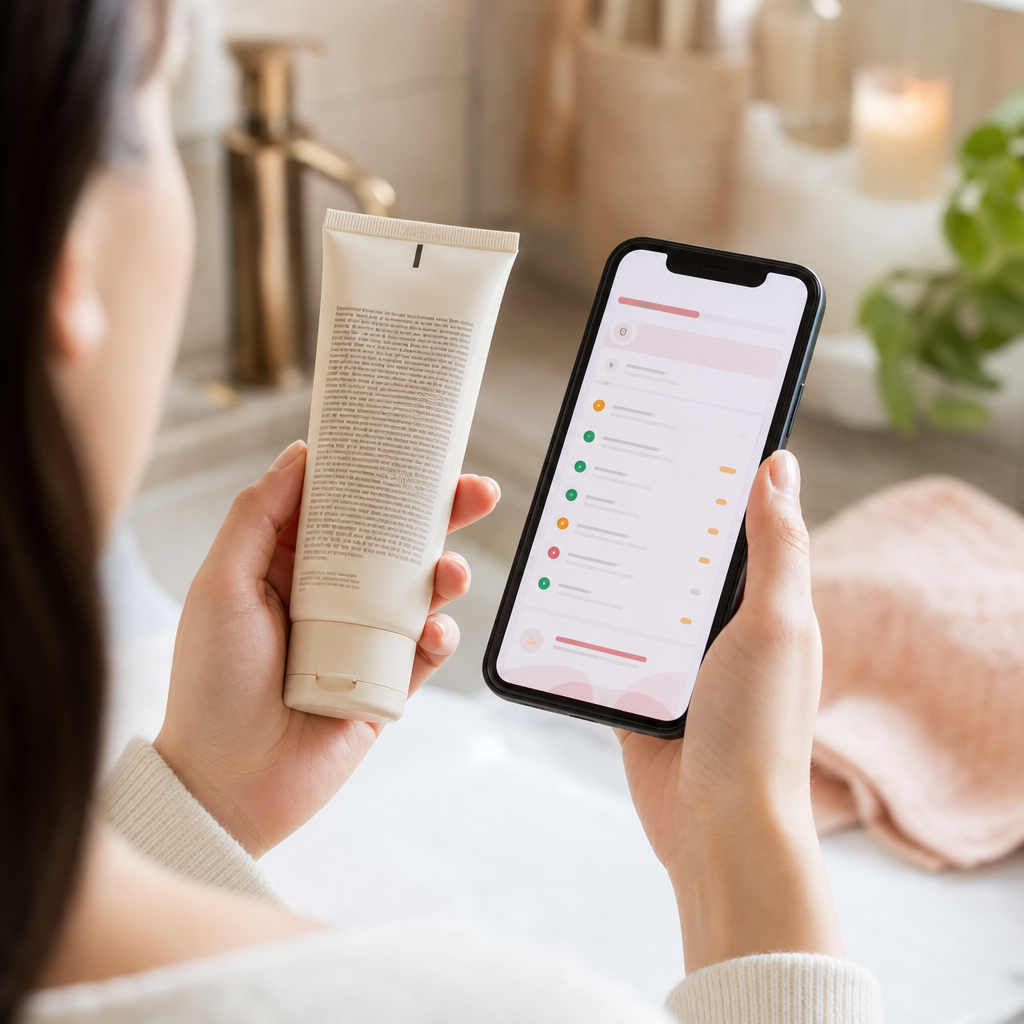
In theory you could screen every product by hand. In practice, the ingredient list is designed to defeat casual reading. A single moisturizer can carry twenty to forty ingredients, each written in its official INCI name rather than anything a normal person would recognize. "Isopropyl myristate" and "cetearyl alcohol" do not announce their pore-clogging potential, and the same botanical extract can appear under three different names across three different brands.
Then there is the contradiction problem. Search any ingredient and you will find one source calling it a safe emollient and another warning that it wrecks acne-prone skin. Comedogenic lists themselves disagree at the edges. Without a consistent reference, you end up making anxious, inconsistent decisions, banning one product for an ingredient you happily use in another. That inconsistency is corrosive in its own way, because it teaches you to distrust your own routine even when a product is genuinely fine for your skin.
This is why the whole category of ingredient checkers exists. The standard model across these tools is straightforward: you supply an ingredient list, and the tool compares it against a curated database of known comedogenic substances, then returns the matches. Some services describe running inputs against hundreds of medically referenced comedogenic ingredients; others translate each flag into plain-English notes so you understand what you are looking at. The value is consistency. A database applies the same logic to every product, every time, instead of relying on whatever half-remembered rule you had that day. It also removes the emotional whiplash of researching in the moment, where the last scary article you read tends to weigh more heavily than the balanced picture.
Macherre's approach follows that recognized pattern, then removes the manual labor. Rather than asking you to become the analyst, the platform does the cross-referencing and hands you an outcome you can act on. If you want to understand a specific ingredient in full rather than only its pore-clogging status, Macherre's general-purpose ingredient list decoder explains what each component is actually doing in the formula, which pairs naturally with a pore-clogging screen. The two tools answer different questions: one asks "will this congest me," the other asks "what is this ingredient even for," and reading them together gives you a far steadier basis for a decision than any single blog post could. That combination matters most for the ambiguous ingredients, the ones that are neither obviously safe nor obviously risky, where knowing an ingredient's actual purpose helps you judge whether its presence is worth tolerating.
Inside Macherre's pore-clogging ingredient checker
Macherre is an independent skincare and cosmetics app. You can scan products, analyze ingredient lists, and get personalized guidance based on your skin type, sensitivities, and goals. Every product you look up resolves into a single compatibility score plus a plain-language breakdown of every ingredient, so the analysis is both quick to read and detailed enough to trust. The pore-clogging checker is one of the platform's specialized tools, sitting alongside dedicated screens for fungal acne and seborrheic dermatitis.
What the checker does is take a product's ingredients, compare them against Macherre's internal database, and surface the ones associated with higher pore-clogging potential. Each flag comes with a plain-language explanation, so a beginner sees not just a scary term but a short note on why it might matter. Those pore-clogging findings then feed into the product's overall compatibility score, which is the part that separates a Macherre check from a bare list of red flags.
That distinction matters more than it sounds. Most standalone checkers stop at "here are the flagged ingredients." Macherre contextualizes them. A single flagged ingredient near the bottom of an otherwise gentle formula reads very differently from three flagged ingredients near the top, and the compatibility score reflects that nuance instead of leaving you to weigh it alone. Position on the list is a rough proxy for concentration, so a flag buried near the end usually represents a smaller share of the formula than one sitting in the first few lines. The score is Macherre's way of doing that mental arithmetic for you.
Two things anchor the tool's credibility. First, the flags are database-driven, not sourced from a comment section or a single opinionated blogger, so the reasoning is structured and repeatable. Second, Macherre is fully independent and privacy-first, positioned as an alternative to the older generation of web checkers rather than a brand storefront. That independence is worth pausing on: when a tool does not depend on selling you specific products, its verdict on whether an ingredient is risky carries less baggage. You are getting an assessment, not a sales pitch dressed up as one. For an acne-prone shopper who has been burned by marketing claims before, that lack of a commercial stake is often the deciding reason to trust one verdict over another.
A pore-clogging flag is a starting question, not a final sentence. The compatibility score is what turns that flag into a decision you can actually make.
How to run a check in five steps
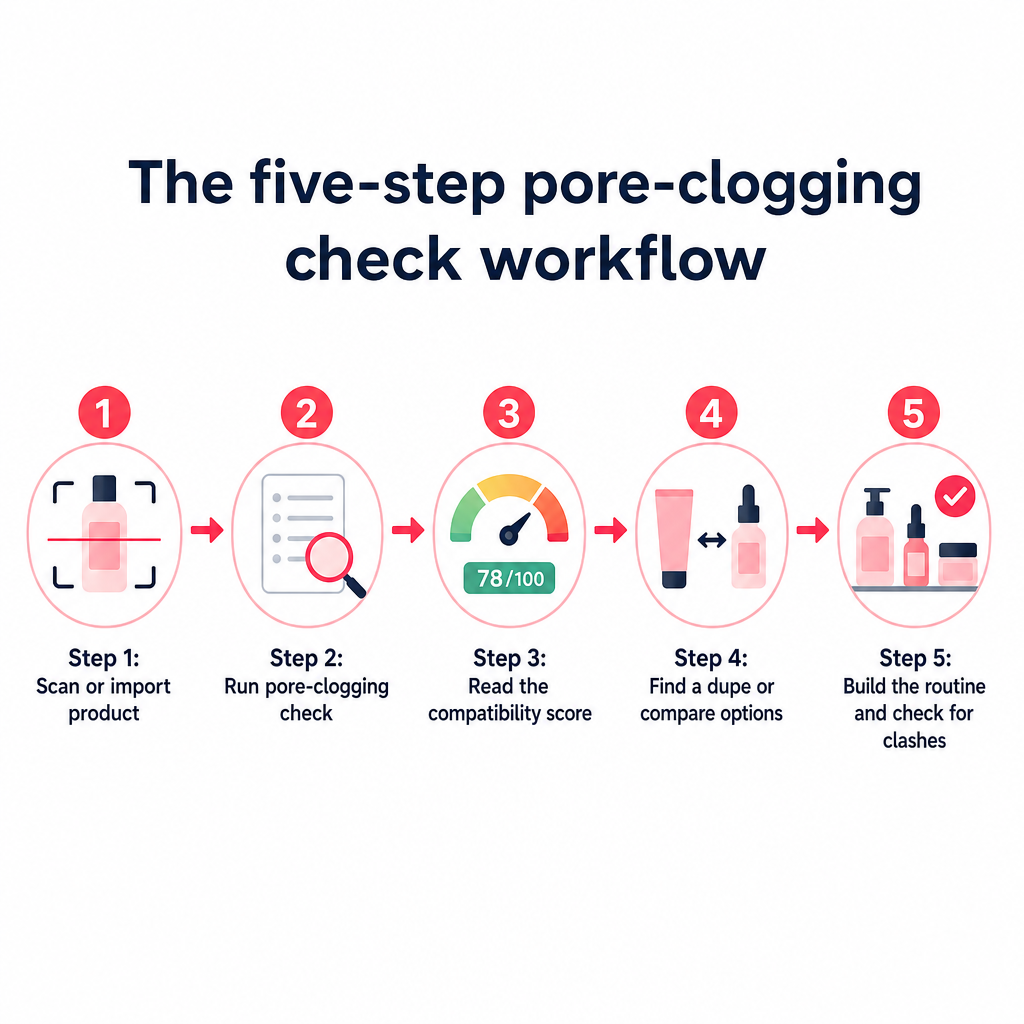
The fastest way to use the checker is as part of a short workflow rather than a one-off lookup. Here is the path Macherre is built to support, from the product in your hand to a routine you can trust.
1. Bring the product into Macherre. If you are holding a physical product, use the cosmetic barcode scanner to pull its ingredient data automatically instead of typing anything out. If you are shopping online, you can capture the ingredient list and let the platform read it. This mirrors what every checker asks for, a complete ingredient list, but the scan removes the tedious copy-paste step that trips people up, and it also sidesteps the transcription errors that creep in when you type a forty-ingredient list by hand.
2. Run the pore-clogging check. Open the pore-clogging (comedogenic) checker and let it screen the product. You will see which ingredients are marked as higher risk for breakouts and congestion, each with a plain-language note. This is the moment the hidden culprit stops being hidden, and it is worth reading past the flag itself to the explanation, because the reason an ingredient is risky often tells you whether it applies to your particular skin.
3. Read the result through the compatibility score. Do not stop at the raw flags. The single compatibility score tells you how serious the pore-clogging risk is likely to be in context, whether the product might still be fine in moderation, and whether it belongs in your routine at all. A product with one low-position flag and a strong overall score is a very different situation from one that scores poorly across the board. Use the score as your primary decision cue and the individual flags as supporting detail, rather than reacting to the first alarming word you see.
4. If it fails, find a replacement instead of just quitting. A negative result is only useful if you know what to do next. Use the dupe finder to locate formulas with a similar texture or function but fewer flagged ingredients, and use the side-by-side comparison tool to line two candidates up and see which one is friendlier to congested skin. This turns a disappointing check into an actual swap, which is the whole point: you keep the step your skin needs and only change the specific formula that was letting you down.
5. Lock it into a coherent routine. Once you have chosen your products, add them to the routine creator so the platform can look at the whole picture. Individual products can each pass a pore-clogging check and still combine into a routine that leans heavy and congesting. Clash detection and overall compatibility across the full lineup catch the problem that single-product checking never sees, which is the layering effect: several individually mild occlusive products stacked on top of one another can behave more like one very heavy one.
Beyond pores: fungal acne, seb derm, and sensitivity
Breakouts are rarely a single-cause story, and pore-clogging is only one of the ways an ingredient list can betray you. What looks like ordinary acne is sometimes fungal acne, which is fed by very different ingredients, certain oils and esters that pore-clogging lists do not always emphasize. Bumps and flaking around the nose, brows, and hairline can point toward seborrheic dermatitis, which has its own set of triggers again. Screening only for comedogenic ingredients would leave those readers with a false sense of safety, chasing the wrong villain while the real one stays on the shelf.
This is where a single-issue checker starts to feel thin, and where Macherre's wider set of tools earns its place. If your skin skews toward flaking and irritation as much as congestion, the seborrheic dermatitis trigger checker screens for the ingredients most associated with that condition, and there is a parallel fungal-acne check for the classic "tiny uniform bumps that won't quit" pattern. Because all of these run inside one platform, you are not juggling three separate tools and three separate databases with three different verdicts. One consistent scoring model looks at your product from several angles at once, which is exactly what makes a mixed-cause breakout easier to untangle.
The practical benefit is a fuller picture. When a product clears the pore-clogging screen but still troubles your skin, the other specialized checkers and the ingredient dictionary give you somewhere to look next, rather than sending you back to a search engine to start over. Multi-concern coverage inside a single compatibility model is increasingly the standard people expect, and it is where independent, ingredient-centric platforms have an edge over a checker that only knows one trick. The decision rule is simple: if the pore-clogging result does not match your experience, run the same product through the checker that matches your symptom pattern before you write the product off entirely. That habit alone can save you from banning an ingredient that was never your problem in the first place.
Real swaps for the products that break people out
Some product categories cause a disproportionate share of hidden breakouts, and knowing which ones to scrutinize first makes the checker far more useful.
Rich moisturizers are the classic offender. A cream that feels luxurious often gets that feel from heavier emollients and occlusives, some of which carry pore-clogging potential. If your favorite moisturizer flags, the move is not to abandon hydration but to find a lighter formula that hits the same brief. Running the flagged cream against a few candidates in the comparison tool usually surfaces a texture-similar option with a cleaner profile. A useful decision criterion here: keep the products whose flags sit low on the list and whose overall score stays strong, and only replace the ones where a heavy ingredient sits near the top. Macherre's non-comedogenic moisturizer guide is the companion read for the underlying logic on what separates a congesting moisturizer from a safe one.
Makeup, especially foundation and long-wear complexion products, is the second place to look. These formulas sit on your skin for hours and often rely on ingredients chosen for finish and staying power rather than for acne safety. A pore-clogging check before you commit to a full-size purchase can save you weeks of blaming the wrong step in your routine. Because complexion products are worn for such long stretches, they are worth checking even when your skincare underneath is spotless, and a poor score is a strong reason to seek a lighter alternative through the dupe finder before committing.
Haircare is the one people forget entirely. Conditioners, oils, and styling products drift onto the forehead, temples, and back, and several common conditioning ingredients rate high for pore-clogging potential. If your breakouts cluster along the hairline, screening your shampoo and conditioner is often more revealing than screening your serum. The tell is location: skin-care flags rarely explain hairline-only bumps, so a hairline pattern is your cue to check the products you rinse through your hair.
Across all three, the pattern is the same: check the product, and if it fails, use the dupe finder and comparison tools to swap toward something with a friendlier profile rather than living with the problem or quitting a category you enjoy. The same verify-before-you-buy habit applies to the first step in the routine too; Macherre's guide to face washes for sensitive skin and how to verify them shows how to run that check on your cleanser before it ever reaches your face.
Frequently asked questions
How accurate is a pore-clogging ingredient checker?
A checker is accurate at what it does: comparing your product against a database of ingredients known for pore-clogging potential and flagging matches. What it cannot do is predict your individual skin with certainty, because concentration, formulation, and personal reactivity all matter. Treat the result as a strong, evidence-based risk signal, and lean on Macherre's compatibility score to weigh how much a given flag matters in context rather than reading every flag as a guaranteed breakout. In practice the most reliable way to use it is over time: check a product before you buy, then note whether your skin's response lines up with the score, which sharpens your own judgment on which flags actually affect you.
Does a flagged ingredient mean I should throw the product away?
Not automatically. Where the ingredient sits on the list, how many flags a product carries, and your own history all change the picture. A single flagged emollient low in the list of an otherwise gentle formula is very different from several flags near the top. That is exactly why Macherre feeds pore-clogging findings into a single compatibility score, so you get a judgment rather than a raw list. If the score is poor, use the dupe finder to line up a cleaner alternative before you decide. If the score is strong despite one low-position flag, the reasonable move is usually to keep using the product and watch your skin rather than discard something that works.
What ingredients does the checker compare against?
The pore-clogging checker screens your product against Macherre's internal database of ingredients associated with comedogenic risk, then explains each flag in plain language. The exact size of that database and its precise scoring thresholds are internal to the platform, so the responsible answer is that flags are database-driven and structured rather than based on scattered opinions or comment-section anecdotes. The important thing for a buyer is not the raw count but the consistency: the same ingredient is judged the same way every time you check it, which is what makes the tool something you can trust across dozens of products.
How often should I check my products?
Check any new product before you buy or start using it, since that is when a screen prevents the most wasted money and skin frustration. It is also worth re-checking a longtime favorite if a brand reformulates, because ingredient lists change quietly and a product that suited you for years can shift without any obvious announcement on the packaging. Beyond that, running your whole routine through the routine creator periodically catches the combined effect that individual product checks can miss, especially after you have swapped in two or three new items over a season.
Can it help with fungal acne or seborrheic dermatitis too?
The pore-clogging checker focuses on comedogenic risk specifically, but Macherre includes separate specialized checkers for fungal acne and seborrheic dermatitis, plus an ingredient dictionary. If your breakouts do not match classic clogged-pore behavior, running the same product through those checks helps you see whether a different trigger is at work, all inside one platform instead of several disconnected tools. A practical cue: uniform tiny bumps point toward the fungal-acne check, while flaking and redness around the nose and brows point toward the seb derm check, so let your symptom pattern decide which screen to run next.
Do I have to type out every ingredient?
No. For physical products you can use the cosmetic barcode scanner to pull the ingredient list automatically, which removes the copy-paste step that most web checkers still rely on. From there the ingredients flow into the pore-clogging check and the rest of Macherre's tools, so a single scan sets up the whole workflow. If you are shopping online rather than holding the product, you can still capture the printed ingredient list and let the platform read it, so the manual typing that discourages most people from checking at all is largely optional.
Breakouts that survive a "perfect" routine almost always trace back to something in the fine print. The fastest way to stop guessing is to let the checker read that fine print for you, then act on what it finds: swap what fails, keep what passes, and build the survivors into a routine your skin can actually tolerate.