What a Skincare Ingredient Checker Really Tells You (And How to Use One)
You flip a moisturizer over, squint at a paragraph of tongue-twisting Latin names, and hope none of them are the reason your skin has been acting up. That gap between the label and any useful understanding is exactly what a skincare ingredient checker is built to close. Instead of memorizing which alcohols are drying or which oils tend to clog pores, you hand the ingredient list to a tool that reads it for you and translates it into something a normal human can act on.
The catch is that not all of these tools tell you the same thing, and none of them can promise a product will suit your face. This piece walks through what an ingredient checker genuinely reveals, where it goes quiet, and how Macherre turns that raw ingredient data into decisions you can make in the aisle or from your couch.
Table of contents
- What an ingredient checker actually reads
- Where ingredient checkers go silent
- Turning a label into a decision with Macherre
- Checkers built for specific skin problems
- From single products to a whole routine
- Saving money once you understand the ingredients
- Frequently asked questions
What an ingredient checker actually reads
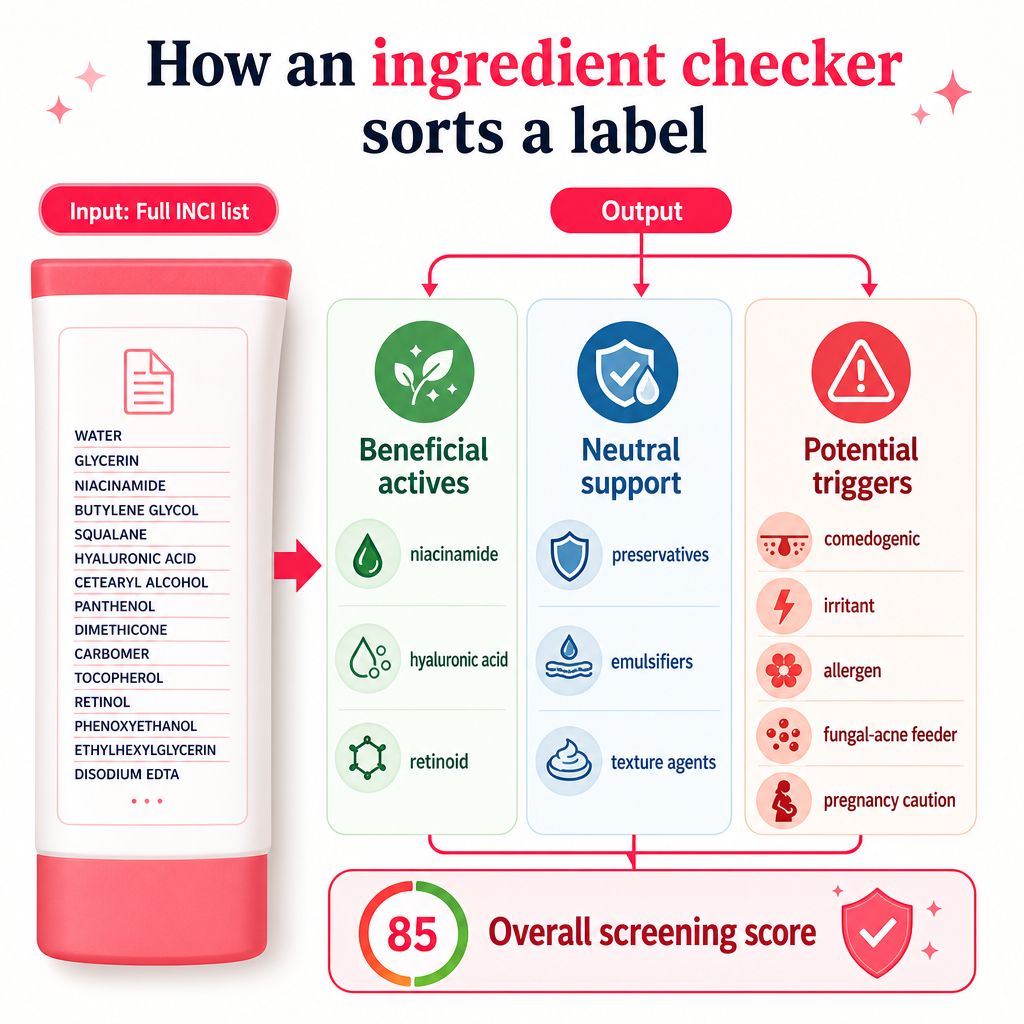
Every cosmetic sold in most markets carries an INCI list: the standardized ingredient deck printed on the box or tube, usually ordered from highest concentration to lowest. A skincare ingredient checker reads that full list and sorts it into human-readable categories rather than leaving you to interpret it word by word. Independent tools describe the same core job: they flag ingredients that may clog pores, irritate skin, trigger allergies, or feed fungal acne, and they explain each flag in plain language.
Most checkers group what they find into a few buckets. There are beneficial actives, the ingredients doing the actual work, like niacinamide, hyaluronic acid, or a specific retinoid. There are neutral support ingredients that stabilize, preserve, or texturize the formula. And there are potential triggers: comedogenic (pore-clogging) ingredients, known irritants, common allergens, fungal-acne feeders, and pregnancy cautions. Healthline's overview of ingredient checkers notes that these tools generally surface ingredient types, safety information, risk level, potential allergens, ingredients that can aggravate acne, and even similar or alternative products.
Many checkers also attach a score. Some rate comedogenic risk on a 0 to 5 scale drawn from the older Fulton and Kligman research; others present a broader safety or compatibility rating, frequently color-coded red, yellow, and green for an at-a-glance read. The scoring is meant to be a screening signal, not a final verdict. It blends how much of the list the tool recognizes with how serious the warning flags are, which is why the same product can score slightly differently across two tools that use different databases.
The practical value is speed and translation. You get to skip the part where you paste each unfamiliar name into a search engine and try to reconcile a dozen conflicting opinions. Macherre's ingredient checker that decodes any skincare ingredient list does exactly this translation step, then layers on a single compatibility score tuned to your own skin profile rather than a generic average. That personalization is the difference between a static database and a tool that knows what your skin actually struggles with, so the same ingredient can read as neutral for one profile and as a flag for another.
Where ingredient checkers go silent
Being honest about the limits is what separates a useful tool from a false sense of certainty. An ingredient checker reads a list; it does not touch, smell, or wear the product. Several things sit outside what any of these tools can tell you, and knowing them keeps you from over-trusting a green score.
First, ingredient analysis cannot predict how a finished formula behaves on skin. The same ingredient behaves differently at 0.5 percent versus 5 percent, and formula architecture, pH, and delivery system all shape the result. A checker sees the name on the list, not the concentration or how the chemist balanced it. SkincareCompass makes this point directly: ingredient analysis cannot confirm how a finished formula will feel, and it cannot tell you the exact texture, finish, or scent you will experience.
Second, results vary between tools. Healthline points out that different checkers use different databases and thresholds, so a product flagged by one may pass another. That is not a flaw so much as a reminder that ingredient flags reflect the best available evidence, not a single universal standard. Comedogenic ratings and fungal-acne trigger lists also shift as new research appears, which means any responsible checker is working from a moving target and updates over time.
Third, and most important, these tools are informational aids, not medical devices. ScanSkinAI states plainly that its checker is for screening and education only, does not diagnose disease, and does not replace a dermatologist. The same framing applies to Macherre. If you are pregnant, managing a diagnosed condition, taking prescription actives, or dealing with a persistent reaction, an ingredient checker can help you narrow options, but it is not a substitute for a clinician who can examine your skin and history.
A checker screens for common triggers and explains what you are putting on your face. It does not promise a product is safe or effective for you.
Finally, individual variability is real. Even a low-risk formula can irritate one specific person, and an ingredient with a scary reputation can be perfectly fine for someone else. That is why the smartest use of a checker is as the first filter in a process, followed by patch testing and honest tracking of how your skin actually responds. Treat a strong score as a reason to try, not a promise of success, and give any new product a few days on a small area before you commit it to your whole face.
Turning a label into a decision with Macherre
Most DIY workflows look the same and involve more friction than people admit. You find the product online, copy its ingredients deck, paste it into a checker, and hit analyze. AcneClinicNYC's pore-clogging tool literally instructs users to Google the product, copy the ingredient list, paste it in, and check. It works, but it breaks down the moment you are standing in a store holding a physical bottle with no clean way to type out thirty ingredient names.
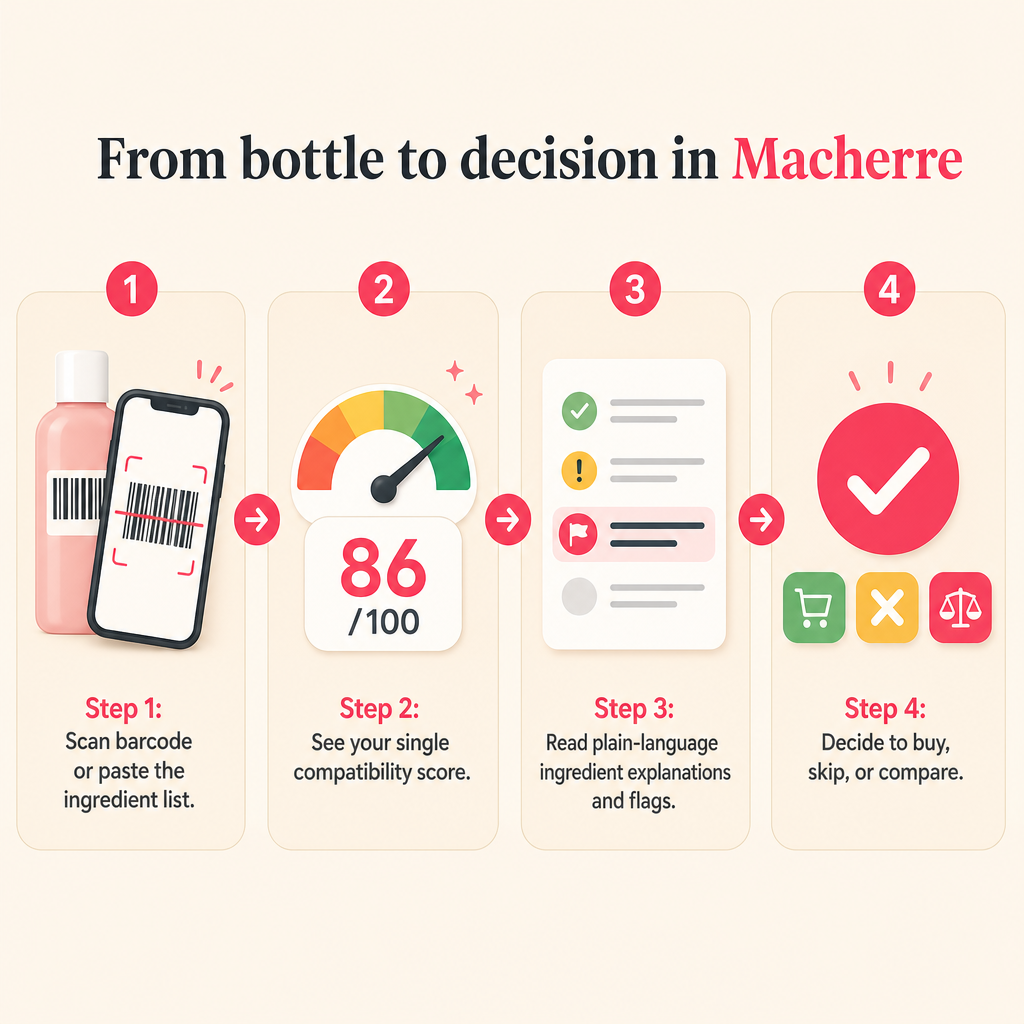
Macherre is designed to remove that friction at both ends. Online, you can paste any product's ingredient list into the checker and immediately get three things: a single compatibility score for your skin profile, flags for acne, irritation, and specific sensitivities, and plain-language explanations of what each ingredient does and when it might cause a problem. The explanations matter for beginners, because a flag with no context is just anxiety. Knowing that an ingredient is a common fungal-acne feeder, or a fragrance that irritates reactive skin, tells you what to actually do with the warning.
In the aisle, the cosmetic barcode scanner built for ingredient clarity collapses the copy-and-paste step into a scan. You point your camera at the barcode, the ingredient list is fetched and decoded, and the compatibility score appears without a single keystroke. That is the difference between checking a product before you buy it and promising yourself you will look it up later and then forgetting.
A realistic run-through helps. Imagine you are considering a new moisturizer. You scan it, and the score comes back moderate rather than glowing. You open the breakdown and see the score is pulled down by a fragrance component and one comedogenic-leaning oil. Now you have a real decision instead of a vague hunch: if your skin is calm and non-acne-prone, that trade-off might be fine; if you break out easily or react to fragrance, you know exactly why to keep looking. The tool did not decide for you, but it handed you the reasoning.
The decision criteria are worth spelling out, because a score alone is not a rule. Ask three questions in order. Does the flag match a concern you actually have, or is it a generic caution that does not apply to your skin? Is the flagged ingredient near the top of the list, where its concentration is likely higher, or buried near the bottom? And do you have a calmer alternative already in mind, or is this the only realistic option? A moderate score on a product with a low-priority flag and no better alternative is often a reasonable buy; the same score on a product whose flag hits your exact weak point is a clear skip.
Checkers built for specific skin problems
Generic safety is useful, but a lot of people are not asking whether a product is broadly fine. They are asking whether it will break them out, or whether it will flare a condition they already live with. This is where a single all-purpose score falls short and specialized screening earns its place.
Acne-prone shoppers care most about comedogenic risk. Pore-clogging screening is a standard category across ingredient checkers, and it works by matching a product's ingredients against lists of components known to clog pores or trigger breakouts. Macherre's pore-clogging comedogenic checker applies that logic and folds the result into the overall compatibility score, so a product loaded with pore-clogging esters cannot quietly pass just because the rest of the formula looks pleasant. If you want a deeper walkthrough of how this works in practice, Macherre's guide on how the pore-clogging ingredient checker spots breakout triggers shows the reasoning step by step, isolating which esters and oils actually earn a flag and why the position on the list changes how much a flagged ingredient matters.
Seborrheic dermatitis and fungal acne are a different problem entirely. Both are linked to Malassezia yeast, which certain fatty acids, esters, and oils can feed. External checkers recognize fungal-acne triggers as a standard screening category, but general safety scores rarely tell you whether a product is safe for that specific concern. Macherre's seborrheic dermatitis trigger checker is tuned to flag the ingredients most commonly implicated in these flare-ups, which is far more actionable than a broad score for someone managing a recurring, visible condition, because it isolates the handful of fatty acids and esters that matter instead of burying them in a long neutral list. A product can read as low-risk overall and still carry two or three quiet triggers that a condition-specific screen surfaces immediately.
The point of these dedicated tools is that a product can be low-risk in general and still be exactly wrong for you. A rich, comforting cream might be lovely for dry, resilient skin and a reliable trigger for someone with fungal acne. Screening through the checker that matches your actual concern turns a generic thumbs-up into a targeted answer. The practical rule is to run any product through the checker that maps to your primary problem first, then treat the general compatibility score as a secondary confirmation rather than the headline result. If two concerns overlap, say acne and seborrheic dermatitis, run both screens and let the stricter result guide you, since it is easier to loosen a cautious call after a patch test than to undo a flare.
From single products to a whole routine
Checking one product at a time solves half the problem. The other half is what happens when several products meet on your face across a morning and evening routine, because ingredients interact, duplicate, and occasionally fight. This is precisely the layer most standalone ingredient checkers leave entirely to you.
Common routine mistakes are not exotic. People stack multiple strong exfoliating acids without realizing they are compounding irritation. They pair a high-strength retinoid with an aggressive acid the same night and wonder why their skin is peeling. They unknowingly run three different products that all deliver the same active, getting redundancy instead of benefit. An ingredient list read in isolation will not warn you about any of this, because the conflict only exists once products are combined.
Macherre's routine creator that builds a routine to fit your skin takes the same ingredient intelligence behind the single-product checker and applies it across a full AM and PM lineup. Its clash detection looks for harsh combinations and duplicated actives, then checks the whole set against your skin profile rather than scoring each item in a vacuum. Instead of a stack of green checkmarks that individually look fine but collectively overwhelm your barrier, you get a view of how the products behave together. In practice that means seeing, for example, that your exfoliant and your retinoid are both scheduled for the same night, and being nudged to alternate them instead. It can also catch the quieter problem of paying for two serums that carry the same headline active, where dropping one costs you nothing in results.
There is a second reason routine context matters. Ingredient analysis is a starting point, and real performance shows up only on real skin over time. Macherre lets you organize what you own on shelves and read reviews filtered by skin type, so the ingredient logic sits next to lived experience. When you can see that people with your skin type reacted a certain way to a product your checker already flagged, you are making a far better-informed call than ingredient names alone could support. Beginners building their first sensitive-skin lineup can also lean on Macherre's guide to the best skin care products for sensitive skin, which applies the same vetting process to full routines and shows how to sequence gentle products so screening results translate into a plan you can actually follow morning and night.
Saving money once you understand the ingredients
Understanding ingredients is not only about avoiding bad reactions. Once you know which components actually matter for your skin, you gain leverage as a shopper, and that is where an ingredient checker quietly becomes a budgeting tool.
The insight is simple: a high price does not guarantee a better formula, and two products with very similar ingredient profiles often perform similarly regardless of what they cost. Healthline notes that many checkers also surface similar or alternative products, which is the mechanism behind finding a dupe. If a serum you love is expensive, and the ingredients doing the work are common and well understood, there is a decent chance a comparable option exists at a friendlier price.
Macherre's dupe finder searches for products with similar ingredient profiles and compatibility scores, so you are not guessing whether a cheaper option is genuinely comparable or just marketed that way. It is grounded in the same ingredient data as the checker, which means a suggested dupe has been screened against your skin profile too, not just matched on price. That is an important distinction, because a cheaper product with a similar marketing story can still carry a flag your original did not, and the score is what catches it. The practical test for a dupe is not only that the actives overlap, but that the trigger list stays as clean or cleaner than the product you are replacing.
When you are torn between two specific products, Macherre's compare tool lays their ingredient lists, compatibility scores, and key differences next to each other. That is the fastest way to see whether the pricier option is actually earning its premium or whether the two are close enough that the cheaper one wins. Look for three things in the side-by-side view: whether one carries a flag the other avoids, whether the actives you care about sit at similar positions on both lists, and whether the compatibility scores differ enough to justify a price gap. For a category like cleansers, where formulas differ a lot in gentleness, Macherre's roundup of the best face washes for sensitive skin shows how comparison and verification play out on real shortlists.
Used together, these tools change the shopping question from how much does it cost to how well does it fit my skin, and then how little can I pay for that fit. That is a more durable way to spend on skincare than chasing whatever is trending, and it compounds over time as you learn which ingredients genuinely earn a place in your routine.
Frequently asked questions
What does a skincare ingredient checker actually tell me?
It reads a product's full ingredient list and translates it into readable information: what each ingredient does, which ones may clog pores, irritate, trigger allergies, or feed fungal acne, and often an overall risk or compatibility score. Macherre adds a single compatibility score tuned to your skin profile plus plain-language explanations, so you are not left interpreting raw chemistry on your own. The goal is a fast screening read, not a final verdict on whether the product will suit you. Think of it as sorting the list into what helps, what is neutral, and what to watch, then attaching a signal you can act on in seconds.
Can an ingredient checker guarantee a product is safe for me?
No. Ingredient analysis screens for common triggers, but it cannot predict how a finished formula will feel or perform on your specific skin, because concentration, formulation, and personal tolerance all matter. These tools are informational aids for screening and education, not medical devices, and they do not diagnose conditions or replace a dermatologist. Treat a strong score as a reason to patch test, not a promise of success. If you are pregnant, on prescription actives, or managing a diagnosed condition, use the checker to narrow options and then confirm with a clinician who can see your skin and history.
Why do different checkers give different results for the same product?
Because each tool uses its own database and its own thresholds for flagging ingredients. Healthline notes that results vary between checkers, so a product flagged by one may pass another. Comedogenic and fungal-acne trigger data also evolve as new research appears, which is why flags reflect current best evidence rather than a single fixed standard. When two tools disagree, read the explanation behind each flag rather than trusting the color alone, and weigh whether the flagged ingredient sits high on the list or near the bottom before you let it change your decision.
How is scanning a barcode better than pasting an ingredient list?
Both reach the same result, but scanning removes the friction. Instead of finding the product online and copying thirty ingredient names, you point Macherre's cosmetic barcode scanner at the label, and it fetches and decodes the list for you. That makes it practical to check a product in a store before buying rather than promising to look it up later, which is exactly when most impulse mistakes happen. The pasted-list route still matters when a product has no scannable code or you are researching from your couch, so the two methods cover each other.
Can these tools help with fungal acne or seborrheic dermatitis?
Yes, when they include condition-specific screening. Fungal-acne triggers are a standard ingredient-checker category, and Macherre offers a dedicated seborrheic dermatitis trigger checker plus a pore-clogging checker. These flag the ingredients most relevant to those concerns, which a general safety score can miss because it averages them into a broad rating. Both conditions are linked to Malassezia yeast that certain fatty acids and esters can feed, so isolating those ingredients is far more useful than a single overall number. For persistent or severe cases, still consult a dermatologist.
How do I turn ingredient flags into an actual routine?
Start by checking individual products, then move to Macherre's routine creator, which uses the same ingredient data to detect clashes across your full AM and PM lineup, like stacked acids or duplicated actives. Pair that with shelves and skin-type-filtered reviews so the ingredient logic sits alongside how products actually performed on real skin. That combination catches the conflicts a single-product check never sees, and it also flags redundancy, so you stop paying for two products that quietly deliver the same active while doing the same job.
Pick one product you already own or are about to buy, run it through the ingredient checker or scan its barcode, and read the compatibility score with its flags. If acne or a sensitive condition is your worry, send it through the pore-clogging or seb-derm checker, then use the routine creator to see how it fits everything else you use. That single pass turns a wall of ingredient names into a decision you can trust.